I really hope this doesn't come across as antisemitic because that is not my intention at all.
I'm curious why the Jewish population was given modern day Isreal after the second world War. From what I understand, that region was taken over by the Ottoman Empire, which was then conquered by the British, but was still effectively Muslim in culture.
While I understand that historically that is their homeland, many nations have been conquered (especially by Britain) but this is the only major instance I am aware of where land was returned like this. There are small examples such as the U.S. and Canada providing reservation land to compensate for taking their land (which hardly counts as compensation), but why was such an offer extended to the Jewish population, unless it solely was intended as a global apology for the Holocaust? And if so, what about the other people's outside of the Jewish population which suffered at the hands of the Nazi regime? Was there a prior precident set that causes/affected this?
In addition, what came of the people's who were living in that region, did they have a choice in the matter, how were they effected and how did they react?
2 Answers 2019-10-07
If I recall, the Soviet Union petitioned to have all member soviet nations participate individually in the UN, this was not allowed. Why then are individual EU nations allowed to retain their memberships?
1 Answers 2019-10-07
The mongols fought against most eastern-european nations and went as far as Austria.Were they aware of the western europe nations such as france,england,aragon,castille and portugal?
1 Answers 2019-10-07
When one looks at the Majestic or Canopus class of British pre-dreadnaughts, it's easy to see the growth and progression towards HMS Dreasnaught. And while each of these classes of ships (and the ships themselves) had variations, they were relatively standardized.
Then there's the French with Carnot, Jauréguiberry, Bouvet, Masséna, etc were all substantially different in shape, variations in armaments, etc. I understand politics played a role in (mis?)shaping these ships but was there less centralized oversight than in the UK? Or was France hoping to find some secret advantage with all the variations? Why wouldn't somewhere, somehow, speak up about having to support so many various calibre of weapons?
And the tumblehome with all those portholes and turrets and casemate turrets and towers and various smoke stacks...how could they have fared in high seas during a real shooting engagement? They look like 1 or 2 shots from either broadside could flip them right over.
Edit: now that I think about this, is it a perfect example of waterfall vs agile methodology?
1 Answers 2019-10-07
Were they free range lecturers like on a modern day lecture circuit relying on speaking engagements and private events?
Or was there some sort of socialized "Lecture Board of Athens" that provided for them?
Or were they street buskers, saying thought provoking things relying on tips?
1 Answers 2019-10-07
So I'm looking for examples of pre Roman British pagan art of any sort but preferably English.
1 Answers 2019-10-07
Wyoming especially. How does a word from the Munsee language, native to eastern Pennsylvania, come to be applied to a state in the mountain west (not to mention no less than 7 Midwestern towns and cities and one in Australia)?
1 Answers 2019-10-07
1 Answers 2019-10-07
Hi everyone and welcome to a bit of an unusual edition of Monday Methods, where we talk about impeachment. Rather than focusing on historical methods, this is an explainer of the impeachment process in the U.S. Congress, and a space to ask questions/clear up misconceptions.
This is not the place to discuss the current impeachment proceeding in the U.S. House of Representatives, but the mod-team has noticed a bit of an uptick in questions about the process, so we thought this would be a good reason to talk about the process historically. Posts referring to the current proceedings will be removed.
So, without further ado, let's be about it!
Impeachment is a term that refers both to the process of gathering evidence and introducing articles of impeachment against a president, and more specifically, the act of voting on articles of impeachment in the House of Representatives, which is the first step in the broader process of removing a federal officer from their position. Impeachment is not a removal from office, but a vote on impeachment functions as an official indictment that results in a trial. (Federal officers, of course, include the President and Vice President, but also other members of the federal government, such as judges.)
The U.S. Constitution outlines the impeachment process in Article 2, Section 4, which reads:
The President, Vice President and all civil Officers of the United States, shall be removed from Office on Impeachment for, and Conviction of, Treason, Bribery, or other high Crimes and Misdemeanors.
Impeachment is a process that starts in the House of Representatives. The House can in theory simply hold a floor vote on an article of impeachment, and, if it passes, the president is impeached. However, in the two most recent impeachment proceedings (Clinton and Nixon), house committees debated articles of impeachment before bringing them to the floor.
After an impeachment in the House, the president is put on trial in the Senate, with the chief justice of the United States (currently John Roberts) presiding over the trial.
Members of the House of Representatives serve as prosecutors, and the president would have defense lawyers. In both cases where a president was impeached previously, the Senate had to work out rules of the proceedings beforehand, including the length of time the trial would take, what kind of testimony would be allowed, whether to call witnesses, etc.
If, at the end of the trial in the Senate, two-thirds of senators vote to convict, the president would be removed from office and the Vice President would become President.
Yes, two presidents have been impeached — Andrew Johnson in 1868 and Bill Clinton in 1998. Neither was convicted in their Senate trial, and both finished their term in office.
Richard Nixon was not impeached, although articles of impeachment were being debated by the House when he resigned. His Vice President, Gerald Ford, became president when he resigned.
Donald Trump is also the subject of a formal impeachment proceeding, but that’s out of scope here.
Impeachment and conviction is also a thing that can happen to other civil servants. See the last section for more information.
This is a term from British common law, which can be boiled down to an accusation of abuse of power by a public official. It’s not limited to criminal offenses. One of the ways that we gain some insight into what the framers of the Constitution thought is in their contemporary writings; in Federalist no. 65, Alexander Hamilton described the process as such:
A well-constituted court for the trial of impeachments is an object not more to be desired than difficult to be obtained in a government wholly elective. The subjects of its jurisdiction are those offenses which proceed from the misconduct of public men, or, in other words, from the abuse or violation of some public trust. They are of a nature which may with peculiar propriety be denominated POLITICAL, as they relate chiefly to injuries done immediately to the society itself.
Impeachment itself is inherently is a political process that courts won't get involved in. (Nixon v. United States, 506 U.S. 224 (1993) -- no, not that Nixon, a judge named Nixon.)
Each past impeachment proceeding proceeded from slightly different grounds.
In 1868, Andrew Johnson was impeached under several articles, the fundamental issue being a dispute with Congress about his power to fire and appoint cabinet officials. The main article dealt with a dispute over the Tenure in Office act, which Congress had passed to prevent Johnson from firing officials whose appointment had required the "advice and consent" of the Senate without the consent of the Senate. (That is, the Senate wanted the power to concur in the removals.) Johnson was acquitted of that charge and, later, two others, after which the trial adjourned.
In October of 1973, the House began an impeachment inquiry into Richard Nixon after the “Saturday Night massacre,” when Nixon ordered three top Justice Department officials to fire a special prosecutor looking into the Watergate affair; two resigned before Robert Bork complied with his order. In February of 1974, the House voted to give the Judiciary Committee authority to investigate whether “high crimes and misdemeanors” had occurred in Nixon’s presidency. Judiciary reported articles out to the full House in July, but Nixon resigned in early August before they could be voted on.
Bill Clinton was impeached in December of 1998 on grounds of perjury to a grand jury and obstruction of justice. A Senate trial in January 1999 failed to convict Clinton.
Again, due to our 20-year rule, that's out of scope here; but the assumption is that the procedure followed in Clinton's impeachment would be the current precedent. Your preferred news outlet will likely cover any further proceedings.
For more information on historical impeachments, you can check out this website from the U.S. House of Representatives, and in particular this page which lists all persons who have been impeached and/or convicted of "high crimes and misdemeanors."
6 Answers 2019-10-07
A sizable contingent of the folks I follow on Twitter are full-on Marxist-Leninists (MtG twitterspace is weird), and are often retweeting Marxist talking points and literature. Something that was retweeted recently that caught my eye was a person claiming that Stalin actually tried to resign from his position as General Secretary(?) of the USSR at least four times. The poster linked a letter that Stalin wrote officially requesting to be dismissed, as well as an article that included a transcript of a meeting where he asked to be released from duty but was supposedly talked-over by a group that wanted him to continue in his position. How much truth is there to these statements, and how much of it is misleading i.e. Stalin "requesting" to be relieved but secretively being behind those who argued for him to stay, etc.
1 Answers 2019-10-07
1 Answers 2019-10-07
1 Answers 2019-10-07
1 Answers 2019-10-07
1 Answers 2019-10-07
1 Answers 2019-10-07
A few days ago I was listening to a YouTube video, and the narrator said "The Byzantines remained stronger than the Sassanids throughout most of their history". This seemed strange to me, as judging by most Byzantine-Sassanian wars, it was the exact opposite. Anastasius, Justin and Justinian all suffered heavily against the Sassanids, and always seemed on the back foot. Tiberius and Maurice seemed to have relative success, and they were focusing all the resources of the Empire on war against the Persians. And, of course, Phocas and Heraclius were barely getting by. So, what's the historical consensus? Who was stronger and why?
1 Answers 2019-10-07
I was just listening to this book on Audible and it struck me how fearsome the Kurds were, according to Xenophon, and how they're still known for valor in the face of overwhelming forces to this day. My question is, are the Kurds we're reading about in Syria, and nearby cohorts in Iraq and Turkey, direct descendants of the ancient Kurds in Xenophon's day?
1 Answers 2019-10-07
2 Answers 2019-10-07
After what I've read both from him and on this site I know I should know better than to take anything Gildas wrote at face value but I suppose an early conversion of the Britons made sense to me until reading a book by Todd that posits there's no proof of any significant conversion of the British before 400 (and that it is unlijely).
The problem then is do I disregard both extremes given that Gildas seems a part of a strongly entrenched Christian society given how he writes and who he is seemingly writing to only a century later and that the life of Saint Germanus mentions Pelagian heresy but not Paganism or even apostasy?
Is there a consensus on the christianisation of the insular celts? I have halsell's worlds of arthur on its way; what other books or articles would be a good look into this?
1 Answers 2019-10-07
Hi Reddit!
For some years I have been looking for an answer to what this object is. It is not a hanko (stamp), both sides are the same and flat, with an indentation (the photos make this clear). Both sides have a painted lotus, it looks like the old family crest of the Ikeda family. On the long side there are slight indentations from what might have been a small rope (you can zoom in on the first picture to see this). Does anyone have any more information on what this could be?
1 Answers 2019-10-07
I’m a young intern working in the development of a feature film focusing on the life of an artist (it’s a biopic, let’s not specify whose) that spent part of his life in Paris. I’m in charge of researching mainly visual references and historic contexts. A few days ago, I’ve been asked to gather information on a subject that has been a bit complicated for me, being critical for the film’s veracity as it is, so I thought maybe this would be the right place to find someone who is an expert and is willing to help.
Parisian street lighting
Was gas lighting the absolute norm? Do you know what gas was used? And what color the flame was (more yellow, more orange)? Or was electric lighting the norm?
Parisian domestic lighting
Take into account that what I’m interested in is the artistic circle (Picasso, Modigliani…). So, not exactly poor but also not super rich. What was the common lighting method? Oil, gas, electricity? Were lighting fixtures attached to the walls/ceiling or did they use portable lamps? If you have any photos or drawing of lighting fixtures it would be amazing!
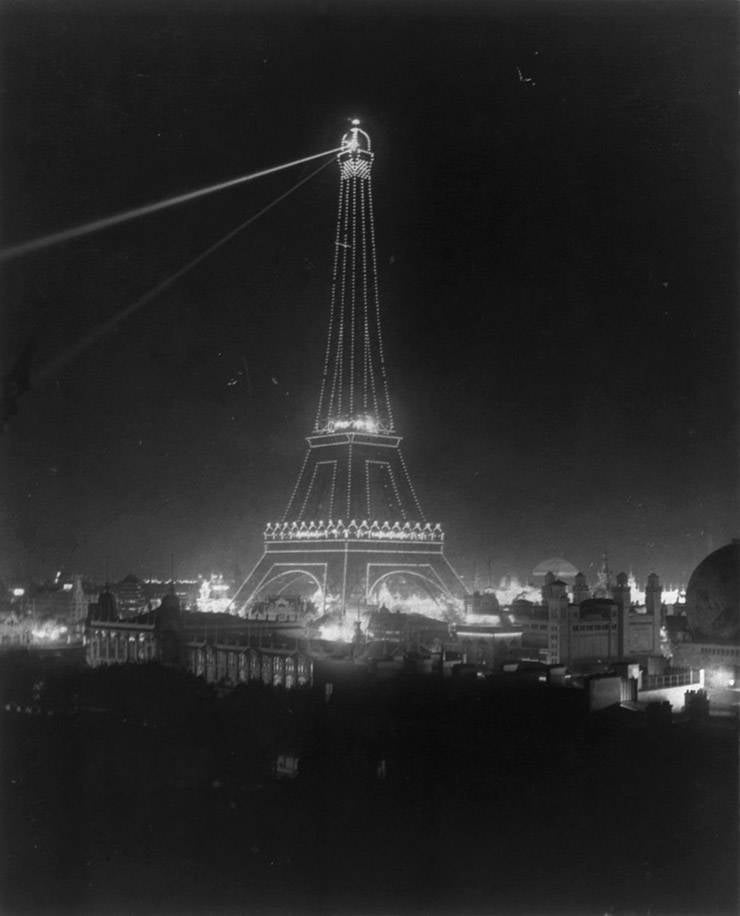
Eiffel Tower
Interested in 1917 specifically. After the 1900 Universal Exhibition, did the Eiffel Tower maintain it’s night lighting? Was the night-sparkling-show already a thing?
(Did it look like this every night? https://cdn.pariscityvision.com/library/image/5166.jpg
Or were there visible changes? Were these lights white or did it have colors?)
I’ve read that in 1907 a six-meter tall giant clock was installed on the second floor. Was it still there in 1917? Any photos?
Hope this isn’t too long of a doubt list….
1 Answers 2019-10-07
At some point, the Salem Witch Trials transitioned from an old shame to a selling point for tourists - do we know when & why this happened?
1 Answers 2019-10-07
Whenever I see references to US Civil War infantry it is usually in reference to the use of muzzle loaders. It's understandable since only a small amount of soldiers would use breech loading weapons in the Civil War, but it makes me wonder if US soldiers changed tactics when using/facing them.
The impression I get from the Franco-Prussian war was that breech loading rifles forced both combatants to rely much more heavily on open order formations. Meanwhile in the Austro-Prussian war Prussian infantry with breech loaders had an enormous advantage against Austrians with muzzle loaders, and many Austrian attempts at charging in closed formations failed. I wonder if a similar change occurred during the US Civil War with breechloader equipped troops.
1 Answers 2019-10-07
Looking at Wikipedia I counted 26 revolts in the 11th century alone. Why was the Eastern Roman Empire so unstable?
1 Answers 2019-10-07
I recently heard it argued that East Germany's denazification policy was much more effective, but from my googling I've been unable to find any sort of easy comparison between the two?
With that being said, what policy did the DDR and FRG use in contrast to eachother, and which was more effective? Were either of them violent etc?
Thanks in advance. :)
1 Answers 2019-10-07