My grandmother was going through her sock drawer after my grandfather passed away and found a small case full of medals that my grandfather had brought back from WW2. He served in the European Theatre as a tank commander in the 43rd Tank Battalion, 12th Armored Division. I would like to know if anyone could help me identify these medals. Thank you
2 Answers 2018-06-20
I know even ancient humans had systems to keep track of day and night/seasons but around what year did we start using a 24 hour clock? How long did it take to spread? Before the current system were there competing clock systems in place in different parts of the world?
For example, when was someone able to say “it is currently 9:52”?
1 Answers 2018-06-20
Okay, so there is a lot to this question so bear with me. I am a 19 year old male who just finished a semester doing as many gen-ed classes as I could. Before this, failed first semester of an engineering major due to lack of motivation and effort. I have been struggling to find a major that interests me, but recently stumbled upon history, which has always interested me heavily. My question is if I were to go on an receive a BA(maybe even an MA or a doctorate depending on circumstance) in history, at a state college, while maintaining above a 3.2/3.3, how can i realistically attain a job in history(archives, library, museum, history abroad) ? I am also very interested in archeology and language so if anyone has had success or knows someone who has had success with history/anthro/archeology paired with a language please let me know.
2 Answers 2018-06-20
Hi guys. I went to Rome a while ago and some tour guides kept saying that, being surrounded by hills, Old Rome got buried by rain carrying sediment from the hills. So now most ruins are completely buried. How exactly did this take place gradually, though? I understand that after 2000 years that much would build up, but when it started getting noticeable, wouldn't the Romans take steps to stop it? This may be a stupid question and I may be misunderstanding something. I just don't quite see how this process took place.
Edited your to tour. Oops!
1 Answers 2018-06-20
Please Be Aware: We expect everyone to read the rules and guidelines of this thread. Mods will remove questions which we deem to be too involved for the theme in place here. We will remove answers which don't include a source. These removals will be without notice. Please follow the rules.
Some questions people have just don't require depth. This thread is a recurring feature intended to provide a space for those simple, straight forward questions that are otherwise unsuited for the format of the subreddit.
Here are the ground rules:
Top Level Posts should be questions in their own right.
Questions should be clear and specific in the information that they are asking for.
Questions which ask about broader concepts may be removed at the discretion of the Mod Team and redirected to post as a standalone question.
We realize that in some cases, users may pose questions that they don't realize are more complicated than they think. In these cases, we will suggest reposting as a stand-alone question.
Answers MUST be properly sourced to respectable literature. Unlike regular questions in the sub where sources are only required upon request, the lack of a source will result in removal of the answer.
Academic secondary sources are prefered. Tertiary sources are acceptable if they are of academic rigor (such as a book from the 'Oxford Companion' series, or a reference work from an academic press).
The only rule being relaxed here is with regard to depth, insofar as the anticipated questions are ones which do not require it. All other rules of the subreddit are in force.
26 Answers 2018-06-20
Can you please give me a detailed account of what the Israeli-Palestinian Conflict is? Because i'm a very not up to date person and all the websites really confuse me.
2 Answers 2018-06-20
I'm writing an assignment for school, where I have to explain the values present in Europe before the Second World War and analyze the war's influence on the breakdown of the values of modernity, and I was wondering if you guys have any experience on this subject, and could potentially point towards any primary and secondary sources I could use?
1 Answers 2018-06-20
The question was asked before, but it lacks any in-depth answers.
1 Answers 2018-06-20
Welcome to a belated Monday Methods – our bi-weekly feature where we discuss, explain, and explore historical methods, historiography, and theoretical frameworks concerning history.
“The children will go bathing” is what the Nazi officer said to Dounia W. after she arrived in Auschwitz-Birkenau with her two kids in 1943. Her children did not go bathing. Instead, they were forced together with other children and old people into the gas chamber, where they died a gruesome death. Dounia, on the other hand, was brought into the camp as a forced laborer. Because she spoke Polish, Russian, and German, she was able to survive as a translator and tell the story, of how she was separated from her children and how she realized she would never see them again, at the Frankfurt Auschwitz Trial after the war.
Sessions of this and similar trials are full examples like this, which is one of many such stories historians of Nazi Germany and other eras in history encounter regularly in their work. The cruelty of both individuals and regimes that forcibly separate children from their parents, detain and imprison people they regard as "alien" or "unworthy" under horrible circumstances, force people into slavery, and commit atrocities and genocide.
“Is such a thing possible today?” and “How was it possible back then?” are frequent questions, and the answer for the historian both regarding the cruelty of individuals and the cruelty of state policy often lies in larger social and political processes, rather than solely individuals, psychopathology or something similar. The descend into cruelty and abhorrent deeds is one that in almost all historical situations is not caused by one individual's personal cruelty but by a socially and political accepted mindset of necessity and acceptance of cruelty.
A central tenet of historians dealing with cruelty is that there is always a larger social, ideological, and political dimension to it.
Nazi Germany will be the example I use but the same methods and ideas can be applied to other eras and examples in history and since the early ‘90s, historiography has shifted focus strongly to the perpetrators and their motives for killing and cruelty. Christopher Browning is one such prominent example, but another researcher who has had a large impact in studying this topic is the social-psychologist Harald Welzer.
“Abolish certain established rationalities and establish new ones” is how Welzer describes one of the most central processes pursued by the Nazi regime. Exploring the issue in his book “Täter. Wie aus ganz normalen Menschen Massenmörder werden” (Perpetrators. How normal people become Massmurderers), he starts off with the psychological evaluations of the main perpetrators indicted in Nuremberg. These tests by the official court psychologists as well as further studies undertaken by George Kren and Leon Rappoport (who evaluated SS-members) could not find a higher percentage of psychopaths and sociopaths among the perpetrators of the Holocaust than are usually assumed to be in any general population. These men weren't psychologically abnormal. Their process of justification was rather quite "rational" in a sense.
“Ice cold killers brought to explain their deeds, assumed that their actions were plausible – as plausible in fact as they had been in 1941 and onward when they killed thousands of people”, describes Welzer. They were able to integrate mass killing and other horrible deeds into their perception of normality. They had been able to make these actions part of their normative orientation, their values, and what they identified as acceptable in interpersonal interactions.
In his explanations for why this was possible, Welzer uses Erving Goffman's concept of frame analysis as way to explain individual actions. Goffman's idea holds that an individual tries to principally act in a way that's right, meaning that they want to emerge from a situation according to their perceptions and interpretations if possible without damage and with a certain profit. What influences their perception of what constitutes "right", "no damage" and so forth is however something that depends on the framing of the actions and the situations. These frames are the connecting nodes between larger ideas and concrete actions; they contain ideas about how the world works, how humans are, and what one can do and must not do. In that they are similar to Bourdieu's Habitus term and they are deeply influenced by our surroundings. Examples for such frames could be the kind of upbringing a person has enjoyed, f.ex. if they grew up in a religious household. Other such frames can stem from the education an individual enjoyed, but crucially, frames of reference for our behavior are formed and provided by the society and the institutions around us. Welzer uses the example of a surgeon to exemplify this: A surgeon is a person who, speaking on some level, horribly injures another person. They literally cut another person open with a very sharp knife. That an individual surgeon is able to do what they do and often use it as a point of pride is because they can rationalize and legitimize their actions with their outcome – lives being saved – and through their social framing. Cutting another person open with a sharp knife is what the surgeon is employed for – how the institution they work in frames their actions. This is why the surgeon can act with what Wlezer calls "professional detachment", meaning that they are on a psychological level able to detach themselves from the full reality of cutting another person open with a sharp knife and instead frame it as a step necessary to save a life.
Despite the vast gulf between a surgeon and a Nazi perpetrator, the underlying processes and the effects of framing work similarly: Countless recorded conversations between German soldiers in Allied POW camps reveal that these soldiers thought about their cruel deeds in similar ways: Tearing families apart, rape, killing hundreds of people, shipping people into camps and putting them in barracks and cages – they regarded these actions as legitimate. The frames they referenced were the necessity for security threatened by Jews and Partisans, their orders, flimsy legal justifications, standing with their comrades-in-arms.
In the protocols of a certain Feldwebel (Sergent) S., who was stationed first in the Soviet Union and then in France, S. argued that the Wehrmacht does have a “legal right of revenge” against the civilian population in case of Germans dying. S. sitting in Fort Hunt as POW explains his thinking to his comrades:
Partisans need to be mowed down like every warfaring power has ever done. This is the law! We can only act energetically. (...) I have sworn myself, if we ever occupy France again, we must kill every male Frenchman between 14 and 60. Everyone of them I'll come across, I'll shot. That's what I am doing and that's what everyone of us should do.
His friends agreed.
From the exchange between between the soldier Friedrich Held and Obergefreiter Walter Langfeld about the topic of anti-Partisan warfare:
H: Against Partisans, it is different. There, you look front and get shot in the back and then you turn around and get shot from the side. There simply is no Front.
L: Yes, that's terrible. [...] But we did give them hell ["Wir haben sie ganz schön zur Sau gemacht"],
H: Yeah, but we didn't get any. At most, we got their collaborators, the real Partisans, they shot themselves before they were captures. The collaborators, those we interrogated.
L: But they too didn't get away alive.
H: Naturally. And when they captured one of ours, they killed him too.
L: You can't expect anything different. It's the usual [Wurscht ist Wurscht]
H: But they were no soldiers but civilians.
L: They fought for their homeland.
H: But they were so deceitful...
The framing is clear here: The distinction between civilians and partisans is basically a moot point because of the deceitfulness of both of them and because they belong to a group that has been painted as en gros dangerous. That's how people like Held, Langfeld, and so many others could justify shooting women and children – the group they belonged to was dangerous by itself. “That people weren't equal was evident to them”, as Welzer writes.
Welzer further describes that Nazism even managed to incorporate an individual's struggle with their deeds into their frame of reference. They knew that what they were doing was immoral on some level but it was framed in a way where an individual who struggled with what they had to do and did it anyway was perceived as a "real man" because he would put the good of the people's community over his own feelings. Hence, when Himmler describes the Holocaust in his Posen speech, he highlights that despite the hard mission that had been given to them by history, they had always remained civilized (anständig). This is a particular nefarious aspect of these mechanism of ideological framing: Wherein overcoming doubt in the face of cruel acts becomes a virtue.
The transformation of a collective of individual's frame of reference doesn't happen overnight and encompasses a social process that is ideologically and politically driven.
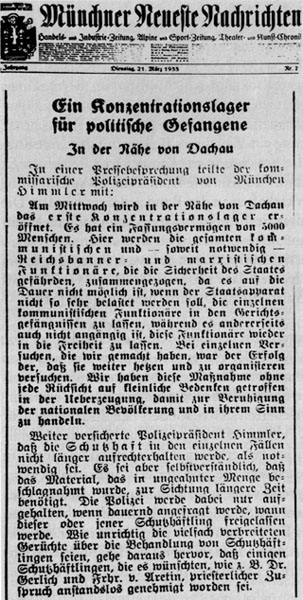
It starts with things like newspaper articles about concentration camps in 1933 like here in the Eschweiler Zeitung (a local paper) or here in the Neueste Münchner Nachrichten, both hailing the opening of the Dachau Concentration Camp as the new method to combat those who threaten the German people and the cohesion of their nation while at the same time Jews, socialists and so forth were constantly described as criminals, rapists, and murderers and bringing violence to the German people's community.
It starts with fostering a general suspicion towards all members of certain groups. “Where the Jew is, is the Partisan and where the Partisan is, is the Jew”, wrote Nazi official Erich von dem Bach. The "Jew=Bolshevik=Partisan" calculus was a central instrument in framing the mass execution carried out by German soldiers as a defensive measure. To throw babies against walls to kill them, became in their minds an action of defense of the whole German people.
That these are in essence social and political process can also be shown with the very examples where the framing was broken by the public. When more and more details about the T4 killing programs of the mentally and physically handicapped emerged in Germany in 1941, public protests formed. Members of the Catholic Church opposed the program and said as much, Hitler was booed at a rally in Bavaria, and locals who lived near the killing centers, as well as families who had members killed, started writing letters – the regime was forced to walk back these measure, stop the centralized killing and instead continued on in secrecy and on a smaller scale.
Similarly in 1943 when the Jewish spouses of German men and women were arrested in Berlin and slated for deportation, their husbands and wives gathered in front of the prison in Rosenstraße and by way of this demonstration forced the Nazi Gauleiter of Berlin to release the arrested again. Far too seldom and few, these protests showed that a public can push back and break these kinds of frames if it can be activate to stand up against these injustices. Regimes that send people into camps, paint certain groups as an essential danger, and undermine the rule of law must depend more strongly on public support than regular democratic regimes ironically. All these things can only be done as long as there is the impression that a majority of the population stands behind them or, at least, won't do anything about it.
Hence, if there is a lesson to be learned from studying historic cruelty, it is that collective cruelty perpetrated by a state and its individual henchmen is a social process that can be disrupted if people start speaking up and demonstrating in the face of it. The current German constitution declares it not only legal but also a duty of every German citizen to resist a government and a regime that violates the principles of inviolable human dignity it enshrines in its first article – a lesson that the historic study of cruelty can only back up.
22 Answers 2018-06-20
Hey /r/AskHistory,
I found some interesting articles about first atomic bombs and it looks like a huge undertaking. Could you recommend a book (preferably) or some consolidated resource where I could find the complete story, in a friendly way?
What I would be interested: How did the idea take shape in the first place? How was president Roosevelt convinced to start this and also allocate money? How much money were spent for this? What were the technical challenges in the way?
1 Answers 2018-06-20
In addition, can you provide a source of books to consult for understanding this?
3 Answers 2018-06-20
I have been doing various forms of postgraduate study for a while now and yet there's still one problem which presents itself which I'm too embarrassed to ask my colleagues. There are a vast number of unedited manuscripts out there. Some are thankfully mentioned in catalogues, but it isn't always clear what they actually deal with.
I spend hours trawling through footnotes, bibliographies and catalogues that it seems I'll never stop, and along the way I gain the sense I'll never find anything original.
How do you, as historians, go about finding the resources that you need?
Edit: I intended this as a rather meta question about research methods, but if it isn't suitable for this subreddit I do apologise.
1 Answers 2018-06-20
1 Answers 2018-06-20
What was the general public's opinion of the monasteries around Japan and did people trust the monks in them?
1 Answers 2018-06-20
I’m quite interested in Learning more but I wouldn’t know where to look and where to start thanks in advance
1 Answers 2018-06-20
Thank you for looking into answering my questions. My understanding of the distribution of the late roman army was that they were primarily stationed in or around the hinterland of the frontier provinces or near imperial capitals i.e. outside of Constantinople. The army would billet near or in frontier cities during the non campaigning winter season.
Modest, but important cities, like Athens were far from the frontiers, but were walled, even after the Heruli sacking in 267 AD. Who manned these walls in peacetime as they were far from the frontiers or did roman units need to be massed there if an incursion occurred?
How was public order maintained in cities without military units especially during riots etc? For instance, did law courts have armed 'militia' or serving 'officers' who could arrest, jail and/or punish criminals?
I appreciate that I may be asking a number of questions here, but the core problem is around defense and maintaining of order and the sources I have been reading suggest that most cities were governed by solely civil officials who may have had no access to armed 'officers' to exercise their authority if the need should arise.
Many thanks for considering my questions. Kind Regards, Matthew.
1 Answers 2018-06-20
1 Answers 2018-06-20
Why was there a focus on absolutism such as the Pharoahs and the Shahs in the east, while in the west there was a tradition of against kingship in Greece and Rome>
2 Answers 2018-06-20
Washington in his prime (circa 1776) was generally described by his countrymen as looking "majestic," "noble," "dignified," and generally having a natural military bearing. But portraits of him at this time, like the famous Charles Wilson Peale painting, look awkward and even a bit ridiculous. Is this because:
the paintings just aren't very good?
the past is a different country, and cultural ideas about what a leader of men should look like are different?
people were generally poor and sickly in the 18th century, so anyone six feet tall who still had all of his fingers and toes counted as a prime physical specimen?
some other reason?
1 Answers 2018-06-20
2 Answers 2018-06-20
Did women in Medieval times (and/or before) consume alcohol while they were pregnant? Or is this something that new science has taught us not to do? If they abstained from alcohol during pregnancy, how did they know they needed to, or know soon enough, considering the lack of pregnancy tests?
1 Answers 2018-06-20
I was always taught when studying American or World History that the Monroe Doctrine was issued by the US to stop the spread of European imperialism in the New World. But, my question is, why did this work? I mean, at the time it was created, the US wasn't nearly as powerful as any of the European powers, with their massive empires and all, so there was no reason for Europeans to fear America. The European powers seemed perfectly content with getting into wars with other, weaker nations to expand their empires. So, given all that, how did the Monroe Doctrine keep the New World safe from imperialism? It's just something I've always been curious about.
1 Answers 2018-06-20