Further questions on the same topic --
When was it decided that year 1 was year 1? At the time or several years later? What was used prior?
When/How did every civilization/society eventually agree on when year 1 started? This seems like it would be highly contested but obviously became globally accepted.
2 Answers 2017-12-22
2 Answers 2017-12-22
Hello all, I am wondering what the consensus is on the reason why Pearl Harbor happened and why. I believe I have the right idea but am curious what you all think about this significant historical event.
2 Answers 2017-12-22
So I was looking at a German document for their fighter plane - Messerschmitt Bf 109F on "Operation and maintenance".
The document appears to be entirely Gothic, I had trouble actually distinguishing the capital letter A (only knew because of the word "Achtung").
Was there any reason to primarily use this font? Is there some sort of connection with Nazi Germany's Pan-Germanism ideology and the Gothic style of writing? That's what I'm getting at.
1 Answers 2017-12-22
This must have had to be a major cover up as it’s kind of the biggest plot point of the Bible. Was it just blamed on them being pagan back then or how did it work?
1 Answers 2017-12-22
on page 180 it says "and that after, he would navigate, the Lord pleasing, to the west, and from there would go to this espanola, in which route he would prove the theory of the King John aforesaid: and that he thought to investigate the report by the Indians of this Espanola who said that there had come to espanola from the south and south-east, a black people who have the tops of their spears made of a metal they call 'guanin', of which he had sent samples to soveregns to have them assayed, when it was found that of 32 parts, 18 were of gold, 6 of silver and 8 copper."
boyd goes on to say the reference to the black people that Columbus expected to find in the south is suggested by the letters of Jaime Ferrer.
https://archive.org/stream/christophercolu02thacgoog#page/n395/mode/2up
does this have any validity to it or not? thanks in advance to any who answer this for me.
1 Answers 2017-12-22
(I actually work at a county historical society and have access to a ton of information, but I'm very new here and still getting a feel for our collection, which is pretty vast.)
I know how to trace a chain of title, but that only tells us who owned the parcel of land. I'm more curious about the people who actually occupied the buildings — not always necessarily the landowner. Could you suggest some ways I might be able to research this? Any ideas at all would be appreciated.
For example, one building that's presently a single-family home previously served as housing for employees who worked at the mill across the road in the 1880s. Their names aren't on the deed, but maybe there are other ways to trace them. Thanks tons for any suggestions.
1 Answers 2017-12-22
[deleted]
1 Answers 2017-12-22
1 Answers 2017-12-22
1 Answers 2017-12-22
Often in Medieval Europe/Medieval Europe-influenced films we see warriors/soldiers practicing against each other with real swords. How accurate is this? Wouldn't this be exceedingly dangerous?
Examples:
Gladiator (Sorry ancient Rome for this one)
2 Answers 2017-12-22
I’m traveling to Kyoto recently, and gone to the world heritage castle which I don’t know the name of but there is only one, I’m Chinese so I can mostly understand the kanji part of Japanese, and I noticed that the Japanese have some really wacky family names, such as 左藤 (left vine) or 田中 (middle field), even the symbols are so similar like some us state flags (no offense), how does this come to be
1 Answers 2017-12-22
The AskHistorians Podcast is a project that highlights the users and answers that have helped make /r/AskHistorians one of the largest history discussion forums on the internet. You can subscribe to us via iTunes, Stitcher, or RSS, and now on YouTube and Google Play. You can also catch the latest episodes on SoundCloud and Spotify. If there is another index you'd like the cast listed on, let me know!
This Episode:
Today we are welcoming /u/OwlOfDerision AKA Danielle Thom to the AskHistorians podcast. This conversation today will be about 18th century visual culture and the life of various artists and the the invention and popularization of the satirical print and caricature. We also discuss what it is like to work inside a museum and how to get a job inside a museum!
You can see some of Danielle's Work at the Museum of London, and she tweets from @Danielle_J_Thom.
1 Answers 2017-12-22
His theory being that the Empire was built on slavery and so constantly needed to be expanding in order to keep the slave class alive. Once the supply of slaves started to decrease, the resultant economic and societal strain impacted the running of the empire and contributed to its decline. Is there any truth in this theory?
1 Answers 2017-12-22
Today:
You know the drill: this is the thread for all your history-related outpourings that are not necessarily questions. Minor questions that you feel don't need or merit their own threads are welcome too. Discovered a great new book, documentary, article or blog? Has your Ph.D. application been successful? Have you made an archaeological discovery in your back yard? Did you find an anecdote about the Doge of Venice telling a joke to Michel Foucault? Tell us all about it.
As usual, moderation in this thread will be relatively non-existent -- jokes, anecdotes and light-hearted banter are welcome.
10 Answers 2017-12-22
So I always wondered why it was so important to waste human life by throwing them against the walls of a castle when invading an area? It seems, in almost every situation I have read about or seen (with the knowledge that most of it is fiction), that its a better strategy to have a token force surround a castle, to keep an army from using it as a staging point, and to keep the people in, and then use the rest of your forces to just settle the land (now that everyone who used to live there probably all escaped to the castle).
2 Answers 2017-12-22
I'm writing an essay trying to examine the impact of the discovery of the Americas on Europe but am struggling to find books or come up with a theme for my essay. Any help would be much Appreciated. So far I have lots on potatoes.
1 Answers 2017-12-22
There seem to have been a great variation with calendar systems across the world but not as much with the week system. Have weekdays always been synced across the cultures and civilizations that used the 7-day week? If not, how and when did it become the way it is now?
1 Answers 2017-12-22
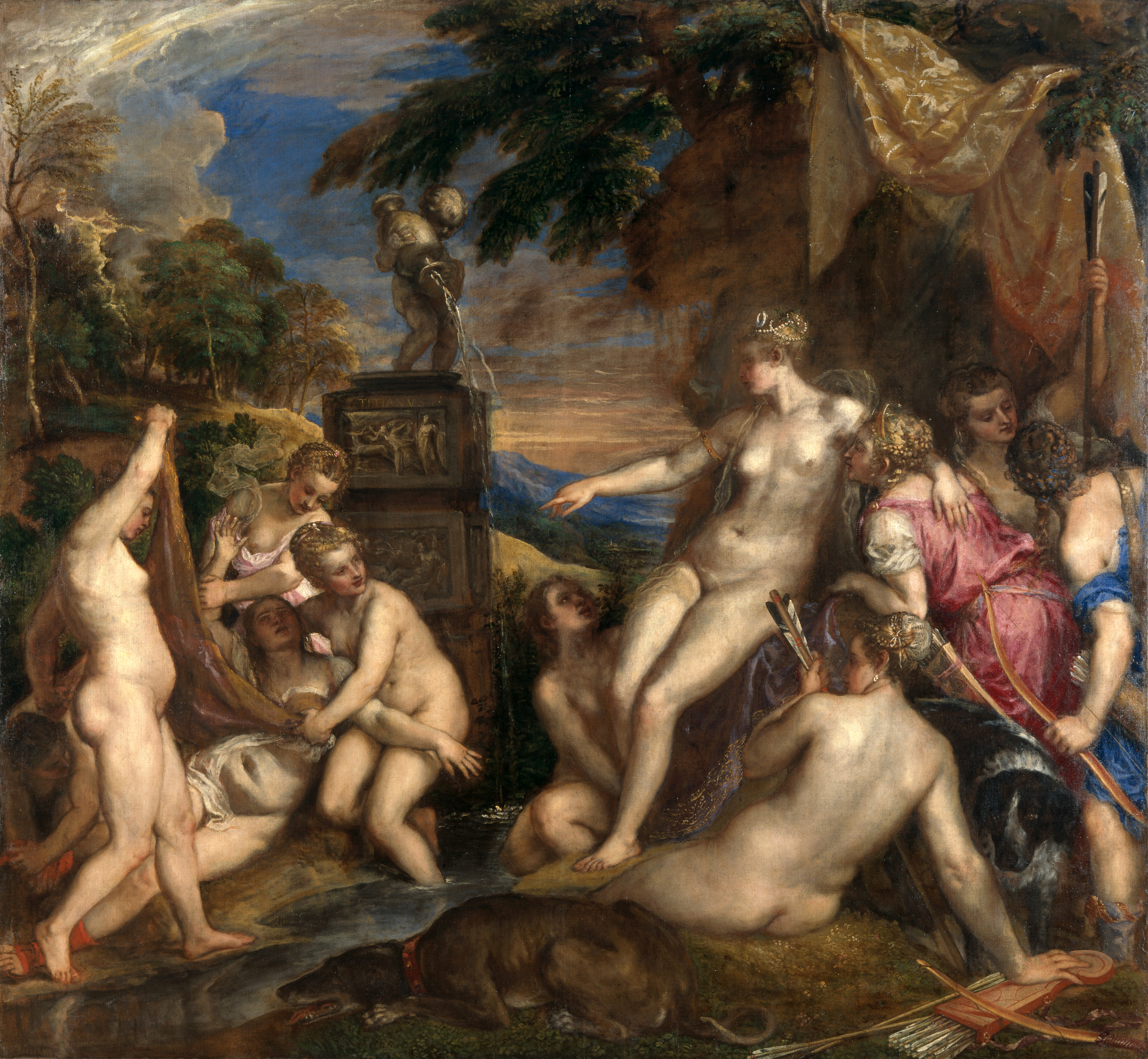
I was reading Wikipedia's "Dart" article when I came across a paragraph claiming that a sort of "fletched spear" was used in the Middle Ages and Renaissance. The only source provided are two paintings by Titian from the 1500s: Venus and Adonis, and Diana and Callisto. Here are links to hi-rez images of them.
https://upload.wikimedia.org/wikipedia/commons/e/e5/Venus_and_Adonis_by_Titian.jpg https://upload.wikimedia.org/wikipedia/commons/1/1a/TitianDianaCallistoEdinburgh.jpg
In both you can see individuals holding the shafts of what look like very thick, nockless arrows. The most prominent one is held in Adonis's right hand. Based on my own hand, the shaft appears to be 1.25-1.5 inches in diameter, the thickness of a typical martial spear haft or quarterstaff. Far thicker than an atlatl dart and suggesting this type of spear could be used for hand-held stabbing in addition to throwing. If the one held by Adonis is assumed to be resting with its tip on the ground (unseen), it is over 6 feet long. The fletchings are plainly visible and look like scaled up versions of those used on arrows.
However, two paintings by an artist depicting ancient Roman legendary figures seems like a spotty source to claim this weapon existed. Is there any other evidence for such a type of spear during this time period?
1 Answers 2017-12-22
I was randomly thinking, in this day and age it's near impossible to meet or greet our leaders (in particular those leading the larger countries), but what about in ancient times? I guess it would vary depending on the period and civilization, but how hard do you think would it be for a common Mongolian to glimpse Ghengis Khan, or a common Greek to wave to Alexander the great, etc.
1 Answers 2017-12-22
[deleted]
1 Answers 2017-12-22
My understanding of the Ikko Ikki (or Ikho Ikki - there seems to be some conjecture about the anglicised spelling) is that not only did they control a province in Japan, but they also had temples scattered around the country. I understand that they practiced a very specific type of Buddhism, and that they were monks first and foremost. However, I am struggling to find good sources that talk about their martial capabilities. They had some level of organization and real capabilities - how else would they hold off the Oda for so long - but I don't know exactly how they managed it. How did the Ikko Ikki function martially, and how were their troops trained? What kind of martial arts were practiced, if any?
1 Answers 2017-12-22