And to what extent did this include the so-called eternal allies, i.e. the Valais and the Three Leagues?
1 Answers 2017-06-18
So I was reading about the Mongol attempts at conquering Japan. In both cases, their invading forces left from Korea or China, and landed in the southernmost portion of the island chain. The weather played a considerable role in deterring their forces, and ultimately they were defeated.
However, I also read that the Mongol Empire had already subjugated the Ainu in Sakhalin by this time. The crossing between Sakhalin and the north of Japan appears to be a much shorter distance than that of Japan and Korea. So why had they chosen Korea as their staging area instead?
1 Answers 2017-06-18
1 Answers 2017-06-18
Not only in terms of education, but how they spent their free time compared to univerity and college students today.
Edit: In Western Europe, preferably as is the customary focus of world history.
1 Answers 2017-06-18
It seems beyond coincidence for it to have emerged simultaneously from two great thinkers at about the same time. Conditions must have been ripe for its emergence. But why?
1 Answers 2017-06-18
I'm aware of the idea that the China entered the war in response to US aggression (i.e. crossing the 38th parallel, pushing north to the Yalu River), but were there any other motivations for intervening in korea. What did they hope to get out of the war?
1 Answers 2017-06-18
I would like to know what mix of scholarly literature and biography can help me get a handle on the various schools of thought and most current historiography concerning Kaiser Wilhelm II (not just in terms of his role in WW1, but more generally). It's become clear to me that having a better handle on this scholarly debate is necessary to more fully understand a number of books that I've read recently.
In my search I found an older thread that recommended John Röhl's work, but only hinted at the conflict between his approach and that of scholars like Christopher Clark. Is it thus necessary to read Clark's 2000 biography alongside Röhl's? Do I need to find Fritz Fischer's older work too? Are there collections of documents, like letters or diplomatic orders, that it would be good for me to read (unfortunately I do not read German so I could only access things that are available in translation)?
I have a Ph.D. in a related field, so scholarly journals, "dry" texts with lots of footnotes, and things like that don't bother me at all. I read Italian and French in addition to English--not that I think that will matter much, but I guess there's a small chance that there's a valuable book or article written in one of those languages.
Thank you for your time.
1 Answers 2017-06-18
Recently I've run across videos of cold war era communist intelligence service defectors Yuri Bezmenov (aka Tomas Schuman) and Ion Mihai Pacepa.
These people seem as though they would be important historical figures, with their claims well-analyzed and cross-referenced by academics. But I've been able to find really nothing that seems at all thorough or impartial on them.
I'm hoping that I'm just being bad at searching, a task made difficult by a large amount of chaff created by the fact that some of their claims are excellent fodder for the conspiracy-minded.
Does anyone know of attempts at dispassionate, well-referenced analysis of their claims, and those of other cold war era communist defectors?
If not, any idea why not? It just seems bizarre to me that they would be overlooked by serious historians.
1 Answers 2017-06-18
Yes, yes, I got it from Bill Wurtz. But why did the Sultan of Oman move to Zanzibar? And how did Oman even control Zanzibar?
1 Answers 2017-06-18
In the Levant, Low Countries, Provence, and Italy during the Medieval Warm Period.
1 Answers 2017-06-18
Today:
Welcome to this week's instalment of /r/AskHistorians' Sunday Digest (formerly the Day of Reflection). Nobody can read all the questions and answers that are posted here, so in this thread we invite you to share anything you'd like to highlight from the last week - an interesting discussion, an informative answer, an insightful question that was overlooked, or anything else.
8 Answers 2017-06-18
Hello. I have taken a look through the book list and a quick search of the posts but I have not been able to find books than examine the economic, political, and organizational realities of the Soviet union. There are more than a few on the cold war more broadly but I am finding it hard to get a book about other details. Any recommendations would be appreciated.
Thank you in advance and sorry if I have broken any rules.
P.s. you guys do great work!
2 Answers 2017-06-18
I mean, looking at the Philippines now, I think joining the Union would have been a better choice than independence.
1 Answers 2017-06-18
When and how did the banana, a tropical fruit, become so pedestrian in Euro-American diets? It seems like it would have been an exotic signature of colonial import, but nowadays it's a basic fruit alongside apples and oranges (from the standpoint of northern hemisphere, western, eaters).
1 Answers 2017-06-18
Weapons like early matchlocks and muskets were around in limited numbers in the 1400's and 1500's, but as far as I know bayonets didn't begin to see wide adoption until the 1700s. Given how significant of an advantage they could have over the typical pike-and-shot formations, why didn't someone think of them earlier? Or, if they were attempted earlier, why did they fail compared to pike-and-shot?
2 Answers 2017-06-18
I keep hearing the statistics: at various times after the US colonial occupation—from the late colonial years before WW2, through "independence" in 1946, until the 1960s when Ferdinand Marcos the dictator came to power—the American Philippines had the best treatment, all things considered, of any colony under any colonial power; or if not the best, certainly up there with the best. As in:
That to me is more than a bit troubling, because if it's true, it means we (I'm Filipino) are indebted to them to such an enormous degree that we can never go it properly on our own. Even today they give us military equipment and keep helping us fight our insurgencies; do you see Vietnam relying on France or Indonesia relying on the Netherlands to the degree the Philippines insists on relying on the US today? Those European powers may not have brought as much material benefits to their colonies … but that helped the cause of nationalism in those colonies in the long run. For Filipinos, America has such an enormously positive public perception, that any sort of genuine nationalism runs afoul of offending American sensibilities.
Like I heard online once: "if you're anti-American, you're anti-Filipino."
Is it really true that the US-PH colonial relationship was, in terms of real benefits, the most "benevolent"? Did any other colonial empire in the last 500–1000 years treat their colonies this "nicely"—the French in Vietnam, the British in Singapore or Malaysia, Hong Kong or India, the Dutch in Indonesia, the Japanese in Taiwan, the Germans in Tsingtao or their tiny pre-WW1 Pacific colonies, or even the Soviets in the satellite republics? Indeed, does the US treat its other colonies this "good" as well (e.g. Puerto Rico)? I mean, they've apparently worked their magic on Puerto Rico so well, that Puerto Ricans insist on voting to become the 51st state!
I realise independence might be fraught with difficulty for a lot of Puerto Ricans, but come on, would you really rather want to remain a US colony? (Because, yeah, let's call it what it is—instead of a PC term like "territory", and it's not like a lot of US politicians like being PC anymore, especially now.)
(For this question, do not include settler colonies, e.g. colonial America, Canada, Australia or New Zealand; the fundamental dynamics of those colonies, even under colonial rule, was very different, because settlers (or prisoners in Australia's case) from the colonial centres founded them; they didn't have large, organised indigenous populations to be exploited (mostly they just killed them off, though they exploited the remainder anyway).)
1 Answers 2017-06-18
Reading up on some of the history of Asia I just can't help but notice the adjective "Sino" being the odd one out when it comes to naming of wars and international relations, for example the Sino-Indian war or the Sino-Soviet split as oppose to, say, the Franco-Prussian war or Anglo-Egyptian Sudan.
Is "Sino" in reference to a Chinese dynasty or is it just a word the West made up to refer to them or is it something completely diffrent?
1 Answers 2017-06-18
Estimates of the % of nobles in the Polish-Lithuanian Commonwealth that I've seen range from 5% to 15%, with many of them not being landowners. At the same time, the aristocracy of France constituted 1% of society during the French Revolution, and I've heard that Sweden and Germany had even fewer nobles. Why was that?
1 Answers 2017-06-18
1 Answers 2017-06-18
1 Answers 2017-06-18
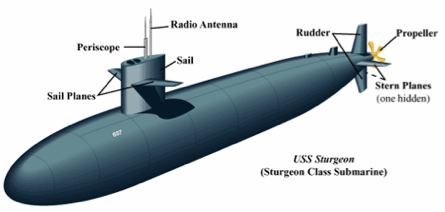
Example of what I'm talking about:
Some of the striking changes include:
I know that in the 1950s the first nuclear submarines started to appear, starting with the USS Nautilus, but I wonder if specifically the switch to nuclear power caused the rather radical shift in external hull design compared to submarines built in the previous decades (both WW1 and WW2), or whether it was caused by unrelated reasons (especially since modern non-nuclear submarines also share the modern hull look).
1 Answers 2017-06-18
How were people treated? I'm not interested in the medical side, but more in the day-to-day life. How was something like depression explained and was it as big of a taboo as today. Any historical writings on the topic you could direct me to would be appreciated as well. Thanks!
2 Answers 2017-06-18
What kind of people became spies? Who did they work for? What methods did they use? Were there different kinds? Was it something that existed professionally the way it does now, or something only on an ad-hoc basis? (Ie could you "be a spy" as a first or second job, or could we only say that someone "was spying" on someone else?)
2 Answers 2017-06-18