Walter Scheidel says this in his paper Roman population size: the logic of the debate as an explanation for why Roman military mobilization rates were higher than those of later European societies.
What taxes is he talking about?
1 Answers 2017-05-09
2 Answers 2017-05-09
1 Answers 2017-05-09
1 Answers 2017-05-09
Imperial China, as far as I understand, usually had a relatively uninvolved, bureaucratic, decentralized state relying on its many provincial magistrates and state functions to run the country rather independently, taking care to local needs. Even military campaigns seem to be delegated entirely to generals. Even in times of war, the various Chinese military cliques and armies and fleets acted relatively independent of each other. If all functions of the state are delegated to subordinates, then what functions have been left for the Emperor?
2 Answers 2017-05-09
I always see a small bay at the Guadalquivir/Baetis' delta in maps of the Roman Empire, such as this one, but I can't find information about it anywhere.
What caused it to disappear? What impact did its disappearance have on Sevilla/Hispalis as a trading port? Are there any written records on it and its uses?
1 Answers 2017-05-09
I've heard varying stories on why Avro cancelled the CF-105 Arrow.
On one hand, the conspiracy is that large american defense contractors and aeronautical corporations told off the American government, who then intimidated Prime Minister Diefenbaker into axing the Arrow and Iroquois programs.
On the other, Avro was faltering at a management level, there were few potential buyers of the interceptor model, and the whole program was very expensive and dubious when compared to the development of the Convair F-106 Delta Dart, which had similar capabilities but was completed sooner.
1 Answers 2017-05-09
For example, Conrad of Montferrat was the cousin of the Holy Roman Emperor, King of France, and Duke of Austria. How did the rulers of this small region become related to the most powerful people in Europe?
1 Answers 2017-05-09
From my limited understanding, it was not uncommon for women (especially of the lower social classes) to have sexual relations before marriage.
I imagine, some of these relations lead to the birth of children and was wondering if there are any sources about the treatment the children (and their mothers) received?
Were they shunned, like illegitimate children in Europe? Were they readily acknowledges by their fathers or could they be adopted into their mothers families? Were the unmarried mothers ostracized, did it depend on the social status of the mothers?
Looking forward to your answers!
1 Answers 2017-05-09
According to a recent article in a Korean newspaper, Colin Renfrew and Paul Bahn's Archaeology: Theories, Methods and Practice, now in its seventh edition, has revised its description of the origin of domesticated rice. While "before 2004" this popular introduction to the academic field of archaeology had rice from 9,000 BC discovered in China's Hunan province as the oldest example, in the latest edition it is supposed to have changed this to rice from 13,000 BC discovered in the Sorori site in Cheongju, South Korea.
I have to say I really doubt the claims in this article, given that the there was strong skepticism in academia about the Sorori rice claims that were first publicized in 2003 and even led to a BBC article, but which smack of a nationalist agenda. I wouldn't be surprised if the whole article was a fabrication or the product of some sort of a wishful misinterpretation. However, I don't have access to Archaeology, so I'm wondering if any redditors can tell me what it really has to say on the subject.
1 Answers 2017-05-09
On the wikipedia page for King Bela IV of Hungary, it says that the Cumans adopted Christianity when they entered Hungary. However, the page of one of his successors, Ladislaus IV claims that the Cumans were pagan during Ladislaus IV`s reign. Can anyone help clear this up for me?
1 Answers 2017-05-09
Were there any special rules on how old someone had to be before taking on holy orders? Were there differences here between different monastic orders?
3 Answers 2017-05-09
I've sometimes heard it said that people - say in the middle ages - didn't think of "progress" the way we do (e.g. we'd say that women's suffrage is a historically important event because it's progress), so I'm wondering what kind of framework they did use to understand their own history.
For example, medieval monks were aware that Aristotle couldn't possibly have been Christian, but did they see this as a sign of a profoundly different society from theirs? And if so, how did they frame the process of getting from Aristotle's world to their own? Or did they conceive of Ancient Greece as a broadly similar world to theirs only pagan? In the other direction, would a forward-thinking monk hold the conviction that certain profound changes in society were desirable to make it somehow better? Would they have thought of such changes as historical processes?
Sorry if the question is a little vague, I'm having some trouble phrasing it.
1 Answers 2017-05-09
Booth was among the more famous actors of his day, and his assassinating Lincoln obviously caused many to turn him.
Nevertheless, was he viewed as a hero or a martyr among some in the South, just recently having been defeated in the War?
Did he increase in his hero factor there?
1 Answers 2017-05-09
I recently made a DNA test. My father was from Sierra Leone and I found out something quite extraordinary: from his side of the family I had some Papuan and Native American from the Amazon. As we all know, these were not places from which people travelled to other countries or continents. How on earth could a Papuan from Oceania or an Amazonian from South America end up in Africa? These were all countries that were visited by the Portuguese who had slaves, right? Yet I'm not aware from which countries they had slaves from.
I hope this will spark some interesting conversation. Thank you.
2 Answers 2017-05-09
By the initial question I mean what was the reaction of the public and the elites to the house of a ruling family becoming extinct, or a new or different ruling house taking over, by peaceful means (i.e. marriage/birth of heir)?
Historically, I'd ask about the Stuarts being succeeded by the Hannovers upon the death of Queen Anne in Great Britain. A later example being the Hannovers being eclipsed by Saxe-Coburg-Gotha after Victoria?
Was the public really only concerned about the lineage of the new King or Queen, or was the house a concern?
It might also be interesting to hear about other countries in Europe as well.
Side question: The British Saxe-Coburg-Gotha branch was renamed to "Windsor" during the first world war, but would Prince Charles of Wales not be of House Battenberg now? Has this spawned two seperate new houses? Windsor (Saxe-Coburg-Gotha) and Windsor (Battenberg)?
1 Answers 2017-05-09
As part of the Egyptian Empire, was it fully part of Egypt, under client Kings, etc? How badly were the locals treated by the Egyptians? Was there much population transfar (either forced or voluntary) between Canaan and Egypt?
1 Answers 2017-05-09
[deleted]
1 Answers 2017-05-09
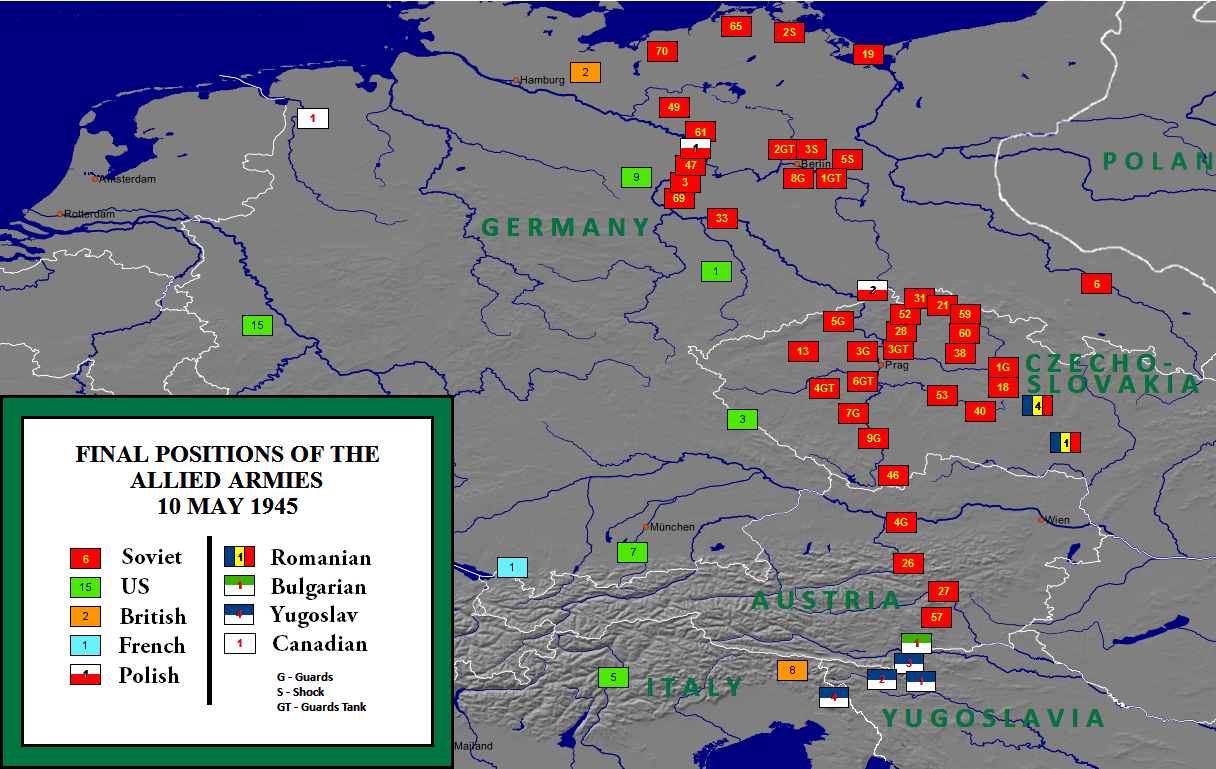
When I say the west I mean US, UK, French, Canadina, etc. and when I say the east I mean mostly the soviet troops. I have read recently somewhere that the liberation and the entire WWII effort as we perceive it today was somewhat influenced by Hollywood's depiction of WWII (I think it was on this subreddit).
So, if one could try and quantify it, how much of Europe was liberated by which side of the later blocks? And a smaller sidequestion which made me ask this one... On wikipedia there is this image: https://upload.wikimedia.org/wikipedia/commons/1/11/Allied_army_positions_on_10_May_1945.png Why does it state that there are only 6 soviet armies and 15 US armies, when the graphic shows otherwise. What am I missing?
(first question on this subreddit so please feel free to advise me on how to properly format it to meet the guidelines)
1 Answers 2017-05-09
Hi reddit! I work in a polythechnical museum and we are about to launch clock/clockmaking month. I have plenty of clocks with figures on them, but I can't quite figure out who this is http://i.imgur.com/uLNqlwP.jpg , http://i.imgur.com/ciq5tWS.jpg . As far as I'm concerned he is from France or Switzerland but I don't know more. The clock itself appear to be French. Any help?
1 Answers 2017-05-09
1 Answers 2017-05-09
Spoilers ahead, if you care about that sort of thing.
The protagonist is initially taken as a slave by a raiding group, but is eventually adopted. Is this something that would have happened? It makes for a nice launching point for the plot, but it seems contrary to the brutal superiority mentality that other Viking-centric entertainment lead me to believe.
After losing a major battle, a couple major Viking characters are taken "hostage" to ensure the peace (a la Theon Greyjoy). Again, this seemed to go against that Viking mentality. I wouldn't have thought they'd be so pragmatic (from a modern Western perspective) because it would have been seen as dishonorable. Did Viking groups ever submit to outside parties, that they were targeting, in such a manner?
1 Answers 2017-05-09
The fact that the "Roman Salute" is false made me wonder: what kind of gestures did they make?
I've read the Greeks (and Ancient Greeks) wave(d) with their palm inwards.
1 Answers 2017-05-09
I'm listening to the great courses audiobook "Alexander the great and the Macedonian empire" by professor Kenneth w. Hart and was surprised when he explained that not only did the Greeks consider Macedonians separate from them culturally, but that the Macedonians spoke a language that was unintelligible to the surrounding Greeks. This surprised me as I always understood ancient Macedonians as a subset of the Hellenistic peoples while culturally very distinct, however, if their languages were not mutually intelligible this would suggest to me this is not the case. My immediate reaction then was to assume that Macedonians may have been part of a subset of the Illyrian peoples but then it was also explained that Macedonian was not intelligible with any Illyrian dialects either (I think that's what he said at least if I remember). This would be rather astonishing as it would lead me to believe that the Macedonians may have made up their own entho-cultural-linguistic category of the indo-European macro-group that is no longer present today. If anyone has more information regarding this I would find it extremely interesting.
1 Answers 2017-05-09