Basically, what were the tenents of Cameralism and how were they specifically put into action?
I've been asking all around Reddit to no avail.
1 Answers 2017-04-30
Garcia serves alongside white characters played by Brad Pitt, Shia Lebeouf, and Jon Bernthal.
The US Army in WWII was segregated by race. Would a man named Garcia really have served amongst whites? If yes, does this mean that Hispanics or Latinos were to some extent considered white?
1 Answers 2017-04-30
I have read various books and heard from various people that the Spitfire ultimately "won" the battle of Britain. However, I have always thought that it was the trusty Hawker Hurricane that was the true hero. Is there a general consensus that a certain plane changed the tide of the battle of Britain?
1 Answers 2017-04-30
One of Gandhi's quotes "Among the many misdeeds of the British rule in India, history will look upon the Act [India Arms Act of 1878] depriving a whole nation of arms as the blackest" came from a WWI recruiting pamphlet, urging Indians to fight for the British Empire to learn the use of arms to potentially overthrow their Imperial masters. Did Gandhi result to his philosophy of nonviolent noncompliance because he and other Indian nationalists did not have access to keep and bear arms?
1 Answers 2017-04-30
I just watched The Lost City of Z and it made me realize that every rendition of Natives I've ever seen showed them with no facial hair or chest hair.
Is this just something that's happened in tv and film, or were Natives unable to grow the hair, or did they have removal processes?
1 Answers 2017-04-30
(I couldn't draw the rigging because that would require an immense amount of detail, and would block most of the sails I drew)
I drew two mizzen masts, and I thought that adding two steering wheels would make a ship like this easier to maneuver. Would that be realistic?
The ship's masts are also much taller (though I ran out of room on my paper) and have more sails than shown. For the individual sails that look like this (pardon me, I don't know the proper term for these types of sails from the 18th century), there are about 5 stacked on top of each other on each mast (fore, main and mizzens) though if I was able to draw this ship at a much larger, full-sized scale, there would be 6 stacked on top of each other on each mast. Would that be too many sails on each mast?
Other questions I have:
how fast could a ship like this sail?
how many people would be required to fully operate this ship? (cannons, sails, commanding officers, etc.)
1 Answers 2017-04-30
When The Bomb was dropped, it was referred to as "the atomic bomb" (edit: and was referred to as such by Truman announcing its use on Hiroshima). The famous Korean War song refers to "if General MacArthur drops the atomic bomb", and a cursory google search results in finds such as "Atomic Power", a film supposedly created in 1946. However, by the time of the Cuban Missile Crisis, Kennedy spoke of "nuclear warheads" and "nuclear missiles" in his October 22 speech, and these days, the use of "atomic" instead of "nuclear" seems almost archaic. We might maybe use "atomic bomb", but warheads, weapons, or the power from reactors are "nuclear". When did this change in terminology occur, and is there a specific reason behind it, or is it merely a more-or-less-random change in language use?
(I also have to think of Frank Herbert's use of the term "atomics" when he wrote Dune in the early 60ies, which sounds almost deliberately archaic and estranging, but I'm not sure how relevant this really is.)
2 Answers 2017-04-30
To start, I'm fascinated by security, but especially with what was done to protect your home or business before mass produced security devices and electrical based systems were around. I've also had a bit of a fascination with the criminal underground of different time periods and how they functioned.
For example of questions I had:
What kind of security would a business have that a home wouldn't?
What was possible for the Plebians and less wealthy compared to the Patricians to be able to use and afford?
What was available for use? What was used to lock a home if you weren't there, or you were inside your home what was possible? What was a way to secure valuables inside your home even if someone was able to sneak in, occupied or not?
What happened to stolen goods after they were taken? How would a thief make money? Was it a black market, fences, or were there other methods to profit from the stolen goods?
Thank you for reading and any answers that are possible, this is one of those little bugs in my head I've always wondered about.
1 Answers 2017-04-30
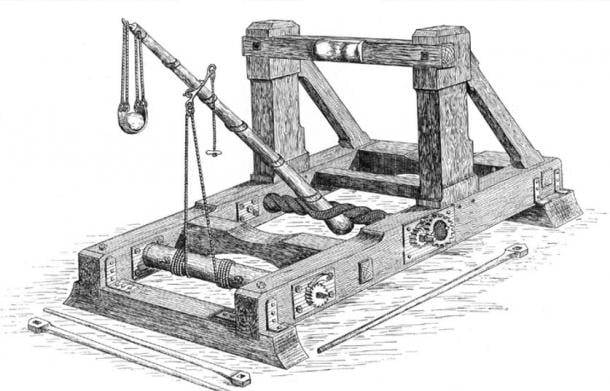
I'm trying to come up with some print designs and I wanna do a series on ancient siege equipment. I wanted to start with the onager but the more research I do the more I begin to doubt the depictions I find. Mainly, I find images like this but this seems to be more indicative of a Mangonel or just a traditional depiction of a Catapult. The drawing on the actual wiki or the one depicted here seem more accurate to Ammianus' account of the machine.
I'm aware the design surely changed over time and may have varied in different theatres, using a sling as opposed to a bucket for example, but the frame is something that will give is a distinct silhouette and I'm a stickler for accuracy so any help would be greatly appreciated.
1 Answers 2017-04-30
1 Answers 2017-04-30
1 Answers 2017-04-30
And if Marxism in 1880, 1900, and 1910 were to be compared to ideological movements today, what are movements with comparable sizes and controversy? (Without making analogies to the good or evil of Marxism, of course. Saying "ok, at this time it was, like, about as big as bronies are right now" would be a perfectly helpful answer.)
1 Answers 2017-04-30
I am a grad student archaeologist working in CT. This is something I've always wondered as I frequently observe this phenomena in my work. All across New England there are stone walls on people's properties and throughout the wooded areas and forests that no longer contain a meadow. Many of these walls are demarcations of former crops fields and grazing pastures. Many of these walls can be seen while driving around the countryside or walking through state parks. I've also worked in historic conservation and I've always been struck by older painting of NE towns and countryside (18th-19th century) showing rolling meadows and fields and very little woodland. Seems to me that New England back then certainly looked much more similar to "old" England. (This may not be unique to NE in the US, it's just the area I've personally observed)
The genesis for my question comes from a very amateur observation of the state of similarly walled meadows and pastures across the pond in the UK. There it would seem, pastures and meadows that were once fully utilised are still kept cleared, for the most part. Perhaps this is due to the significance of the "rolling meadows" in UK national identity and character.
I suppose you could also look at this question from the opposite angle and ask why the UK has preserved open land when it is no longer necessary.
I understand that the answer could simply be that economic conditions were such that these meadows fell into disuse and abandonment. I remember reading a statistic discussing how NE is actually at one of the highest amount percentage of woodland and forest since Europeans arrived and began clearing it away. This appears to have occurred because of the very phenomena I'm talking about.
Basically I'm hoping someone can lend expertise and detail even though this may be very simple.
EDIT: I wonder if anyone has any knowledge on the situation in the UK. If I'm not mistaken, cultivated land has decreased over the past century (I don't know by what percentage this is just off the top of my head). What factors have kept UK fields cleared? Is it that they're all still utilised somehow contrary to what I thought? Or is it Cultural? Or flora related somehow? (Different tree species?)
2 Answers 2017-04-30
I recently started reading Anna Karinina, and it is a bit annoying to me that they always refer to someone with their first and middle name! I understand in introductions you would use the first, middle, and last name, as I believe all 3 were very identifying at that time. However, in casual conversations, they continue to use first and middle names - two brothers, discussing their 3rd brother, always refer to him with both names. Is there a reason for this? I don't think I have noticed this with other literature of the time, though I have probably only read American novels, was this a Russian thing?
1 Answers 2017-04-30
I've always loved Greek mythology but want to know more than just Wikipedia and pop culture. Any recommendations for websites, YouTube channels, books, etc. would be greatly appreciated!
1 Answers 2017-04-30
1 Answers 2017-04-30
Alexander the Great's empire was the largest in history by the time of his death. How did the successors to it react to Rome conquering it within a few decades?
1 Answers 2017-04-30
It's impossible to know whether the influence of Majorana would have successfully boosted the Nazi team toward constructing the first atomic bomb, however the following quote from another genius, Enrico Fermi, is clear evidence of the value of Majorana's presence:
"When the Manhattan project was briefly stuck, Fermi is reported to have said to Eugene Wigner, “If only Ettore were here.”4 Majorana’s absence was brought up regularly enough that one of the army officers running the Manhattan Project asked Wigner where Majorana was, and if he could be induced to emigrate to the United States. All Wigner could tell him was that Majorana was gone, and that nobody knew where."
1 Answers 2017-04-30
She argued that before the crusades, most of Western Europe only had wooden motte and baileys for fortifications. I found a book making a similar argument from a cursory google search, but is this a mainstream view?
1 Answers 2017-04-30
Can someone tell me what regiment and Front/Battles my relative was in, I'm having a hard time reading it. Thanks. https://recordsearch.naa.gov.au/SearchNRetrieve/Interface/ViewImage.aspx?B=8094745
1 Answers 2017-04-30
I've seen total tribal count numbers in the millions. What role did cultural, geographic & technological limits play to prevent a coalescing of larger sovereign entities?
1 Answers 2017-04-30
Recently I read "The longest day " of Cornelius Ryan and i saw that the rangers assaulted the Pointe du Hoc and Omaha Beach. After the assault did the Rangers participate in the European Theater? Did some of you know some good books about the assault in omaha beach and the ranger story during ww2?
1 Answers 2017-04-30