I did do a search in this sub for similar questions, but the only one I found had no suitable answers. Thanks.
2 Answers 2015-06-20
A documentary I once saw claimed that a hurricane or tornado of some kind hit the British encampment causing enough damages/casualties that they were forced to withdraw from Washington DC. Did this actually happen or is it an over-dramatization of American historical folklore? Also, if it is true, is there any real, documented, loss of life or casualties?
1 Answers 2015-06-20
2 Answers 2015-06-20
3 Answers 2015-06-20
Today:
Saturday Reading and Research will focus on exactly that: the history you have been reading this week and the research you've been working on. It's also the prime thread for requesting books on a particular subject. As with all our weekly features, this thread will be lightly moderated.
So, encountered a recent biography of Stalin that revealed all about his addiction to ragtime piano? Delved into a horrendous piece of presentist and sexist psycho-evolutionary mumbo-jumbo and want to tell us about how bad it was? Need help finding the right book to give the historian in your family? Then this is the thread for you!
8 Answers 2015-06-20
I'm sure it is not official, but the crescent is on mosques and flags, etc. what is the history behind it?
1 Answers 2015-06-20
You have several Frankish figures with names like Clovis, founder of the Merovingian Kingdom; Charles aka Charlemagne, founder of the Carolingian Empire; and Louis, son of Charlemagne and King of Aquitaine. And then you have figures with more Germanic names like Childeric, Frankish king and father of Clovis; and sons of Clovis: Chlodomer, Childebert, Chlothar, and Theuderic.
I know that the Franks were a group Germanic tribes that spoke Old Franconian, a Germanic language. In Crusader Kings II terms, the Franks, at some point, "flipped" or changed their culture to French while adopting the French language which was a Gallo-Romance language, thus being more related to Latin.
Right now, I'm tempted to pronounce Clovis, Charles, and Louis as "clo-vee", "sharl", and "loo-ee", even though they were Franks rather than French.
So I reiterate my question: How "French" were the Franks?
For my bonus questions: How "Italian" were the Lombards? How "Dutch" were the Franks or the Frisians? How "Castillian" or "Catalan" were the Visigoths?
Best regards, a Crusader Kings II player.
PS: If this is the wrong subreddit to ask such a question, please point me to the right one.
7 Answers 2015-06-20
2 Answers 2015-06-20
Reading historical accounts about how gratuitous torture wasn't just commonly practised as a form of execution but was commonly attended by the public, I just wonder why and how people used to be just fine with this sort of thing. If someone today went out to watch someone be torn apart with red hot pitchers with some friends we would think them psychotic or insane, but back then it seemed pretty normal.
2 Answers 2015-06-20
2 Answers 2015-06-20
I know how impractical it is to attempt to diagnose a long-dead person with a current medical condition, but are there any individuals throughout history where there's a common consensus (or theory) that they may have had some form of mental illness? Also, some books or direction for reading about the perception of mental illness through history would be golden, if that's within the realms of this sub.
1 Answers 2015-06-20
Hi,
I am reading the history of Ovid and in one point of his life he was banished from Rome and continued his life in Tomi (Black sea region).
How did the Romans prevent him from reentering the empire?
1 Answers 2015-06-20
Ages ago /r/askhistorians made a rule against vague questions that don't specify a very specific time/place/situation. The reasoning was to improve the subreddit and occurred around the time that /r/askhistorians really started to grow. I think there was an understandable fear that the influx of new people would hurt the quality of the subreddit. However overtime the quality and research/sources of this sub's comments have gone way way way down.
I believe this to be because most people who can make a truly high quality multiple paragraph properly sourced post that's interesting can only do so if they have a true passion for the subject.
When you ask an extremely specific question someone may have knowledge of the answer but it's just a minor part of their area of expertise and you don't elicit their passion for history; their answer will be short, bland, to the point, and often unsourced.
When more open ended questions were allowed, historians could apply the situation/question to their field/interest and you would get these amazing detailed long posts, sometimes spanning multiple comments, heavily sourced that were just a treat to read, and which had more scholaristic integrity. As the frequency of these high level comments went down, what we as a sub have let slide has gotten worse and worse, as an almost desperation for content has allowed lackluster comments to survive mod purging. These comments are generally factually accurate, but not as long as we would like, and often not actually sourced (sources are nice, i miss them)
I think this sub would be improved if the quality requirement of comments was ramped back up, while the standard for what is an acceptable question was reduced.
Questioners are not necessarily historians, and even a really poor, vague, uninformed question can lead to an excellent commenter dispelling misconceptions or enlightening us on a period of history.
I really feel like that rule hurt the quality of askhistorians, both in terms of enjoyability of reading, and in terms of quality/quantity, and I'd love a discussion with the subreddit, or for some mods to consider such a shift.
Thanks for reading.
Edit: To be clear I am in no way advocating a reduction in rules regarding commenting. Nor am I against strict moderation of comments.
Edit: I'm also for more comment removal, I think that quantity will lead to quality as long as you remove the bad quality comments, like how a larger country will do better in the olympics.
30 Answers 2015-06-20
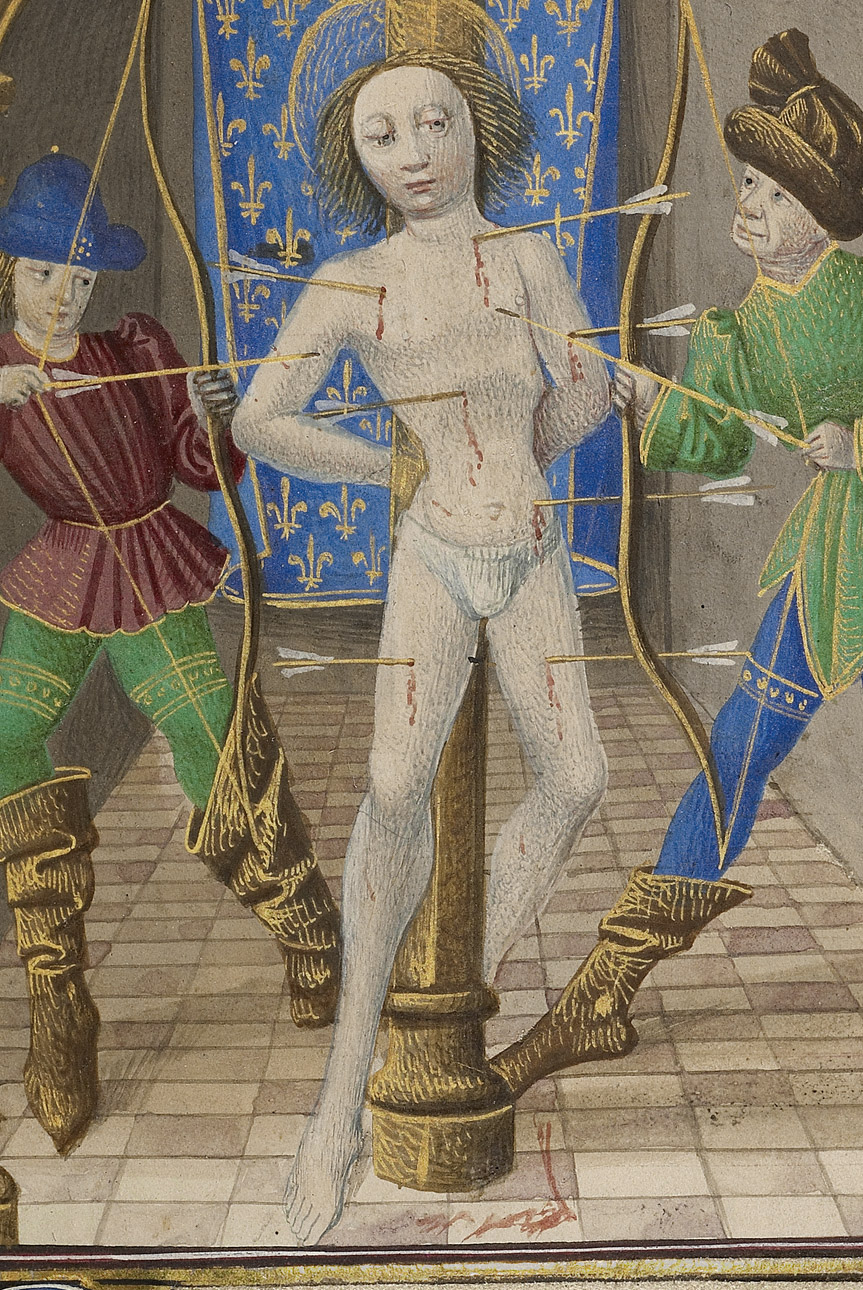
While I was already aware of how western art until roughly the XIXth century showed ancient historical events or biblical stories in an anachronichal way (such as romans wearing plate armor), or their extensive disregard of proportions, I always wondered why medieval art, especially in its earliest form, showed every character with a standard, smiling face instead of actual situation fitting expressions. This especially is flagrant when it comes to tortured biblical or historical characters, or battles where soldiers are butchered, which seems to endure any form of torture with perfect calm. Some instances :
http://blogs.getty.edu/iris/files/2013/09/gm_00403601.jpg
https://fr.wikipedia.org/wiki/Jeanne_d%27Arc#/media/File:Vigiles_du_roi_Charles_VII_10.jpg
https://s-media-cache-ak0.pinimg.com/236x/30/90/76/30907658a25d430642638dc55ec17f09.jpg
1 Answers 2015-06-20
1 Answers 2015-06-20
Athens faced slavery by the hands of the Spartans; yet were spared. What misery did they expect?
Rome enslaved most of the Macedonians (or a part at least) with the conquest of Macedonia.
Did the nobles barter? Did they run? Did it vary largely based on region?
I've read Corinth had at least 3 days forewarning before they were enslaved/subjected to loss.
What happens during a loss? How does all that operate?
Can Nobles who stayed behind appeal to their captors?
If all the nobles fled, what impression did that leave on the remaining force who was left defending? How did they react?
1 Answers 2015-06-20
I don't know too much about Scandinavia, but considering it's sparse population today with all our modern medicine and farming techniques I find this hard to believe. How could such a place be overpopulated so long in the past?
2 Answers 2015-06-20
1 Answers 2015-06-20
Boer families were treated terribly by the British during the war (concentration camps etc.). This coupled with earlier fighting with tribes must of influenced Afrikaner thinking?
1 Answers 2015-06-20
Specifically I'm wondering why the US didn't view Chinese intervention on the side of the Korean as an act of war.
1 Answers 2015-06-20
To me this is important, because you can't be a Roman Empire without being Roman, or rather, considering yourself Roman. I want to know. I know for sure that the Greek Byzantines considered themselves Roman, but I know of no others. I'd prefer to know of places where both the rulers and the populace considered themselves Roman, as I don't think the populace of the Holy Roman Empire considered themselves Roman.
1 Answers 2015-06-20
I was listening to the Beatles discography today and noticed how striking Indian cultural influence became in their music. As an American, it seems pretty random. Upon reflection, I realized England has a serious history with India, and it must have been a more sensible direction for an English band than an American band. Was India a popular tourist destination for Brits art the time?
2 Answers 2015-06-20