Previous weeks' Tuesday Trivias and the complete upcoming schedule.
Today’s trivia theme comes to us from /u/Banko!
It’s dinnertime again in AskHistorians. Today we’re looking for examples of things we no longer eat, either:
Next week on Tuesday Trivia: Some time periods seem to turn into misty legends more readily than others: King Arthur’s Knights, Samurai, Cowboys, they've all entered our culture in a major way as legend. But what’s the less glamorous side of these time periods? And why do some time periods get more Vaseline on the lens than others? These heady questions are yours for the exploring next week.
So this food is kind-of #2. It's a traditional Jewish food, but is almost forgotten. People still eat it occasionally, but the overwhelming majority of Jews don't even know of it, unlike foods people know about and don't eat (like chopped liver) or know about and eat, like gefilte fish, macaroons, babke, or matzah ball soup. It's even less known than, say, mandelbread.
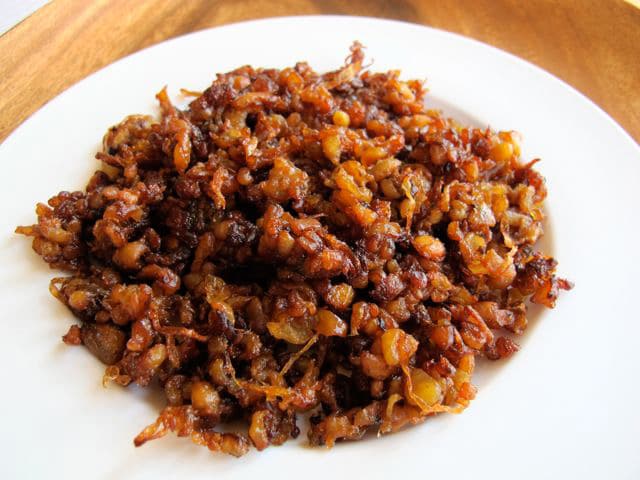
This obscure Jewish food is gribenes. What is gribenes you ask? Delicious, that's what. To explain what it is in context, you have to back up several steps, because while it's simple to make, exactly why you'd make it is kind of difficult to immediately figure out. If you want to save some time but be mildly confused and just find out what in the hell gribenes is, skip to the paragraph beginning "so gribenes is...".
Jewish law prohibits mixing of meat with milk. The problem that arises (besides good dessert after eating a meaty dinner) is how to avoid using butter. You need fat of some sort for many things, and margarine was invented fairly recently.
The solution is schmaltz. It's just chicken fat. It was used in place of butter (kind of like lard, actually) in many Jewish dishes. Its use has declined since the proliferation of margarine, but it still can optionally be used in many dishes. It's especially important in matzah balls, since the texture that results from using other kinds of fat isn't quite as good. You can still buy schmaltz if you know where to look.
But how do you make schmaltz? You take a whole bunch of chicken skin and fat, either that's your leftover from making chicken, or that you bought from the butcher. You then sautee this slowly with an onion, and collect the fat. It solidifies at room temperature, and boom, schmaltz.
But then you're left with bits of fat, onion, and chicken skin that didn't make quite make it into becoming schmaltz. What do you do with it? You certainly don't throw it out--money is tight, and throwing away perfectly good chicken skin would be wasteful. So these scraps become gribenes.
So gribenes is onion and chicken skin, fried in chicken fat. See what I mean when I said it's simple but confusing? Yeah. It's delicious. It will also take years off your life. But it's totally worth it. They look like this or this (that's the schmaltz on the left). The internet can't decide if it's the Jewish equivalent of bacon or pork rinds, but it looks to me like the latter.
Unfortunately, with the advent of margarine and the availability of purchased schmaltz for when it's occasionally needed, along with people not wanting to die of a heart attack at 50, this delicious dish has all but disappeared. But you can snack on it as an appetizer plain or on bread, or put it in another dish. The internet tells me it's sometimes used as a crunchy flavorful addition to chopped liver, or used in jambalaya in place of shrimp. Which I kinda wanna try now--chicken jambalaya with gribenes sounds delicious. But the traditional way to eat it is on bread. Remember, it's a Jewish dish, so it belongs on either challah or rye.
tl;dr chicken skin and onion fried in chicken fat. Mmmmmmmm
Not exactly lost or forgotten these days, but Dogfish Head Brewing Co. and Dr. Patrick McGovern have for many years been resurrecting ancient malt beverages from all over the world.
I think Garum/Liquamen would fall into catagory 2.
Aspic!
Aspic is, quite simply put, meat jello. Bone stocks (if prepared properly) contain enough gelatin to set up like a jello once cooled to room temperature. You can clarify the stock (basically remove all the bits and pieces that make it cloudy), add whatever filling you'd like (often meats or egg), and set it in a mold to cool. Once cool, the aspic is turned out and sliced and served.
Aspics were most recently "en vogue" as recently as the mid-20th century with America's jello/gelatin obsession, but you'd be hard pressed to find one anywhere outside of a classical French or modern molecular gastronomy restaurant. But next time you've got an extra turkey carcass or two...toss 'em in a pot, simmer for a good number of hours, and strain. Once it all cools...turkey jello! Eat it with a spoon and pretend you're a Parisian elite at the table of the great Marie-Antoine Carême
Huntley and Palmer's Biscuit Company, based in Reading, Berkshire, used to make "meat wafers." I never came across a recipe for it, but it sounds delicious! Category 1, maybe? I'm sure there'd be a huge market for them, if only H&P would revive production.
The bogs of Northern and Western Europe are a fascinating place. Their unique anaerobic conditions mean that we can find today what fell into the bog centuries and millenia ago. Furthermore it sems as if the bog always had an appeal to people, especially in the Bronze and Iron Ages. It seems to have had ritual significance in some cases and we sometimes find offerings and bog bodies (some of whom almost certainly were sacrificed (or at least violently killed) in the bog).
One of the weirdest things one can find in such bogs is a waxy, foul smelling substance deposited in baskets, skins or wooden containers. For a long time scholars did not know what these were but from the mid 20th century on chemical analyses showed that they were butter, chemically altered by the conditions in the bog. These deposits are known as bog butter.
It seems the butter was actually buried for storage but there have also been theories that it was primarily for taste. Personally I think it was originally a method of storing left-over butter that in time might have evolved into a specialty, which is a developement that can be observed with almost any foodstuff, e.g. cheese or bacon.
Modern experiments by the Nordic Food Lab have returned some interesting results:
In its time underground the butter did not go rancid, as one would expect butter of the same quality to do in a fridge over the same time. The organoleptic qualities of this product were too many surprising, causing disgust in some and enjoyment in others. The fat absorbs a considerable amount of flavor from its surroundings, gaining flavor notes which were described primarily as ‘animal’ or ‘gamey’, ‘moss’, ‘funky’, ‘pungent’, and ‘salami’. These characteristics are certainly far-flung from the creamy acidity of a freshly made cultured butter, but have been found useful in the kitchen especially with strong and pungent dishes, in a similar manner to aged ghee.
For those interested I recommend the whole article by the Nordic Food Lab and their work in general. On an interesting side-note they are part of a growing trend of local and hyperlocal haute cuisine that has risen in Scandinavia in the last few years (primarily through Noma) that emphasizes ingredients found indiginously in the Nordic countries and that is therefore probably closer to prehistoric cuisine in the region than anything eaten there in the last 500 years.
In my parents' time, in Madagascar, tiny beetles and grasshoppers seem to be common snacks. I don't know why they are not as widely eaten any more.
OK, the vagueness of this one makes it one of my favourite recipes from a collection of old Nova Scotian recipes. I don't know exactly when this tradition died out, but my mother recalls something similar with cake from birthday parties as a child and there's a very similar idea in French Canadian tradition involving a bean during La Fête des rois.
[Note from the book: Forach is a rich dessert traditionally served in Scottish homes on Hallowe'en]
Scotch Forach
Fine oatmeal
Whipping cream
Sugar
Take the amount of cream you think you will need and whip until stiff. Slowly stir in the oatmeal, adding enough to make the cream appear like sand. Add sugar to taste. Turn into a shallow pan and drop a wedding ring into the contents. The family and guests each take a spoon, and all eat from the same dish. The one receiving the wedding ring in his or her spoonful of forach will be the next one in the group to be married.
Dried salt cod is relatively hard to find in markets these days, at least in the Eastern U.S., but all of my older relatives remembered eating vast quantities of it back in the 1920s and 1930s...
Hardtack. Although my teeth really aren't up to it anymore, I have an odd fondness for the stuff, and from time to time bake my own. Granted there are many better ways of preserving bread for the long term that don't involve baking armor plating, but it has certainly vanished from common use.
In Hungary freshwater crabs were a common meal on fridays but as religious devotion declined so did boiled crabs. I have never eaten them in my entire life and have never met anyone who did.