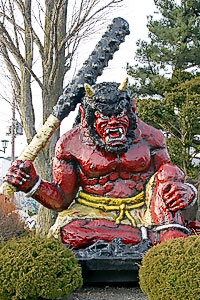
They left a major mark on Buddhist art. Buddha is still depicted with a giton and with curly hair based on the Indo-Greek sculptures. Buddhist depictions of Demons are based on Hercules. They are muscled, clad in skins and wield a club.
So I'd actually like to disentangle the question of 'realism' here, because otherwise we'd just be doing a laundry list of things we consider realistic and I'd just be making a list of classical Mayan portrait heads or something equally pointless. Now if you compare most Greek and Roman sculptures to most people, it becomes sort of obvious that they are pretty well idealized; that is they are carved to conform to a certain set of ideas of what the beautiful human body look like. Consider for example the Apollo Belverdere: http://upload.wikimedia.org/wikipedia/commons/e/e6/Belvedere_Apollo_Pio-Clementino_Inv1015.jpg This work has a long history of being considered one of the great examples of Greco-Roman statuary. However, if you try to mentally picture it as a real person it becomes that such a person would look rather...unusual if you were to meet them. And renaissance treatises on painting highlight this idealization; Alberti for example quotes Pliny in describing approvingly the sculptor who takes the best part of each body he sees and combines them to create the image of perfect beauty. The reason these sculptures are so often held up as realistic is less because they are "Objectively realistic" but rather because they conform more to our habits of visual discrimination and thought; we are more attuned to the canons of a Greek sculpture than a Chinese painting out of visual habit and they therefore seem more natural to us. Japanese accounts of Western perspectival paintings are especially interesting in this regard. Shiba Kokan, writing a treatise defending western painting, wrote that they were quiet comprehensible provided that you made sure to hang them at approximately eye level and stand in front of them from a certain distance, in which case objects would clearly recede according to their distance. That he felt the need to spell out this kind of art-viewing behavior(very different from the way one might sit down and unroll say a long scroll) suggests a great deal about how our throughly we must be trained to 'read' Western art even if it is not intentional training. Or as Michael Baxandall put it in _Painting and Experience in Fifteenth Century Italy:
Much of what we call “taste” lies in this, the conformity between discriminations demanded by a painting and skills of discrimination possessed by the beholder
Related to this is the question of complexity you pose. Now once of the things you learn studying any non-western artistic form is that less realistic art is not any less complex. Consider for example Mi Youren's Cloudly Mountains: http://www.metmuseum.org/Collections/search-the-collections/40007?rpp=20&pg=1&ao=on&ft=mi+fu&pos=4#fullscreen
Now this is not a "realistic" painting, but it is still exceedingly complex. First, if we examine the handing of the ink it is clear that the artist has taken significant care to make his brushstrokes as light and non-linear as possible, and a contemporary Chinese scholar would have been far more attentive to that subtle handling of the brush than we might. Different artists might be heavier or lighter or more or less linear with their brushwork, or perhaps vary their brushwork to express a particular mood or season. We might also note the careful way in which the lower half of the mountain is less distinctly painted than the upper half, to express the sensation or feeling of a low fog. In fact, the lightness and insubstantiality of Mi Youren's painting would even have been seen as especially suited to a painting as light and insubstantial a thing as clouds. All of these require very subtle habits of visual discrimination and the ability to pay attention to certain artistic habits not typically valued very highly in the western tradition outside of a few specialized kinds of art like drawing.
Sculptures from ancient Egypt and the Near East did strive for realism. The most famous example of Egyptian sculpture, the Bust of Nefertiti picture, was made in the 14th century BC under the reign of Akhenaten. The bust shows that the Egyptians did have some understanding of sculpting naturalistic facial proportions. In East Asia, the Terracotta Army sculptures of the Qin Dynasty (3rd century BC) are also considered realistic. However, realistic sculptures have not been found prior to the Qin Dynasty and disappeared in China for centuries after the Qin collapsed.