Here's the post, and here's the picture. Many commentors have expressed understandable skepticism about the possibility of its really being from the 5th century. Are they right? If so, when is it actually from?
I'm an ancient coin and artifacts dealer. I do not like dealing in Byzantine iconography, because they are so easy to fake, and the fakes are really good.
One thing is for certain, this is not 5th century. The crosses on the left and right edges didn't develop into this style till later. The Chi-rho was used primarily, and the crosses looked more like an x when it was used.
This is really all I can say for now. It's too difficult to tell without actually having the piece in hand to investigate.
I'm not claiming to be an expert in Byzantine iconography (I specialize more in military history, society, and government), but I'll provide what I know to try and verify/debunk the claim.
To start I will say that I do not believe that this is a work that originated in the 400s AD. There are several reasons for this which I will elaborate on below.
First, paintings from that era (c. AD 400) of Roman/Byzantine history are incredibly rare. With the many challenges faced by the Western Roman government following the death of Theodosius I, the Eastern Roman government tried its best to prop up the West by sending vast amounts of supplies, military support, and money. This likely had the effect of reducing the productive output of artistic studios in the East, just as had occurred a few centuries later during the Arab Invasions of the 7th Century (which is often called the "Byzantine Dark Ages", partially due to the lack of literature and art that emerges from that era). There was a brief resurgance during the time of Anastasius I, Justin, and Justinian I (roughly AD 490-530), however, with the Gothic Wars, and the strange "slanted light" droughts of AD 535 and 536, artistic work seems to have declined. Most of the art that we do have is in the form of mosaics, diptychs, and the occasional statue - and this can be observed by the lack of quality images of the Emperors when you research this period. Only Justinian I, with his grand visage preserved at San Vitale, is truly memorable.
Second, the Iconoclast policies of the Isaurian Emperors that began in the 8th Century succeeded in destroying a great deal of iconographic works dating from Late Antiquity. They believed that the old icons were an improper way of venerating God, and so permitted only simple symbology in churches, such as the Chi-Rho or the Cross, over elaborate and "vain" icons of the past. This perhaps partially explains why we have so few Byzantine icons that date from before the year AD 850 or so - because so many of them were destroyed or defaced.
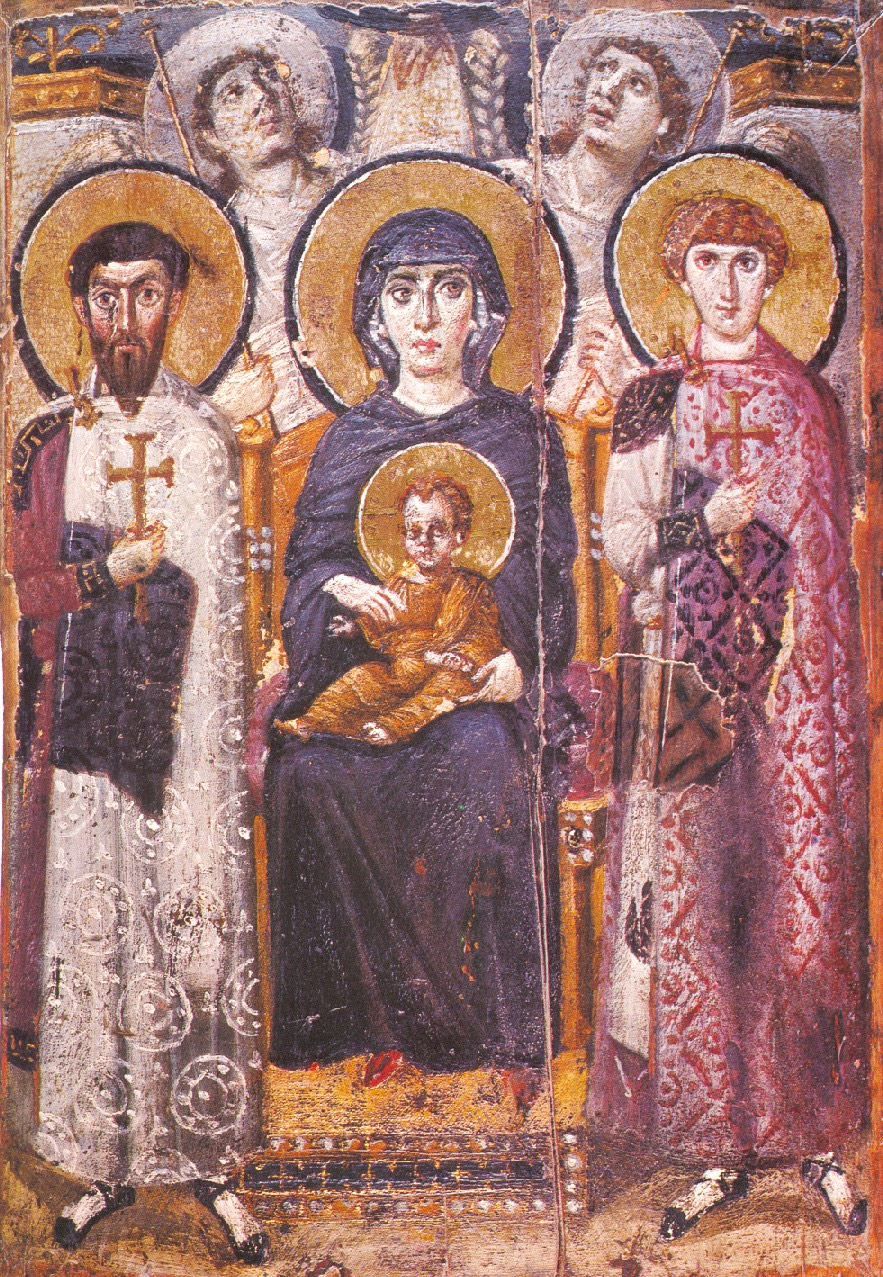
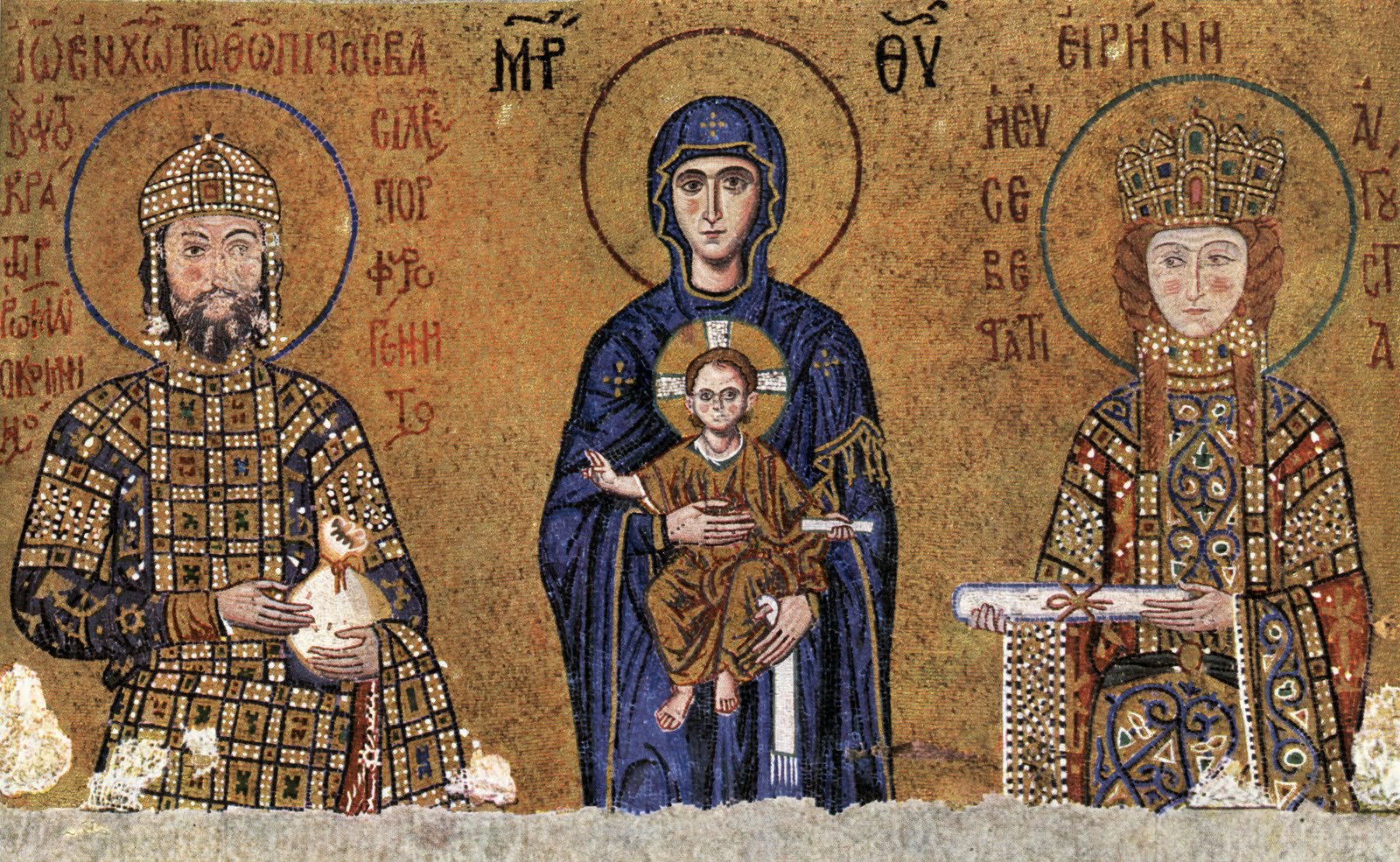
Third, the styling of the icon is not consistent with known works that date from Romano-Byzantine Late Antiquity. In general, these works are characterized by realistic portayals, such as the Christ Pantokrator icon at Mount Sinai, which dates from around the time of Justinian (AD 550). Further examples such as this icon of Mary dating from around AD 600, possess a certain realism, and a certain amount of depth. Even depictions from Middle Byzantium, such as the miniatures in the Skylitzes Chronicle, this miniature of Nikephoros II Phokas and the mosaics of Constantine IX Monomachos and John II Komnenos/Empress Eirene, while beginning to exhibit a certain flatness, also possess a lot of features of realism that the old Late Roman ones do.
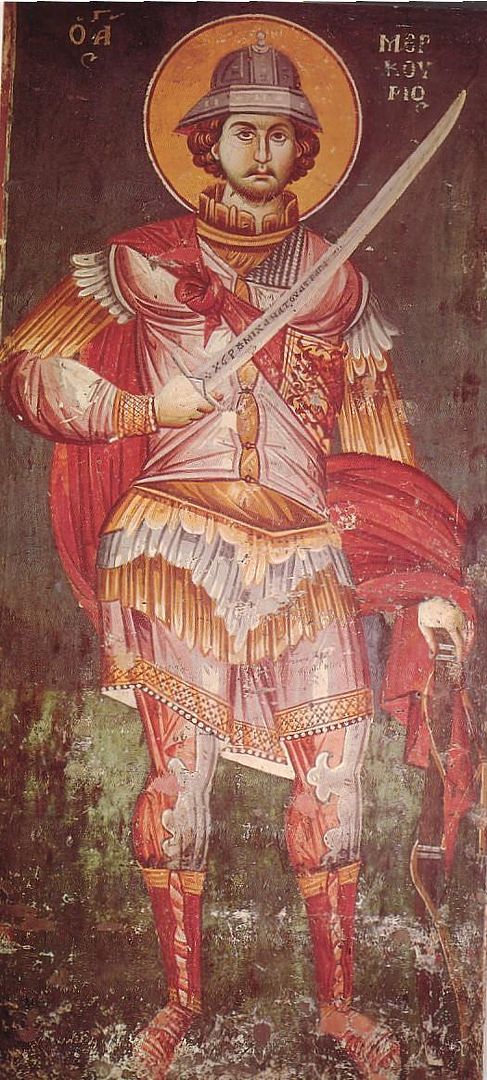
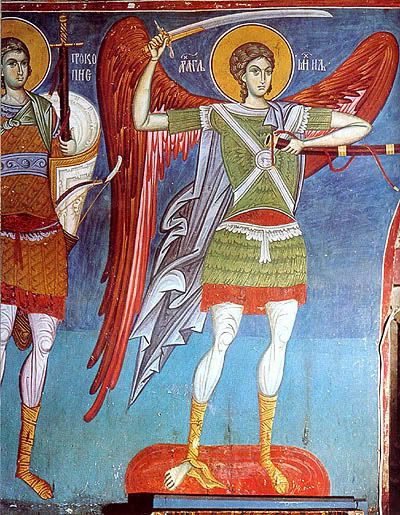
As the years go on, with the fall of Constantinople to the Latins during the Fourth Crusade in AD 1204 and the subsequent recapture of the ruined city by Michael VIII Palaiologos in AD 1261, art in Byzantium begins to change drastically (although, it could be argued that this began during the later years of the Komnenian restoration). Palaiologan art builds up the flatness of the previous depictions, but also adopts a very smooth, and dark shading and combines it with often surprisingly colorful palette choices. This kind of work is what dominates both Slavic and proper Byzantine iconography from the late 1200s and leading up until even the present day. Some great examples can be seen in this transition work dating from the late 1200s, as well as this one of Michael the Archangel from a Serbian church dating from the 1400s. The image of the Theotokos, in this distinctive style, also begins to emerge around the same time (c. 1250-1400).
The mystery icon that was posted on /r/pics exhibits a lot of the "flatness" and dark shading that characterized Late Byzantine (or Palaiologan) art. I would say, using this evidence, the work in question cannot be older than approximately AD 1250.
This isn't going to be in depth, but this is a few points to consider. The points don't make the answer a hard "no" necessarily. But I think they definitely bring this claim out of the area of "plausibility".
The official language of the Empire (military and administration) wasn't Greek until the 600's. Official adoption of Christianity and proscription of other religions also didn't occur until after this piece would have been made. So that right there makes me skeptical that this could be any older then 1400 years old.
Now this is not to say it isn't possible, Greek was the language of the people long before Heraclius made Greek the official language. But lets think about this, how likely is it that an icon such as this would have been owned by a common person, and then survived to the modern era in such a state? Such an icon would have belonged to someone that spoke Latin (and hence we would see Latin used in the icon), one of the "upper class" to use an anachronism. Which brings me to the next point.
I'm almost certain there are no known icons from before the 6th century, which means this man is basically claiming to own the oldest known extant icon on Earth. Also, icons weren't really a thing until the 6th century, and even the apocryphal stories about them say they started as an art in the 6th century. So this claim of being 1600 years old is suspect, very much so. It is probably not older then 1400 years old, and likely isn't anywhere near that old at all.
Hopefully we get an art historian in here that can speak more authoritatively on this subject.