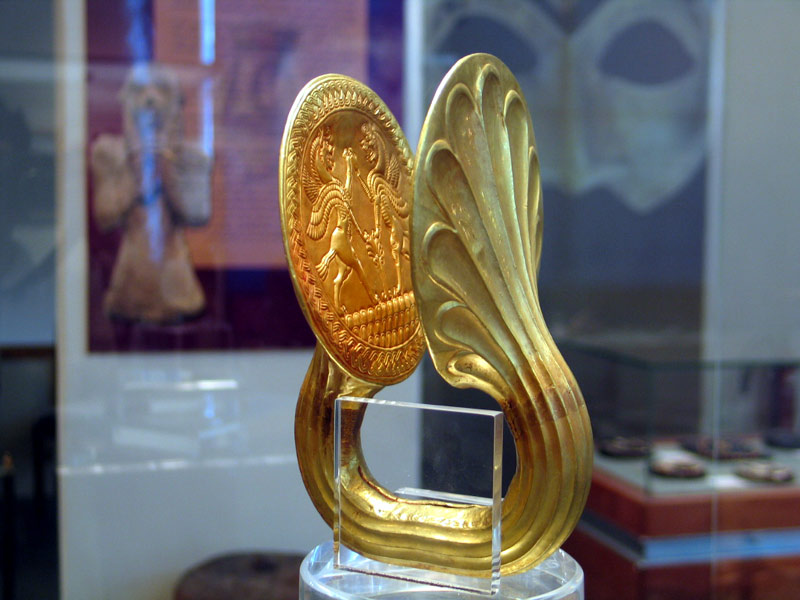
Ah, this is a very interesting question! I should say at the outset that this would make an excellent topic for a research paper, so obviously a full answer is outside the scope of Reddit, but we can certainly make some useful points about the griffin in Iranian art. The griffin actually predates Achaemenian Iran and can be found in older Elamite art; probably the most famous example of the griffin in Elamite art is the [Arjan Ring] (http://seeiran.ir/wp-content/uploads/2014/01/%D8%A7%D8%B1%D8%AC%D8%A7%D9%86-12.jpg), which bears comparison both to Neo-Assyrian art(compare for example the Arjan ring's griffins to[this] (http://www.aakkl.helsinki.fi/melammu/database/images/orninurta.jpg) carving of Anzud being chased by Ninurta at the entrance to the Ninurta Temple of Nimrud, and older Elamite art. Interestingly, it is possible that both the Mesopotamian and Elamite griffins were related to weather gods, Ninurta in Mesopotamia and Inšušiak in Elam. In other words, the griffin is part of a larger artistic vocabulary that spans the Near East in the first millenium. In either case, the meaning in the Assyrian and perhaps Elamite context is mixed; on the one hand we have the griffin as the image of the demonic Anzud bird that Ninurta fights, on the other hand we have the griffin as a protective guardian, an atropaic(that is, evil-repelling) figure. These are not so far apart, of course, given the quite common impulse in many cultures to domesticate demons and evil forces by putting them into protective roles. That after all is precisely what a gargoyle is. So even before the Achaemenids, griffins already had quite potent symbolic associations.
Turning to the Achaemenid context, we see griffin imagery in a fair range of contexts. In the collection of sealings found on cuneiform tablets from Persepolis, the griffin is found as both an independent subject and as part of a type of combat called the "Master of beasts", in which a hero is shown in control of a beast or pair of beasts. This scene also has much older antecedents and in fact the "Master of beasts" is one of the oldest themes found in Mesopotamian seals. In the Achamenian context, the king is sometimes show as this hero and is shown fighting griffins. The other context in which we see griffin imagery is the reliefs at Persepolis, and in particular[a kind of relief] (https://oi.uchicago.edu/gallery/pa_iran_paai_per_pd/index.php/3E11_72dpi.png?action=big&size=original) a kind of relief found on door-jambs in which the king is shown stabbing a griffin, lion, or other monster. In addition we also find griffins as a more marginal architectural feature in the form of capitals. What these uses of the griffin in sealings and relief to me suggest is that the same duality exists. On the one hand, the griffin can be used as a guardian or protective figure, but on the other hand it can be made into a symbol of evil and chaos in conflict with the good king, a visual embodiment of everything that the Great King is obligated to drive out from the land. As Darius I put it in his inscriptions at Persepolis:
Darius the King says: If you shall think thus, "May I not feel fear of (any) other," protect this Persian people; if the Persian people shall be protected, thereafter for the longest while happiness unbroken -- this will by Ahura come down upon this royal house.
And at Behistun:
Darius the King says: For this reason Ahuramazda bore aid, and the other gods who are, because I was not hostile, I was not a Lie-follower, I was not a doer of wrong -- neither I nor my family. According to righteousness I conducted myself. Neither to the weak nor to the powerful did I do wrong. The man who cooperated with my house, him I rewarded well; whoso did injury, him I punished well. Darius the King says: You who shall be king hereafter, the man who shall be a Lie-follower or who shall be a doer of wrong -- to them do not be a friend, (but) punish them well.
In this role the griffin is also a sort of foil to the king's physical strength. The Achaemenian royal inscriptions stress the physical hardiness of the king:
Trained am I both with hands and with feet. As a horseman I am a good horseman. As a bowman I am a good bowman both afoot and on horseback. As a spearman I am a good spear-man both afoot and on horseback.
And the (physical) skillfulnesses which Ahuramazda has bestowed upon me and I have had the strength to use them -- by the favor of Ahuramazda what has been done by me, I have done with these skillfulnesses which Ahuramazda has bestowed upon me.
(Darius, Naqsh-i-Rustam(DNb))
And by being shown in the process of being defeated by the king, the griffin highlights the king's strength; even this powerful mythical beast is helpless before the king.
Unfortunately, I'm not familiar enough with the later Iranian empires like the Parthians or the Sassanians to discuss the significance of the griffin to them, but it's worth noting that the griffin remains popular in Parthian and Sassanian art(See for example [this Sasanian stamp seal in the Brooklyn Museum] (http://www.brooklynmuseum.org/opencollection/objects/101595/Stamp_Seal%3A_Recumbent_Griffin))and remains popular into the Islamic period, as the example of the Pisa Griffin attests. Sources and Further reading:
Javier Alvarez-Mon, The Arjan Tomb: At The Crossroads between the Elamite and Persian Empires
Mark Garrison, Seals on the Persepolis Fortification Tablets, vol. 1: Images of Heroic Encounter and Seal Workshops and Artists in Persepolis: A Study of Seal Impressions preserving the theme of heroic encounter on the Persepolis Fortification and Treasury Tablets.
EDIT: Made some of the link formatting look nicer. Margaret Cool Root, The King and Kingship in Achaemenid Art