Today:
You know the drill: this is the thread for all your history-related outpourings that are not necessarily questions. Minor questions that you feel don't need or merit their own threads are welcome too. Discovered a great new book, documentary, article or blog? Has your Ph.D. application been successful? Have you made an archaeological discovery in your back yard? Did you find an anecdote about the Doge of Venice telling a joke to Michel Foucault? Tell us all about it.
As usual, moderation in this thread will be relatively non-existent -- jokes, anecdotes and light-hearted banter are welcome.
Yesterday this photographed was posted, and with it came a lot of misinformation. Some people thought it was colorized, and most people couldn't really believe it was from 1911, which I can understand, by all means! It's quite mind boggling looking at Gorskii's photographs, and his collection of over 2,000 negatives are something to simply just adore, and thankfully the Library of Congress has archived most of them by now.
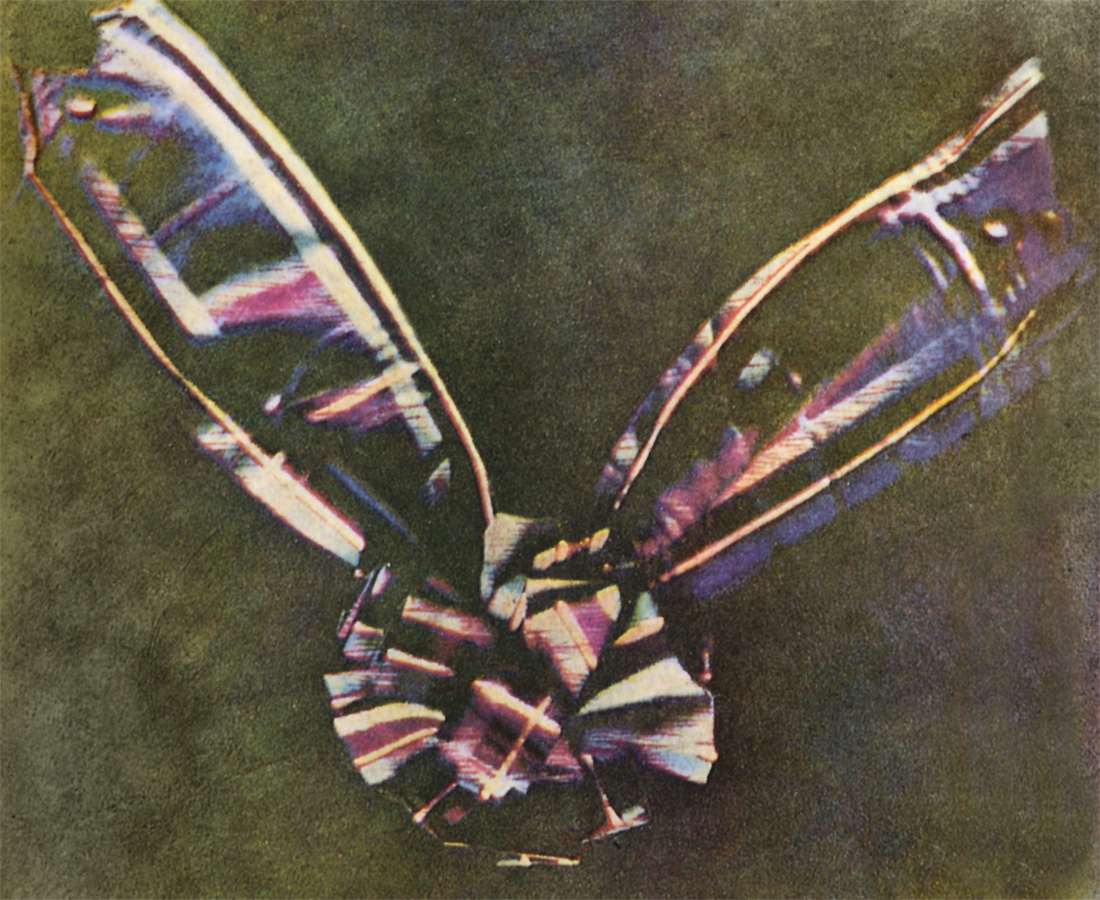
However, what most people don't know about are the early annals of color photography. Gorskii used the three-color process that was theorized by Scottish physicist James Clerk Maxwell in 1855, and carried out by Thomas Sutton in 1861. This tartan ribbon was the source of the experiment that Sutton chose, and it worked out brilliantly! There's been prior experiments with color photography, specifically those carried out by Levi Hill in upstate New York, this was called the 'Hillotype', aptly named for old Levi himself. These have been the source of much discussion, and I can't definitively comment on whether or not Hill was able to reproduce color already back in 1855, since dyes have been found on the plates, but it's still a very interesting matter nonetheless! Moving along...
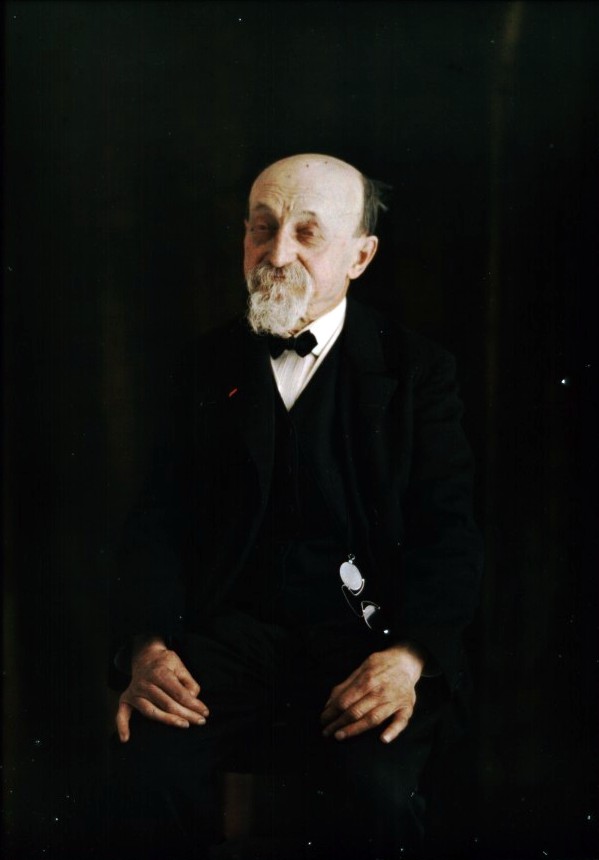
People forget the photographs taken prior to Gorskii's massive collection. Gorskii's first trip was undertaken in 1909, and his second occurred in 1911 - both of which were funded by Tsar Nicholas II. In 1868, some 40 years prior to Gorskii's adventures, a man named Louis Ducos du Hauron had patented a method for photograping in subtractive color, and in 1869, he published his works. The photograph linked of Hauron is actually taken by the Lumière brothers, the 2 brothers who invented the single-exposure color photography method, they were helped along quite a bit by Hauron.
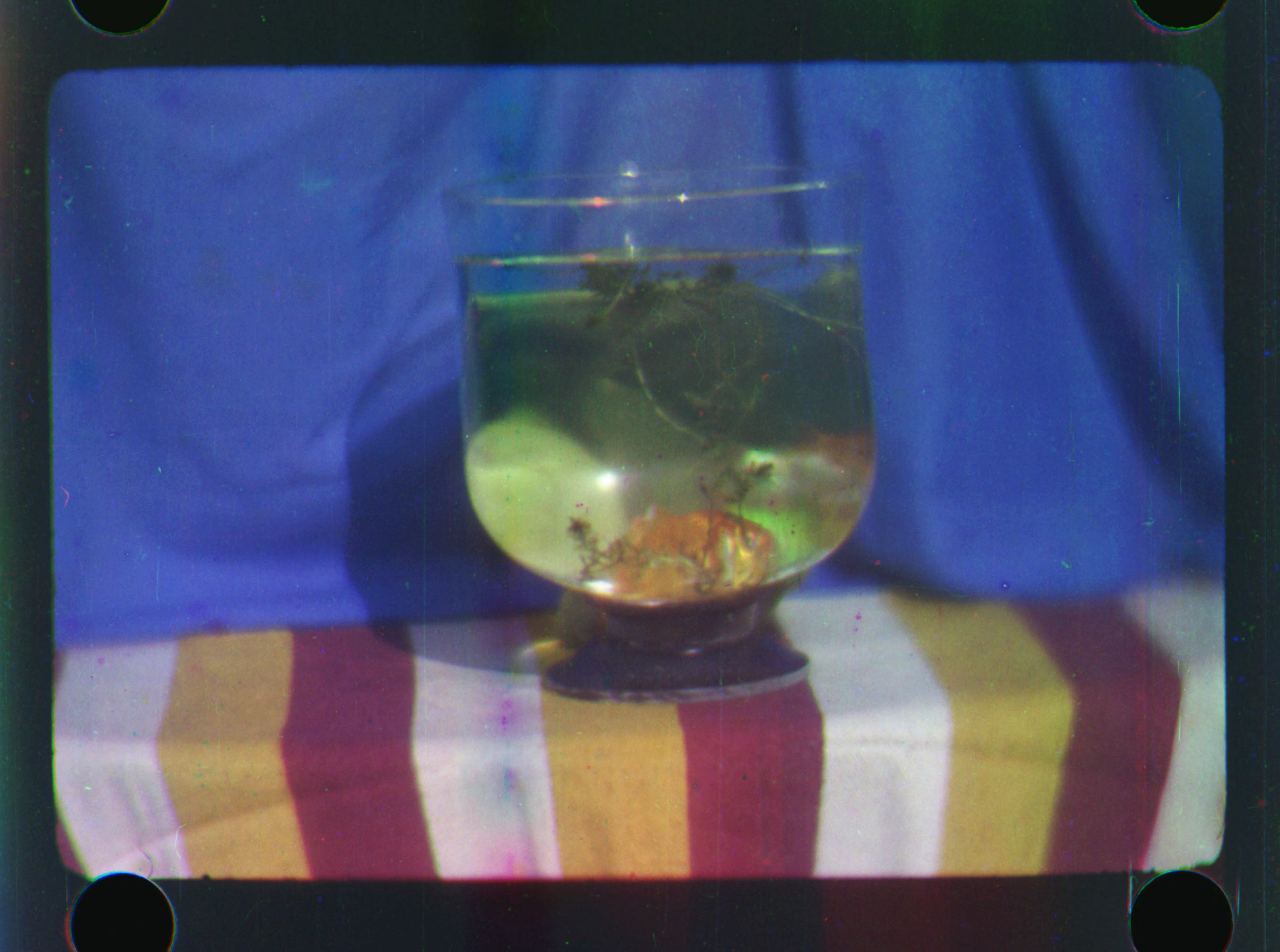
Hauron's earliest photograph is this 'Still Life with Rooster' which supposedly dates to 1869 (It's also pinned to 1879) is one of the earliest examples of (viable) color photography we have. This is a view of Agen, France, in 1877 - an absolutely mindblowing little shot from so long ago. Hauron's process was overshadowed by the later accomplishments of the Lumière brothers, who not only had several processes patented inside the world of cinema, but also invented the dryplate, which was necessary for their process of single-exposure color photography. What's also funny is that in 1902, Edward Raymond Turner invented a three-color process for a video camera (Still from a 1902 video) - which means we had color film in 1902. Although, what all these processes shared, was a similar burden. Each and every single process not only needed 3 different exposures for the 3 colors, but they also needed a similarly engineered projector to properly display all the color through one channel. When the Lumière brothers patented their process in 1903 (But didn't market it until 1907), they introduced something entirely revolutionary, as mentioned earlier - an affordable (Although not compared to B/W photography still, but comparable!) color photography with just a single exposure. No special equipment needed to display proper color, no especially commissioned/self built camera, just the same old style as the photographers of the 1860s.
The reason for this post is to really bring attention to the Autochrome Lumière. Since it was so easy to use, and so readily available, they were so much more personal, and it's why I have such a love for them. You could buy them as a comfortable middle class family and capture your personal life in color from 1907 and onwards, 2 years before Gorskii went on his venture. The only difference between Gorskii and the Autochrome Lumière, is that Gorskii's photographs are enhanced due to modern processes, and the Lumière was exposed on a single plate, rendering the same process unusuable in this occasion, sadly. I'll link some example of an Autochrome Lumière in use. Some are famous individuals (Mark Twain for one), others are of Swedish landscapes, some are of Germany, and most are from France since Albert Kahn (The famous banker who decided to capture the world in color in 1920, and captured more than 20,000 photographs) has the primary source for most of these, while the other primary part are simply candid family/friends moments (There's a lot by the way), and the often uncredited Paul Castelnau are to thank for the bulk of the WWI photographs. There's even a shot of the Lumière brothers with Louis knitting, and another one of Auguste in a WWI uniform, and last but not least, a shot of General Antoine - Remember, these aren't the highest quality unfortunately, as most Autochrome plates lie in different archives (The National Geographic archives houses 14,000 of their own plates for instance), with different restrictions -
Massive imgur gallery, 150 images in total
In closing, while I love Gorskii's photographs to death, I still prefer the Autochrome. They had a very very distinct feel, and they just feel so God damn personal. Gorskii's photographs are of landscapes and posed individuals, like the olden times, and they don't feel as personal as a couple of college students photographed in a lounge, or a wife and her husband standing by a lake, or a smiling woman from 1910. I love the Autochromes, and I have a huge collection saved (Unfortunately not physical), and every now and again I take a trip down memory lane. If you wish to have more information on each photograph, feel free to ask and I'll update the Imgur descriptions. I also have a video that details a few earlier pioneers in color photography, like Adolf Miethe - it's focused more on the general history rather than color photography. If you'd like to know more about how the Lumière brothers managed their inventions, I'd love to go in-depth on that, too, as it's quite an ingenious invention!
Edit: Here's a collection of 45 Autochromes that I particularly like myself, and most are in high resolution and quality. A few aren't up to date, one being the French officers, and the French soldier eating lunch, as the latter is part of a series of photographs. - also it seems the gallery is malfunctioning, fun!
I spent a lot of time talking to a friend from grad school the other day. We ended up rehashing very bad jokes.
Historians love political scientists -- their errors give us something to write about.
If I had a dollar for each time an economist correctly predicted the future, I'd have a couple of dollars.
Someone asked a question about what distinguishes a "saber" from a "scimitar," but then seems to have deleted their account before I could post an answer. I don't want to feel like I wasted the effort to write it, so I'll post my reply here.
The main distinction between the words saber and scimitar is that "scimitar" implies that a sword is from the Middle East. Saber is a general term for what are usually single-edged, curved blades. When people say "scimitars," they're most likely referring to the same general variety of swords. There’s no technical distinction between a "scimitar" and a "saber." Middle Eastern weaponry isn't something I've studied extensively, but I rarely see the word scimitar except in older academic literature. More recent writing seems to just use "saber," perhaps out of an effort to avoid the dilemmas of the term.
Sword typology in general is a notoriously difficult subject. Part of the problem is that these typologies we attempt to create are inherently projections placed onto the past and often have little connection to what historical cultures thought about their weapons. For example, the Arabic word saif simply means "sword," but that hasn't stopped some people from claiming that the word saif refers exclusively to curved swords. This ignores the fact that Arabic authors would simply have used saif for any type of sword, and then attached a descriptive phrase to the word. For example, one writer in the mid-9th century referred to a curved single edged blade as a sayf al sughdi, or "Sughdian sword," in reference to the Sogdian people of Central Asia. It's best to think of the different varieties of swords as extremely broad types rather than ultra-specific and exclusive categories.
Random question sparked by talking with the staff at a local eatery in a building that was once one of the oldest continually used prisons in the U.S. ...
Is the link between "old stuff" and perceived supernatural activity/hauntings an American thing? There seems to be a lay tendency to link anything old (here defined as >100 years) with ghosts, ghouls, and all manner of spooky things. Is this just a U.S. tradition, or do other cultures associate old buildings with a dodgy past to wandering souls?
I stumbled on a blog about sword-and-sandle movies and read an article on "beefcakes" in these films that was humorous and completely accurate. Seriously, what is up with genre films and shirtless, muscle bound men? Why was the mid century zeitgeist full of hunks?
Just wanted to say that netflix now has a ton of smithsonian channel programs about WWII, and they are pretty good.
I have a less conventional question. I have been thinking of getting a dog lately, but am concerned that it would have a negative impact upon my postgrad studies. I'd be curious as to hearing experiences from those who have had pets while working on their postgrad degrees.
Based on some fascinating duelling stories people posted here by /u/Georgy_K_Zhukov and /u/caffarelli, I've had it in the back of my mind to read up on that topic. So I was delighted to spot a second hand copy of "Pistols At Dawn: A history of duelling" by Richard Hopton last week.
The book is a fun read, there are loads of first hand quotes and stories about duels and it's sort of logically organised, starting out with the components of a duel (challenge, seconds, etc.), then going more into the history of duelling, and finally moving on to the weaponry.
It's not going very deep, but it's a great introduction. If I have to list a gripe, I'd say that the book is very much focussed on France and the United Kingdom, with a lesser focus on Germany and Russia. Italy is practically not mentioned at all, which is odd since it's clearly pointed out as the source of the formal duel at the start of the book.
Still, it's worth reading if only for all the duel descriptions.
Just had a job interview with a school that wanted to "test" my knowledge of history (because 14 years of teaching experience is not enough). They asked all these obscure questions about WWII. I know there's a fascination in the US with that war, I get it...but where did this idea that if you don't know everything about WWII, you don't know anything come from? Why is it still the only thing that so many want to study? Will it ever end? I'm frustrated.
I missed James McPherson's AMA today (damn you, gainful employment!), but I would like to express my thanks to the mods and whoever else helped make that happen. It was a really interesting thread to read through.
Today was a great day. I attended the farewell party for the Alaska State Museum, which is closing today and being demolished in favor of a new state library/archives/museum (it's actually named the SLAM) that's more than three times bigger.
That line about the Doge of Venice and Michel Foucault made me remember a sentence I read a few weeks ago in an article by Cornelius Holtorf, and that really made my day:
"To paraphrase Douglas Adams, it would be the answer to the question of the meaning of the thing in the universe."
There is just nothing quite like finding a quote to a book like The Hitchhiker's Guide to the Galaxy in an academic text.
This really belongs in Theory Thursday, but it popped into my head walking to campus and oh well, here goes: I've been reading Harmansah's Cities and The Shaping of Memory in the Ancient Near East and Lincoln's Happiness for Mankind and am intrigued by how interested both of these seem in pushing back against "imperial" histories, Harmansah by suggesting that the late bronze age and early iron age be understood as a period of decolonization rather than decline and Lincoln by specifically studying Achaemenid royal ideology as an imperial project, and a way of handling the least savory aspects of imperium, and comparing it to other empires. Does this mean we are now looking at postcolonial approaches to antiquity? Is this a good thing? I think it may or may not be.
Wait, did the Doge of Venice tell a joke to Michel Foucault?
That would be pretty interesting as there's a 200 year gap between Michel's birth and the last Doge of Venice...
Well played dear moderator, well played.
But in all seriousness, my question is if there's anywhere I can read about Maritime trade. Any time period would be alright with me, but the earlier in history the better.
I was looking to snag a book on the Golden Age of Piracy, and picked up "Raiders and Rebels" by Frank Sherry, and I want to know if anyone has read it and if so what they think of it.
I had another prof. this week tell me that I should do grad school. The idea scares the shit out of me, not only because I don't have the GPA to even apply, but also what the he'll would I do with a Masters in Political Studies?
I know nothing about grad school, but yet my entire life really revolves around me getting into grad school. Whether that be Law or Political Studies/Policy.
How do you apply for grad school? What do you do I'm grad school? I know nothing about it.
Also! Finally a question about Louis Riel! But, it was about how he is taught in grade school in Canada, so I didn't answer in depth. Which led me to thinking, I know the narratives on Riel, but how did the people of the frontier , the people he essentially represented, view him?
So new pet project for whenever I have time I guess.
Can anyone tell me where the actual painting of Makovsky's the Bulgarian Matyress is located? I became interested in Makovsky after seeing the Russian Bride Attire at the Legion of Honors in SF.
Thanks in advance.