This is an interesting question. I don't have an answer for you, but perhaps can shed some light on the issue.
TL;DR: T-72 and T-90 have a crew of 3. Compare the M1 Abrams crew of 4. They could get away with a smaller turret.
The tank turret is a classic example of several competing requirements like armor, production cost, crew safety, gun etc are traded off, resulting in a compromise where one or two are favored, but not so much as to make others really bad. This is very common in engineering. A tank turret is one of the busiest places on the battlefield, and tradeoffs on how many crew to include are particularly difficult. The primary goals are to enhance survivability and effectiveness, but other minor goals count too. One summary is that the Soviets optimised different things.
Before getting into details, it is worth noting that reactive armor was first proposed by a Soviet designer. They did not pursue it right away, but did later.
Adding on to this, why is everything Soviet portrayed as round while Western is seen as angular? Did this come out of the Cold War or earlier?
Wikipedia tells me that the first widespread use of composite armor was the Soviet T-4. I don't know if they ever had access to Chobham armor.
My guess you've meant T-64. There were no T-4 in USSR official designation. While USA experimented with composite armor in 60s, none of those experiments got to production until M1 Abrams.
T-64 was adopted as MBT and in full-scale production by 1964. In USSR this type of armor was called "combined" or "multi-layered". Chobham armor was developed and deployed much later. Therefore I doubt soviet type of composite armor and Chobham is in any way related. Since exact construction of Chobham tiles is a secret, it is difficult to compare it 1:1 with T-64 armor anyway. Note that T-64 wasn't exported (not until USSR dissolution) and T-72 is simplified and cheaper version of T-64. Well, roughly speaking - at least engine and mechanically.
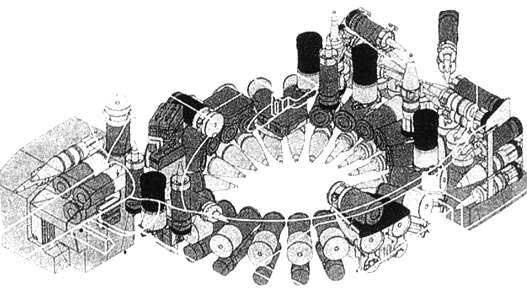
Main design principle for soviet tank constructors was to lower effective profile. On one hand, this improves survival rate (on paper at least - it's harder to hit low-profile tank), on another - it led to cramped quarters inside the tank. Huge issue for all soviet tanks is placement of ammunition - it is not separated from crew by fireproof wall. So in real combat detonation of ammunition with total loss of crew happened too often, as cramped spaces does not facilitate quick evacuation in case of fire either.
T-72 is fast, reliable and cheap. But it also more likely to be destroyed beyond repair after penetration and provides less comfort to crew in comparison to western tanks.
Sources
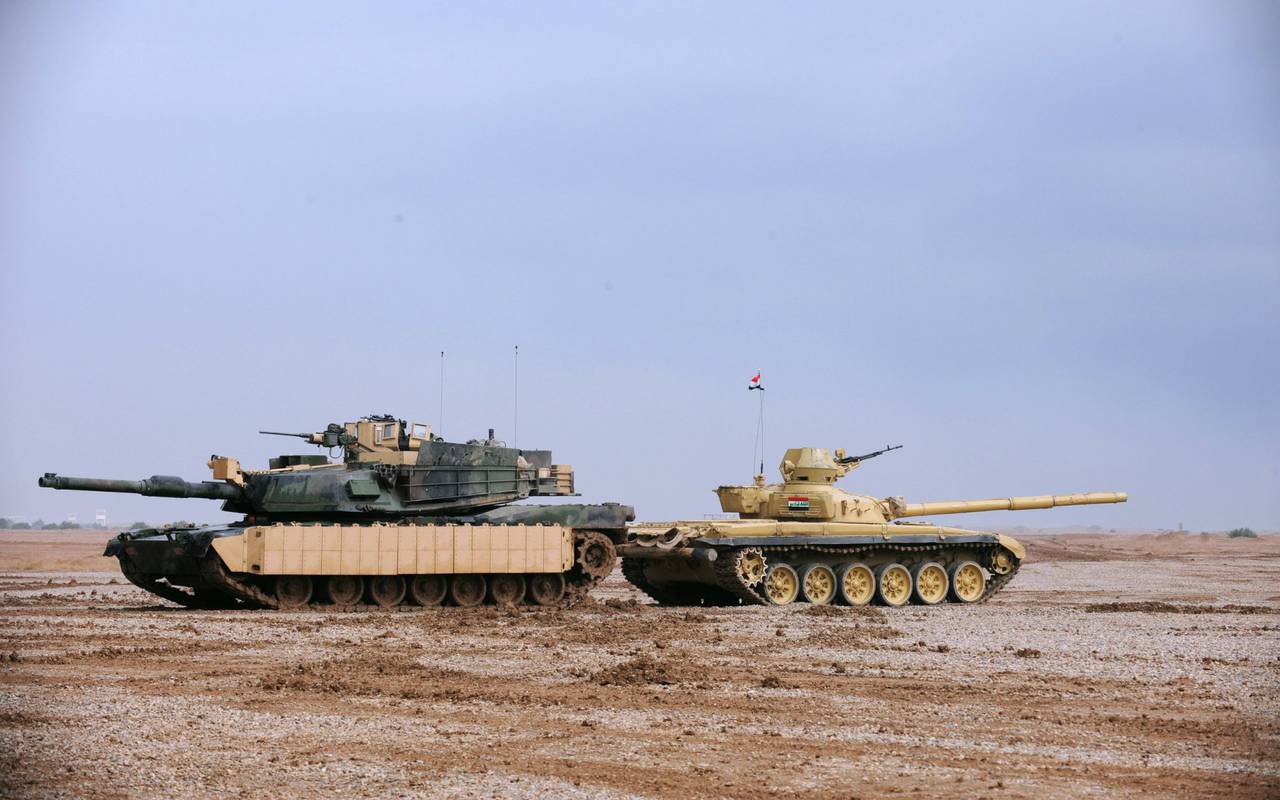
Photo - T-72 and M1 Abrams. Note how much lower T-72 is.
Scheme - T-72 ammunition placement. Note how ammunition is all around the turret.
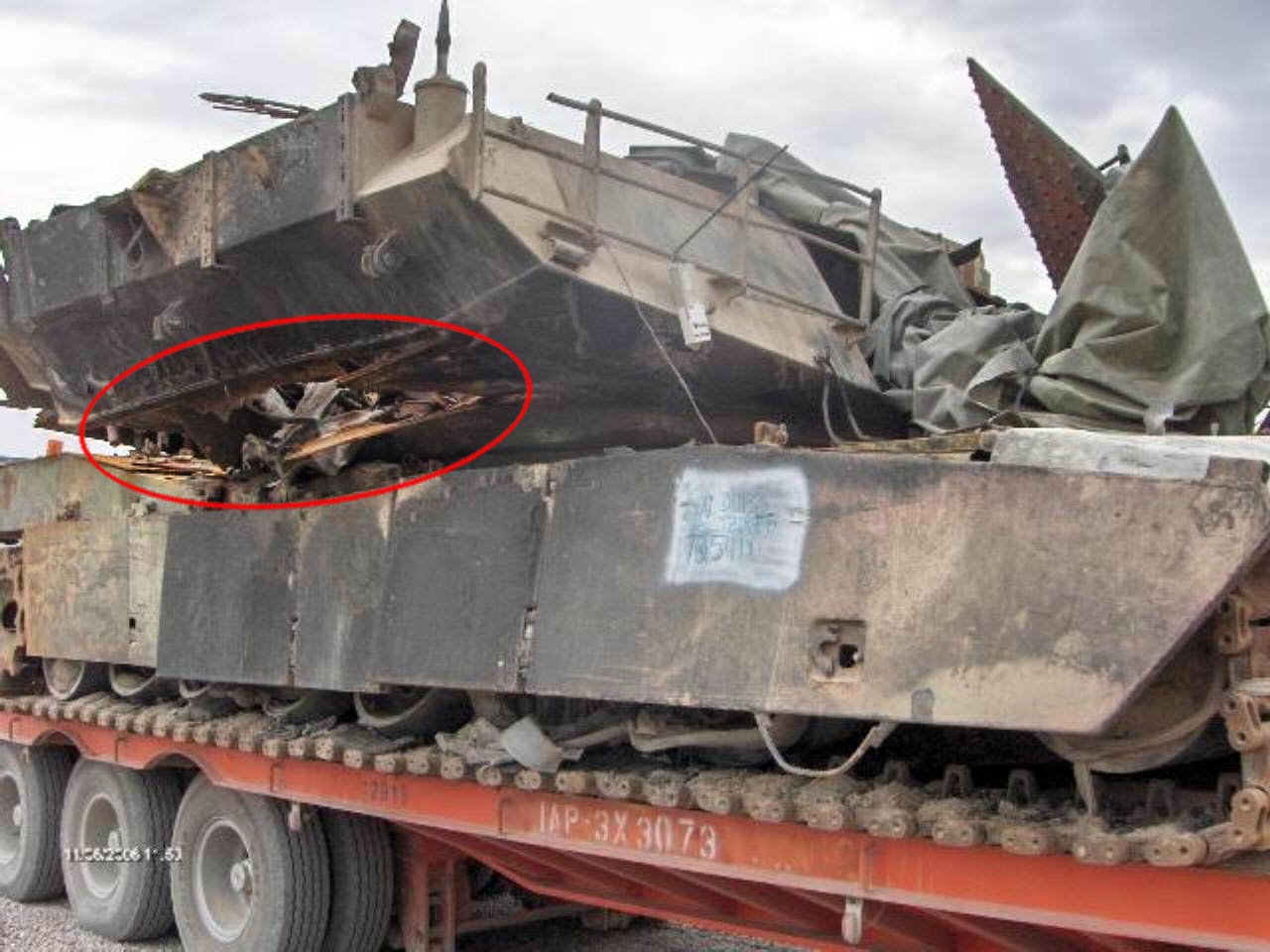
Photo - M1 with blown off ammo compartment. M1 has a special compartment for ammo with 'blowoff charges' - ammo could be blown off the tank in case of fire. While this particular tank doesn't look quite repairable, the result of ammo detonation looks much worse than that.
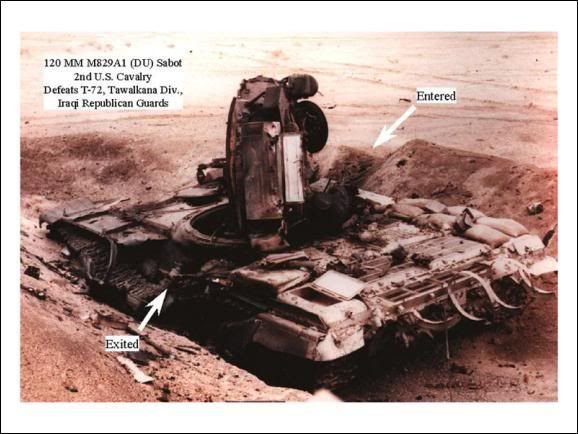
Photo - Iraqi T-72 with detonated ammo Note how turret is separated. SABOT round on cannot separate turret on its own, only ammo detonation could inflict such damage.
I don't know much about composite or reactive armor, so I'm not going to answer that part, but I do know a lot about WWII and early cold war designs, so I'll comment on those.
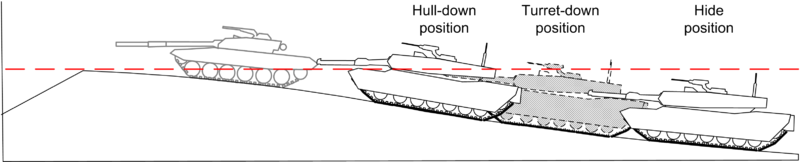
First of all, in general, turret size is very closely related to the maximum angle that the gun can depress. A higher turret roof provides more room for the breech of the gun to rise, therefore allowing the barrel to point further downward. American designs tended to focus more on having good gun depression (many having -8 to -10 degrees) while Soviet tanks did not (typically about -5 degrees). This may seem not terribly important, but having strong gun depression allows a tank to fight better over hilly terrain and make use of hull-down positions (places where only the turret is exposed). In order to compensate for having highly restricted gun depression, the Soviets actually started equipping tanks with dozer blades, theoretically allowing them to create a berm with flat ground behind it. However, the major reason for the two sides thinking differently was that Western tanks were envisioned in a defensive role, hiding behind ridges waiting for the Soviets to attack; Russian vehicles were built for invasion, pushing across open territory while taking fire.
So what advantages does a small turret have? It's simple; they weigh less and they make the tank a smaller target. By reducing the overall surface area of the armor, it also allows for the armor to be thick without increasing the weight very much. For example, the Soviet T-54/55 weighed about 36 tonnes and was 2.4 meters tall, while the similarly armed and armored American M48 Patton weighed 45 tonnes and was 3.1 meters tall. Hemispherical turrets in particular, which the East was so fond of, are very low and light partly because they have no underside that needs to be protected.
It's worth mentioning that Soviet tanks were also notoriously cramped while Western tanks were fairly comfortable. Russian tank crew members were typically required to be less than 5 feet, 5 inches tall while there were no such limits (that I know of) on American tankers. There was an old Western joke during the cold war that all Russian tanks must be crewed by strong, left-handed midgets (and as soon as they run out, they'll be in trouble!). Meanwhile, as a counter-example, the Japanese actually started designing their own tanks after WWII partly because the American Sherman tanks were so roomy that the average Japanese man had difficulty reaching the clutch pedal from the driver's seat.
Finally, perhaps the biggest determining factor in turret size is the number of people in it, and some Western tanks had more. For example, the M103, America's only heavy tank to ever be mass-produced, had a turret crew of four, while the Soviet T-10 heavy tank had a turret crew of three. In fact, the early version of the famous Soviet T-34 had only two men in the turret, and it was very small as a result. The Later T-34/85 had a turret crew of three, and the turret was much larger.
Some sources (mostly from memory; I hope citing Wikipedia is ok):
I think I can partiallly answer this. I have posted this before so here goes:
It was all about doctrinial differences. The Soviets favored a massive fleet of thousands of these tanks pouring through the Fulda Gap. Due to the offensive nature of this doctrine, they opted for low profile tanks, trading gun depression for survivability (thanks to the very low height and angled armor, making them hard to take out).
NATO, knowing it would not win an offensive land war in Western Europe due to the sheer numbers advantage of the Soviets, geared themselves for a defensive war. Doctrine was to prepare firing positions in advance, shooting from defilade (only turret/gun visible). This requires adequate gun depression, otherwise you cannot get into a good defilade position. The trade-off here is the increased height of the tank.
Edit: Here is some more very relevant information http://en.wikipedia.org/wiki/Hull-down#Armoured_warfare
The Leopard 1 for example has a maximum gun depression of -9° vs the -4° of the T62. The T72 is not much better at -5°. This leaves them severely exposed in most defensive cases.
I think the issue of armour type has been covered pretty well, but a major difference between the two sides which must be discussed was their methods of recruitment. The Soviets relied upon conscription, and therefore could not expect tank crews to have more than a few years' experience. Training had to be brief, tactics had to be basic, and hardware had to be simple, hard to damage through misuse and easy to repair. This fed into turret design because there was little need to keep crews comfortable--they would not be carrying out any particularly skilful role, simply advancing alongside thousands of other tanks, were quite expendable and on balance it was better to reduce the profile of tanks and improve their reliability. As /u/Rognik points out, there was less need for gun depression in a tank designed to attack, but it was to be expected that these tanks would have to endure a lot of counter fire and would benefit from having as small a profile as possible.
NATO forces were more reliant upon professionals. Their troops had to be better trained, because there was a smaller manpower pool to draw on. The investment that went over years into creating a professional tank crew meant they were not expendable. It made sense to design tanks with spacious turrets which would have allowed the limited number of tanks to operate to the full potential of their crews' training by reducing fatigue and discomfort as much as possible. Furthermore, a defensive doctrine meant tanks needed to be able to operate from hull-down position and larger (or rather taller) turrets meant more gun depression and more tactical flexibility when on the defence. Counter-fire was less of an issue since (with respect to British armour at least) the doctrine was one of defensive firepower combined with mobility. Advancing enemy would be damaged as much as possible and then the British armour would withdraw as soon as they were brought under fire, relocate to new positions and begin the process again.
You're kind of missing the real dichotomy (Trichotomy?) here:
Tanks from a design perspective are a balance of 3 critical aspects - Speed, Firepower and Survivability.
As with all great triangles, you can pick any two (by and large).
Soviet tanks are(were) generally considered "offensive" designs - they tended to favour heavy firepower, and generally better speed/mobility over armour, which was in keeping with the general soviet military doctrine, which is beyond the scope of this discussion beyond saying that we will imagine that the Warsaw Pact generally saw its self as "attacking" and the NATO was generally considered to be "defensive". Russian tanks were manned by conscripts with little attention paid to crew comfort or survival - in a full blown conflict an individual tank's lifespan on the imagined front was measured in seconds. Russian tanks are much cheaper to build and man than their western counterparts, and as such armor was generally placed at the bottom of the figurative triangle. On the other side of the coin, Soviet tank designs tended to include an ATGM (Anti-Tank Guided Missile) to help bolster their offensive punch, and for much of the cold war were ahead of western developments with respect to gun caliber. Because Russian tanks utilized an auto-loader, they could have smaller turrets, in turn making the whole profile of the tank smaller and thus harder to hit than western designs. The disadvantage was because of these design decisions, Russian tanks tend be able to achieve a lower depression of their gun (which is useful for something called a "hull down"" tactic whereby only the turret of the tank is exposed to the enemy - see this link - as you can imagine, the ability to depress your main gun is very important for a defensive point of view. There are some other disadvantages to auto-loaders, people get their arms ripped off by them, they can jam, and traditionally - once they have loaded a round - the only way to unload it is with a bang.
Russian tanks (especially their turrets) rely on having sloped armor, the idea being that it may cause an incoming round to glance off the tank rather than penetrate into it. As time progressed this was proven to be an ineffective means of defense, but, because Soviet tanks were cheap, fast and well armed this wasn't seen as a huge issue.
With regards to (explosive) reactive armor (ERA), this was/is a cheap bolt on answer to HEAT (high explosive anti tank) and particularity shaped charge/KE (kenetic energy) and other advanced amour penetrating rounds, which began to be utilized in the later half of the cold war. Rather than designing and building a whole new tank, one of the benefits of ERA is that it could be added to older designs to keep them current, and in general is better at defeating the above mentioned new rounds than on-board amour due to the way it works. "The west" also uses ERA, for the same reasons. Another benefit of ERA is that if it stops a round, you can generally speaking just replace the now-useless ERA module, if a tank's composite armor takes a hit, it's going to be weak there until the whole section is eventually replaced.
On the other side of the Berlin Wall things were rather different, western tanks were manned by an large with professionals, and countries appetites for mass causalities was much lower, so they tended to prioritize survivability higher, being by and large "defensive" within their respective military plans of the day.
Each NATO country had/has it's own way of doing things, the British historically preferring survivability (and later firepower) over speed, while post WW2 the French went the opposite direction and valued speed and to a degree firepower over armor (which is much more in-line with the Soviet way of thinking)
The American's tended to have a mixed or balanced view, along with the Germans. All these tanks use a 4th crew member in place of an auto-loader, and in turn were larger than their soviet counterparts - this wasn't seen as a massive problem as they designed primarily as defensive machines, often fighting from prepared positions, so the "hull down" tactic could be used. (I saw someone down thread asking about Israeli tank designs - the Merkava places surviablity way out in front - which makes sense for a small nation with many enemies).
Only a few countries actually use the previously mentioned Chobham composite armor - The UK, The USA and (originally West) Germany. Nobody actually knows what it's made of but it's preformed well in the field - however it's not indestructible. As such the countries that do use it have upgraded their tanks and may use ERA themselves now.
i am not an expert (more a 'student of history'); anywhere here is my take.
The T-34 has a skewed frontal armor plate, i remember having read that the reason for this is that upon frontal impact a projectile has to traverse a longer path of armor; also part of impact is deflected upwards. I guess this was a good idea, the Panzer V and M4 Sherman would have the same feature; this might have resulted in institutionalized design tradition; the round turret of the T-54/55 and T-64 would have a similar advantage - actually here the turret was quite big. Of course the advantage is lost with air based projectiles that come in at an angle.
Reactive armor came later, also the turret became smaller as a result.
Of course the question remains as to why Soviet and Russian Tanks do not divide between crew and weapons compartment ; i guess that again is institutionalized tradition; (however i wonder as to what and how much they were drinking)
Броня крепка, и танки наши быстры, И наши люди мужества полны: В строю стоят советские танкисты - Своей великой Родины сыны.
the armor is strong and our tanks are fast/our men are full of daring/Soviet tankmen standing in formation, the sons of their great Motherland