My family arrived here in the 1630s and is said to have had a large swath of land that encompassed what is now Winthrop and most of Revere Massachusetts (I am told at the time the area was referred to as Winnisimiit). The ancestor I am speaking of was named Belcher. I learned from someone I met at a party a few years back that, his ancestors (guy at party) and mine were complicit in the round up of Natives and having them placed on Deer Island where most starved to death.
I am seeking more information on the actual roundup of the natives and their exile to the island as well as any other information I can find about the natives that inhabited the area.
I believe the tribe just to the north of us were called the Sachem if that helps at all?
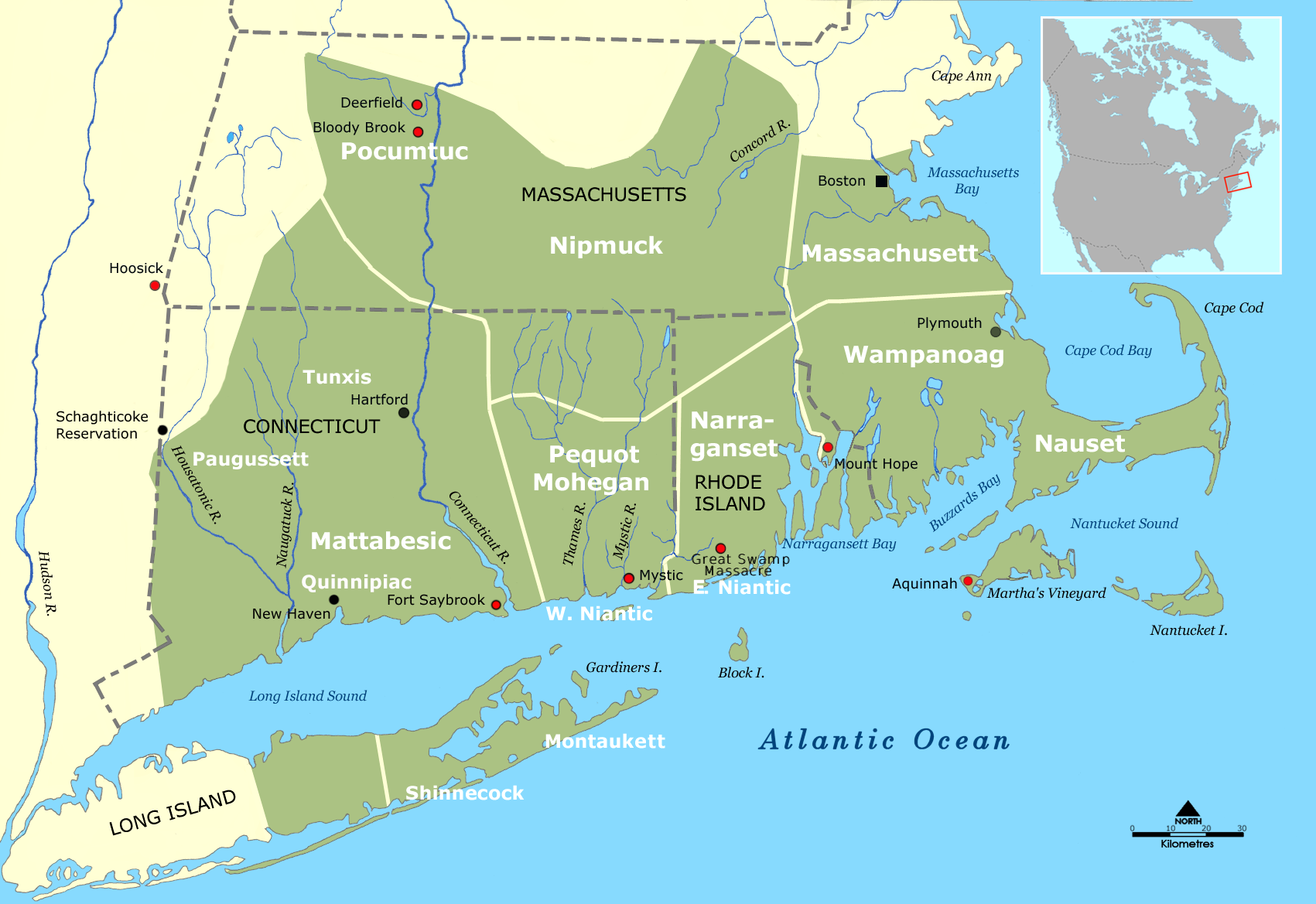
First, you'll find this map useful for this discussion.
After decades of rising tension between the Wampanoag Confederacy and the New England Confederation, Metacom's War (better known as King Philip's War) broke out in 1675. Metacom (King Philip) was the son of Massasoit Ousamequin. As the massasoit, Ousamequin had been the leader of the Wampanoag Confederacy when the Mayflower first arrived in 1620. In 1661, Ousamequin died, apparently from a European disease. The title of massasoit passed to his elder son, Wamsutta, who died mysteriously after being summoned to Plymouth by colonial authorities. Metacom believed his brother had been poisoned, and added that allegation to a long list of grievances that had manifested since his father tentatively welcomed the English (other issues involved dishonest land purchases, biased courts, and English livestock running amok over the countryside).
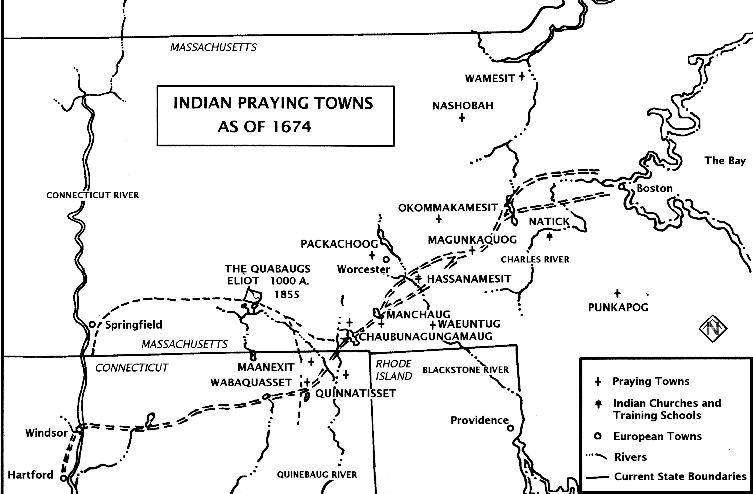
Meanwhile, the Puritan missionary John Eliot had been busily proselytizing in the region, beginning in 1646. Most of the converts came from the Massachusetts and Nipmuc nations. These converts resettled in the borderlands of the Massachusetts Bay colony, establishing new villages known as Praying Towns and becoming known as the Praying Indians. Unfortunately, despite their conversion, they suffered from considerable amounts of prejudice from the English and were not fully trusted.
When Metacom's War erupted in June 1675, the English's paranoia regarding the Praying Indians came to a head. In October 1675, the inhabitants of the Praying Towns were forcibly removed to internment camps on Deer Island and a few other places, despite protests Eliot and offers from the Praying Indians to assist in the war. The camp on Deer Island was particularly disastrous. Of the 500 people sent there (predominantly from the Praying Towns of Natick and Punkapoag), only a third (167) survived the the winter.
In December 1675, Daniel Gookin visited Deer Island with Eliot and a few others and recorded the conditions there:
I observed in all my visits to them, that they carried themselves patiently, humbly, and piously, without murmuring or complaining against the English for their sufferings (which were not few), for they lived chiefly upon clams and shellfish, that they digged out of the sand, at low water; the Island was bleak and cold, their wigwams poor and mean, their clothes few and thin; some little corn they had of their own, which the Council ordered to be fetched from their plantations, and conveyed to them by little and little; also a boat and man was appointed to look after them. I may say in the words of truth (according to my apprehension), there appeared among them much practical Christianity in this time of their trials.
The first half of Metacom's War went very well for the Wampanoag and their allies. In their frustration, some of the colonists sought to take revenge on the any Native peoples that could get their hands on, which included those imprisoned in Deer Island. In late February 1676*, a mob of 30-40 men set out to attack Deer Island and massacre those remaining there. Fortunately, the very Council that had imprisoned the people at Deer Island also intervened and stopped the mob before they could launch their boats.
*A word of warning here. At the time, the calender didn't tick over to the next year until March, so if you're reading contemporary records, they'll still say January and February 1675.
Once the winter was over, the internment camps were disbanded and the people allowed to return to the Praying Towns. However, with the war still ongoing, most simply gathered up what supplies they could and moved out of the crossfire. Others built up fortifications, either around their current towns or new towns established for the purposes. The war came to an unofficial end in August 1676 with the death of Metacom and the exile of many Wampanoag into slavery on Bermuda. Skirmishes continued until the spring of 1678 however, and in the midst of that simmering violence, the colonial government dissolved what little autonomy remained for most of the Praying Towns in 1677.
Check out Daniel Gookin's The Doings and Sufferings of the Christian Indians for a contemporary account of events.
I believe the tribe just to the north of us were called the Sachem if that helps at all?
Also, to quickly clear up this confusion, "sachem" is a political rank. In English it's used for any Native leader from the Northeast, but it's originally derived from the title of Massachusetts-speaking leaders (pretty much everyone on that map at the beginning of this post falls somewhere on the Massachusetts-speaking spectrum). In this sense, sachems are mostly local leaders, outranked by people like the massasoit who lead confederacies.
The ancestor I am speaking of was named Belcher.
Do you happen to know if / how Joseph Belcher fits into your family tree? He's was involved in the early fighting of Metacom's War.