It seems counter intuitive to me that they would use an image of someone that was looked down upon at the time on their coinage. I'm just curious of the mindset or significance of the move.
Tl;dr It does seem counter-intuitive to honor Native Americans on coins while denying their humanity and the right to their own language, religion, culture and customs, but this simply didn't slow America down. Phil Deloria does a great job of showing how the idea of Native Americans has pretty much always been divorced from the realities of Native American life or U.S.-Indian policy. Indeed, as he puts it when writing of the early 19th century organization The Improved Order of Red Men, "They desired Indianness, not Indians." (The Wiki here notes that membership was restricted to whites until the 1970s.) It's the same type of appropriation of cultural motifs and generic imagery that /u/Brickie78 is referring to and still exists today in the form of many professional, collegiate, and high school athletic mascots.
As /u/ggarcimer15 suggests, read Vine Deloria (his most famous work being Custer Died for Your Sins) and his son Phil's Playing Indian. Phil especially goes into how Native Americans were a convenient "other" for Euro-Americans. They were variously portrayed as savage; noble; epitomes of freedom; enemies of the United States; threats to Christian civilization; or the last vestiges of a pre-modern society, tragically fading away under the superior technology and lifestyle of white Americans.
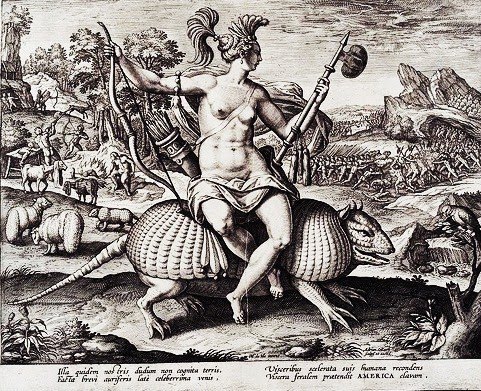
So how did Indian head coins come about? In the abstract, especially in the early days of the United States, Native Americans were symbols of freedom and liberty - think of early personifications of Colombia or the U.S. Capitol's Statue of Freedom, with their vaguely Native American headdresses and attire, or more explicitly, the Boston Tea Party disguising themselves as Native Americans because of their popular association with freedom. As a perception that predates America, it was influential enough to survive the demonization of Native Americans during the 19th century "Indian Wars," and afterwards the idea of Indians as paragons of virility and ruggedness (compared to the effete, urbanized late 19th century American) came back in full force - this time frame also saw the rise of organizations like the Camp Fire Girls and the Boy Scouts, which co-founder Ernest Thompson Seton explicitly linked to Native Americans: "Indian teachings in the fields of art, handicraft, woodcraft, agriculture, social life, health, and joy need no argument beyond presentation; they speak for themselves. The Red Man is the apostle of outdoor life, his example and precept are what young America needs today above any other teaching of which I have knowledge." Putting "his" face (the designer of the "Buffalo nickel" claimed not to have drawn a portrait, but a "type") on coinage was another way of using the image of Native Americans to reinforce the idea of American uniqueness and freedom, just like the "Mohawks" in Boston Harbor.
Also see Jared Farmer's On Zion's Mount for more on the late 19th/early 20th century obsession with the declining virility of the American male and how embracing certain aspects of Native American lifestyle (albeit a heavily idealized lifestyle) was seen as a remedy.
You could try r/Anthropology, or r/CulturalAnthro with is question too; This is a topic that they might be able to shed a different light on than historians on this sub(not downplaying their knowledge or expertise, but just offering a different light on the subject).
I'm not an expert on Native American history by any means as I am trained as an Anthropologist, but what you have described, and the co-opting of imagery and creation of a mythos in this situation is partly due to the idea of a "free", and "natural" society, one which was idolized, yet paradoxically, was also being controlled and oppressed. This is a condensed answer, but it gives a broad stroke answer to the question. Like I said I'm not an expert, but I would recommend reading either Vine Deloria or Philip Deloria(his book, "Playing Indian" refers to the kind of cultural romanticism and co-opting which has become associated with many Native American cultures and practices); they are both Native American scholars and very respected in their work. I know this doesn't really answer your question, but I hope that maybe it helps point you in a direction that might be helpful.
To the mods: this is my first time commenting on a post in this sub and I'm aware that the rules are enforced; if something I have posted is not in keeping with these rules I will revise the post so that it does.
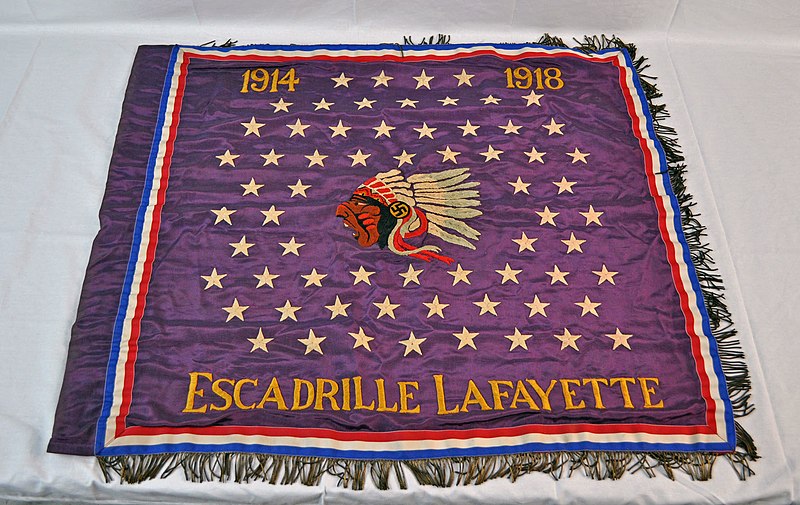
I don't know if it's the same period you're thinking of, but I know that during World Wars 1 and 2 the US armed forces liked to use imagery of "Red Indians". I have always assumed - but am willing to be corrected by those who know better - that a "fierce warrior" image is being invoked. For example:
*The Lafayette Squadron, an American Volunteer unit in the French Air Force during World War 1, used a "Sioux Chief" as its squadron motif.
*US Paratroopers during World War 2 would habitually shave their heads into "Mohawk" cuts before a combat drop and would often also apply "war paint" - see this picture.