Hello, First time posting here, Im working as a teacher at a High-School level School in Sweden and some of my students are working on a paper about WW2 and Nazi Germany, I wonder what the nazis used/borrowed/stole from other cultures and history more than the svastika. Anything related to science, culture and Ideology would be greatly appreciated. I Might add that I do NOT teach in History or English, I Teach Swedish and Math. Edit: Grammar
There's a huge amount of their ideology and symbolism that was stolen. Racial theories started in the late 18th century. By the late 19th century, they had a pretty complicated set of ideas. One of the key ones there was the Aryan myth. As Sanskrit had been discovered to be closely related to proto-indo-european (at that time it was thought it was PIE), they built up this dodgy idea that the light skinned 'Aryans' had become the lighter-skinned ruling Brahmin caste there. This theory was espoused by the Grimm brothers (of fairy-tale fame) among others.
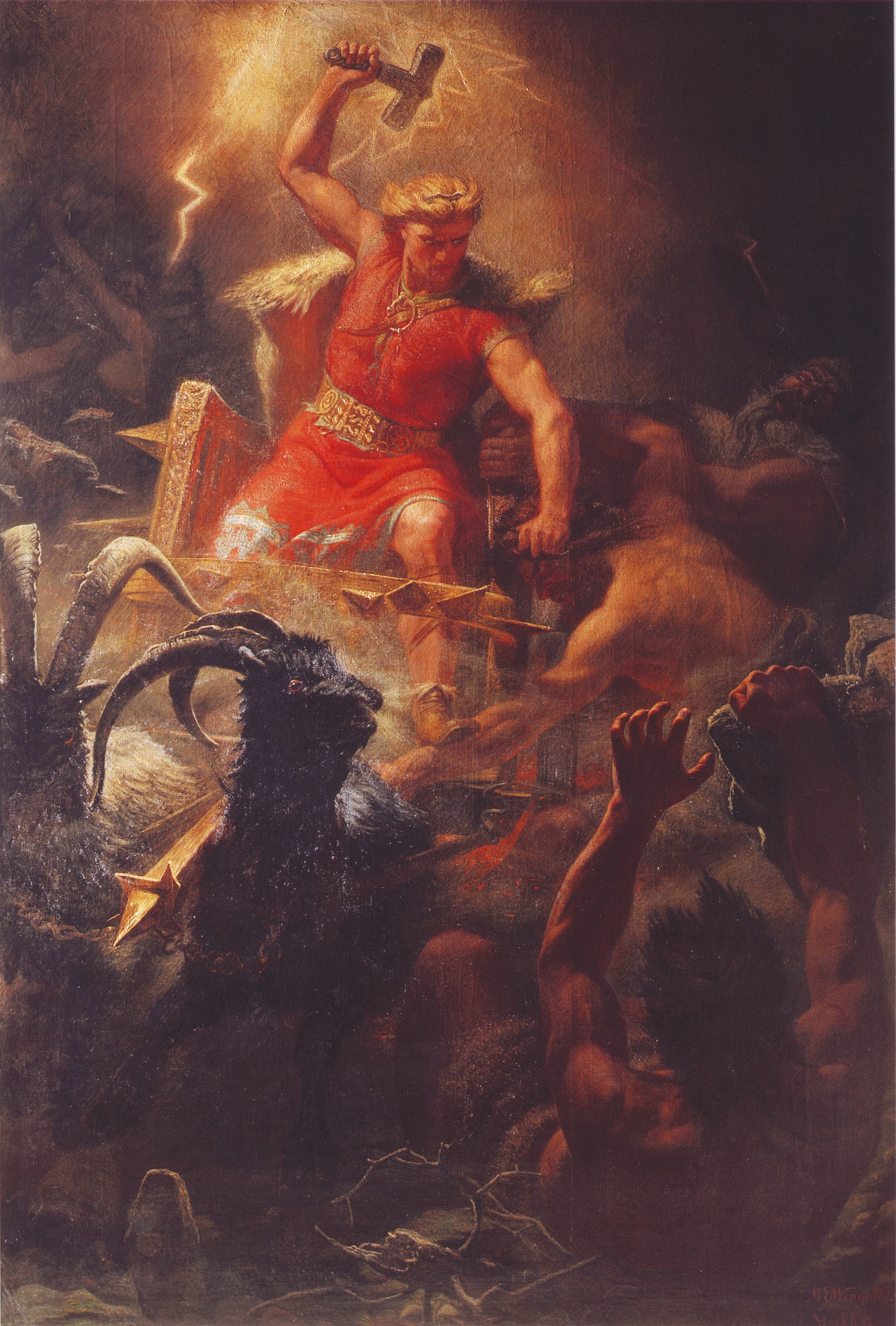
Then in the 19th century you have the rise of nationalism in Germany and everywhere else, intermingled with romanticism in the arts, so you have Wager and Nietzsche, who were both influences on the art and philosophy of the Nazis. The Swastika entered into romantic art as a Germanic 'sun symbol', as seen on Thor's belt here. You had bellicosity, such as in von Bernhardi's "Germany and the Next War". You had racist theories in The foundations of the Nineteenth Century, and the nascent ideas of eastern expansion in Ratzel's "Political Geography". It's one big mess of far-fetched racial/historical theories, nationalism, romanticism, etc - even before the 20th century had started, all of which came into the Völkisch movement, which the Nazis got much of their stuff from.
These were very spread ideas. Even though most weren't ardent supporters of any particular racial theory, the believe in European superiority was taken as a given. Antisemitism was also common, although seldom as virulent as that later expressed by the Nazis. There were ideas about 'racial hygiene' and eugenics starting to take hold in mainstream discourse at the turn of the century - and which got stronger in its first decades.
After WWI the German Empire falls apart, there is revolution and street battles between factions. The conservatives Freikorps schooled many future Nazis.
Monetary crisis and then the Great Depression coincide with the formation of the Nazi Party. Carving themselves their own niche in politics as nationalist and racist, conservative in many respects but opponents the old Prussian Junker aristocracy that had lead the old Empire (and wanted it back). An anti-communist, anti-social-democratic yet 'socialist' party which sought to raise the workers against the evil Jewish bankers.
The idea of 'Lebensraum' to solve the problem of unemployment was not unique to the Nazis either. While the idea of eastern expansion was older, other 'solutions' along the same premise existed, such as the far-fetched Atlantropa idea created by Herman Sörgel in the 1920s. '
There are certainly many sources I've missed here. But I hope to illustrate the point that very much of their ideology was derived from elsewhere, and many of these ideas were floating around at the time.