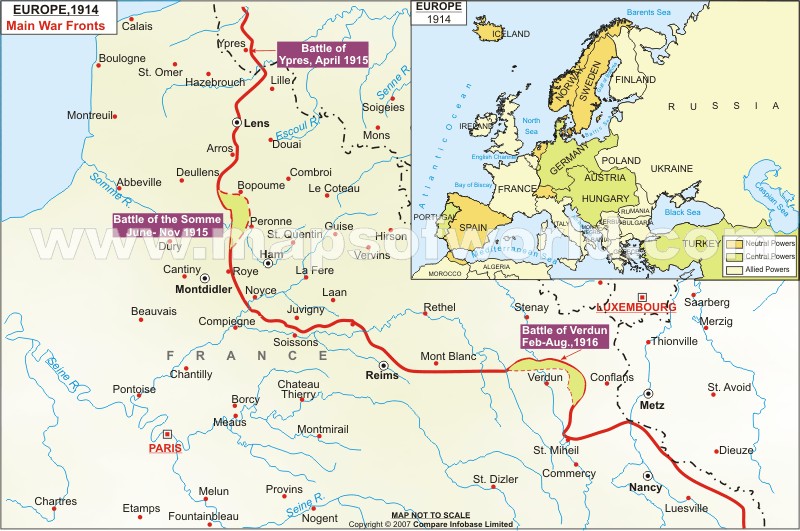
I have never been able to find this out. My thought is that it would be impossible for a single trench to span the whole of the western front (300 miles???) but then if that was the case why couldn't each side just out flank the other?
There was not a continuous trench running 400 miles, but, of course large stretches did run in a line, because a trench line doesn't function effectively if it's got gaps. Both sides tried to reduce these gaps and create a solid line, and we can say they were basically successful because even if they couldn't create a continuous trench line they did create a continuous front. In other words, even though the defence works were not uniform, they still prevented the enemy being able to advance at any point. So you're not correct to assume that a continuous line was needed to prevent flanking manoeuvres. Gaps were acceptable as long as they could be covered by fire from either side (so 300-odd metres for rifles, 500-odd for machine guns, and maybe 10-15 kilometres for artillery), and didn't provide space for big attacks (because there was no point sending troops in if they couldn't be supported and resupplied, and that required a substantial amount of space free from enemy interference with proper roads). As far as possible trenches did form a continuous line, but this was often not possible. Where the terrain was mountainous, as in the south-east sector of the Front, or where river valleys crossed the front, gaps had to be left. For example, here is part of the Somme battlefield near Thiepval where the river Ancre caused a gap.. This was usually fine because such features didn't make good targets for attack (it's not a good idea to attack through a swamp) and could be defended by isolated redoubts.
There were also areas where the conditions made trenches themselves impractical, usually because of the high water table in Flanders and Artois--much of the northern part of the Front. Large sectors of the front in northern France were comprised of lines of above-ground ramparts instead of trenches. These could be 10-15ft thick and were reckoned by some to be even more resistant to artillery than normal trenches, which is why neither side began to dig trenches instead even when the ground got dry enough. The Germans had the additional idea of entrenching machine guns in the ramparts themselves so that they were virtually invisible and could fire from ground level. I've actually stolen /u/QuickSpore 's link from below because I was looking for a trench map of such a sector and I believe that this sector was actually formed of ramparts, not trenches. Plainly, the use of ramparts didn't prevent continuous defences being formed. Also, that canal formed another point where it was necessary to leave a gap in the trench lines. It was easily defensible, although there was a rather hair-brained scheme in 1915 to send gunboats up it. Here it is.
Similarly, during the later stages of the battles of the Somme and Third Ypres (Passchendaele), it became impossible to build trench lines and instead defences were based upon lines of shell craters, sometimes with shallow communication trenches dug between them. Each would be manned by a few men and this provided a very elastic defence because, of course, a shell crater can be fired out of in all directions, including into the rear of attackers who have bypassed it. This actually initially came about as an attempt by the Germans to reduce the effectiveness of Allied artillery by forgoing any easily identifiable continuous trench works. On the other hand, however, in the spring of the next year (1917) the Germans drew back into the Hindenburg Line, which was a very conventional trench line with three lines of deep, continuous trenches, huge barbed wire entanglements and deep dugouts. I think that in the end comfort for the defending troops trumped the flexibility of defence lines based on craters. The salient point is that the precise layout of defences varied greatly depending on the precise conditions.
There was a lot of variety in trench layouts, and the ideal of a continuous line wasn't always possible. There was, however, a continous front. For further reading I'd recommend Stephen Bull, Trench: A History of Trench Warfare on the Western Front (2010) and Paddy Griffith, Fortifications of the Western Front 1914-1918 (2004) for the trenches themselves, and Tony Ashworth Trench Warfare: The Live and Let Live System (1980) for a brilliant analysis of what normal trench life was like.
No, of course not. If it was a single line, it would mean that they started digging across a length of 300 miles at the same moment. That would mean they made the same advances (or retreats) everywhere at the same time. That is of course not possible. For several reason:
Location, there were mountainous/hilly, areas, forests, rivers, lakes. Defending these areas is different than defending a flat piece of land.
Cities, towns, etc.
Different units at different locations.
There were tens of thousands of ''smaller'' trenches. Some were connected with each other, most were not. This doesn't mean they were completely out of line, they were close to each other.
Trech line:
http://www.mapsofworld.com/world-maps/image/world%20war-1.jpg
Relatedish question, was tunneling under no mans land ever considered or a viable tactic?
Also, the trenches was not made up as a straight line. They where built in a zigzag pattern to limit the blast effect once a shell would land in the trench, and also to limit the range enemy could fire along once they had overtaken parts of the trench.