I'm asking this after I seen a question asked on how hard it was for arrows to be supply in battle.
Surely after a bit of time the arrows would start to bow or twist, which is a common problem with timber manufacturers of today. They can't have lacquered the wood or something along those lines back in the day?
I'd like to note there's a difference between massed produced "livery" arrows for a battle and the matched arrows a marksman would use. The former is being loosed en masse in a huge volley. It doesn't have to perform perfectly and a bit of bend in the shaft isn't going to defeat its purpose.
The latter would be distilled from hundreds of arrows that were tested over and over again to see which were the most consistent, straight and accurate. Archers still do this today, even when using precision made carbon fibre or aluminum arrows. You take, say, a dozen or so, number them and start shooting. After a while you'll see certain ones are performing better than others. Those are the ones you compete with. ;)
That being said, you still want your wooden shafts to be as straight as possible. Even if it's only going to get shot once. There's a few elements to this:
The first part is the most important. The species of wood used for arrows is very deliberate. Cedar is one of the best because its growth rings run very straight (and it's lightweight). Warping in wood is heavily influence by grain and moisture. So it's no surprise that those are the two most controlled elements when making shafts. Sections of log are split length-wise to produce sticks with good grain direction. These are then bundled together so they can support each other as they're straightened out prior to planing to make them round. Do this right, and you end up with an arrow with good elastic properties that wants to stay relatively straight.
They can't have lacquered the wood or something along those lines back in the day?
Wood arrows were sealed. Waxes, oils and varnishes were available then. For example you can make a varnish from pine sap and alcohol. The purpose is to control the moisture. You need enough in there that the wood isn't brittle and prone to cracking/snapping. Nor too much, otherwise it will be heavier and prone to warping.
Storing the arrows as a bundle goes a long way. One arrow can get squished or bent in transport. Dozens tied together support and protect each other.
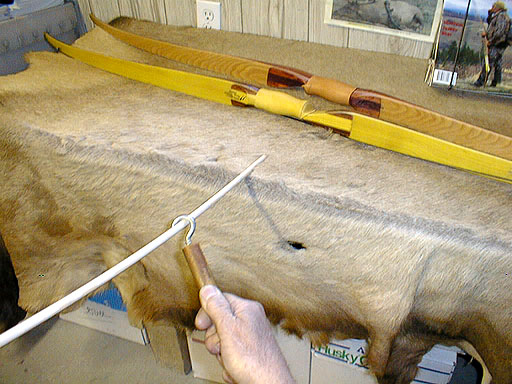
In the end though, wood arrows do warp. No matter how perfectly you make them, you will always have arrows to straighten. Thankfully though, since the effort was made to make an arrow that wants to be straight, it doesn't take a lot of effort to correct it. It's rather simple to fix bends in an arrow and any archer could take care of their own. All you need is something to burnish the wood back and forth, like a small hook on a handle. By pulling gently against the bend with the hook and burnishing back and forth, you will stretch and compress the fibres in the wood, altering its shape and correcting the bend. This technique has also been adapted into other simple products based on the same principle.
Fletchers had a number of ways to make their shafts straight when manufacturing their arrows. One of the most common was stretching, which was soaking the wood for a day, then putting it in a stretcher; which usually held 1 to 30 arrows, and then drying the wood, for a day, or until it was completely dry. This produced a pretty good uniform straight shaft for the arrow to be built from. The welch, American Indians, and the Romans are three that used this method from my readings. I am sure many others did the same, because of the effectiveness of the process.