Frederick Stockley was born in Wesleyville, Newfoundland, and joined the First Newfoundland Regiment when he was 19, in March of 1917. (Regiment # 3518) He was "killed in action" on March 11 of 1918.
I have other records thanks to my local museum such as his enlistment papers and medical records, telegraphs that his parents sent, report of death, etc.
My first question is, how would he be KIA? I did some research and found that the nearest battle of WWI to his death would be the Second Battle of the Somme in late March. Does anybody have any ideas?
Another question I have is what other information would be good to know about a soldier? I am submitting a short biography to a program my University is doing called "Memorial Remembers" and was hoping to give my grandfather a copy as well, since it is his father's cousin I am researching.
Thank you so much for your help, and I'm sorry if anything I asked was dumb! :(
This has a great deal of info on the latter part of the war and Newfoundlanders role in it: Newfoundland Regt - End of War -- he could have been killed in action in the run up to the [Fourth Battle of Ypres](http://en.wikipedia.org/wiki/Battle_of_the_Lys_(1918), where the Royal Newfoundland Regiment saw action.
Also, not sure if you have this, but this is the index card from British medal rolls for WW1 that matched your relative's name and regiment: Imgur - Frederick Stockley
The above means that he was awarded (posthumously) the Victory Medal and the British War Medal.
Additionally, here are a few more links:
Details the history of the Regiment overseas
Having done this research before, any kind of conduct reports or medals (like above) might be of interest.
Other than that, research what life was like in the trenches he found himself in. The film [Passchendaele](http://en.wikipedia.org/wiki/Passchendaele_(film) documents Canadians during the terrible Third Battle of Ypres, and would have been in the same area. The Second Battle of the Somme happened too late for your relative; it began with the German offensive in August 1918.
That said, no where on the Western Front was ever "safe" and battles were simply the major offensives that were planned. Plenty of unplanned actions, patrols, raids, snipers and artillery exchanges would result in KIA status.
Best of luck to you.
You may have already seen this, but Frederick Stockley is listed on the Commonweatlh War Graves Commission site, as well as the Canadian Virtual Memorial. There, you can see his name on the memorial at Beaumont Hamel. Since he's listed on one of those bronze tablets, that means he has no known grave, which makes his death an ever greater mystery!
You can also read 507-510 of Nicholson's Official History. Nicholson writes that the Regiment did not come under attack in March though. They were billed in Flanders. When we look at who else from the Newfoundland Regiment died on 11 March, 1918, we find two others buried at the Oxford Road Cemetery, both from the 1st Battalion. Which suggests they were attacked, but Stockley's body wasn't found.
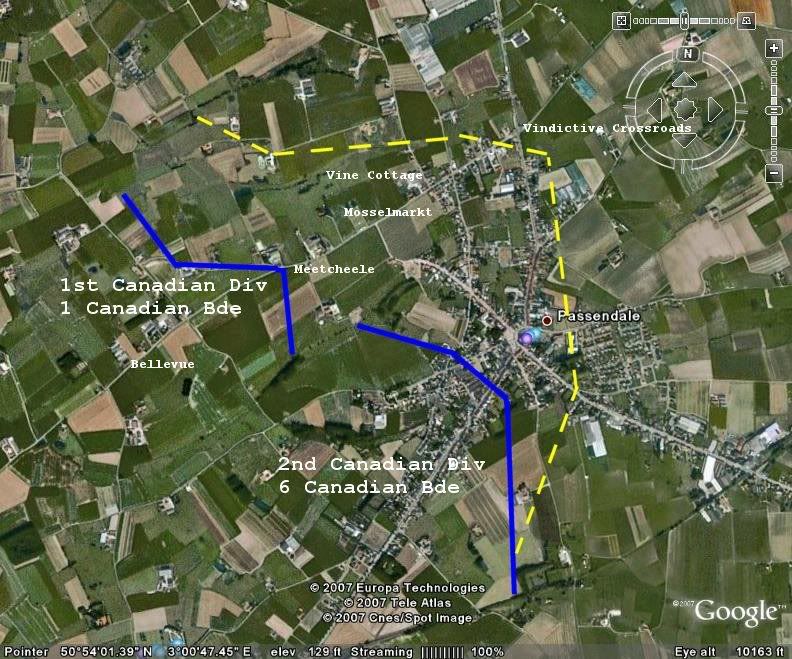
From there I decided to look at the Regiment's War Diary See page 62, and it says on March 7, 1918, the regiment moved from Steenvoorde to California Camp on the front lines north of Wieltje and from there, two companies took up positions on the frontlines, one at support at Mosselmarkt and another at "Bellevue" which is presumably the Bellevue Spur which is a low slope approaching Passchendaele. This map gives you a better idea. And here you can see the frontlines as of April, 1918, reflecting what the Newfoundlanders were defending.
On 11 March, 1918, the War Diary reports that "on their right" C Company was shelled and casualties were "light"! That might explain why there is no known grave and could be what killed him, though we don't know where exactly C company was stationed. Though he could easily have been wounded earlier and died from his wounds.. It is pretty certain that he was probably killed during that tour on the frontlines from 7 March - 14 March 1918, somewhere near Passchendaele. If I had to guess, I would say the "frontline positions" mentioned above were in the middle of the ruined village of Passchendaele, and since "on the right" implies a frontline location, C Company was probably on the frontlines somewhere in the tip of that salient around Passchendaele shown in the April 1918 map.
On another note, if you find out when he joined, it might be neat to look up a local newspaper (or the newspaper from his hometown or whereever he enlisted) and see what the headline would have been the day he woke up and joined the war.