When Europeans first came into contact with both the Native Americans and Africans they were well ahead of them technologically, culturally, etc. Why didn't these tribes form together to advance and prosper like people did in Europe and Asia?
I'm an archaeologist, not a historian, but your question centers on some prehistoric American archaeology, so I'm going to give you an answer.
In anthropology (of which archaeology is a subfield), we do not in fact compare cultures the way you ask in this question. The cultures of the Americas were as advanced as their European and Asian counterparts. There's some old-school racist anthropology that talks about the "evolution of culture," but this kind of anthropology grew up at the time when Europeans didn't really believe the rest of the world's population were people. The "evolution of culture" theories are no longer accepted in anthropological theory.
That's one part of your question.
Let's talk about the rest of it.
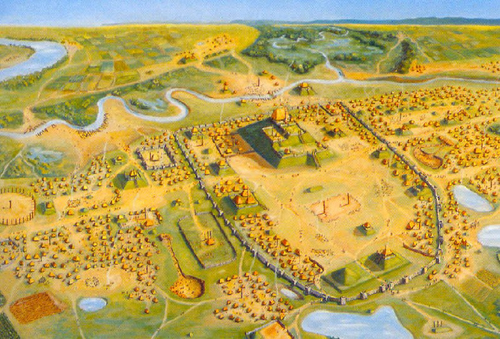
The people of the Americas did come together and advance and prosper. Here's a brief list of some of the major pre-Columbian cities:
The indigenous populations of the Americas were not decimated by European technology, they were decimated by European disease. All over the Americas millions of people died before they ever set eyes on a European, because disease spreads faster than European explorers or invaders. The later spread of Europeans (manifest destiny settlers in the US for example) were meeting a population that had already been affected by a widespread epidemic of measles and mumps and other diseases.
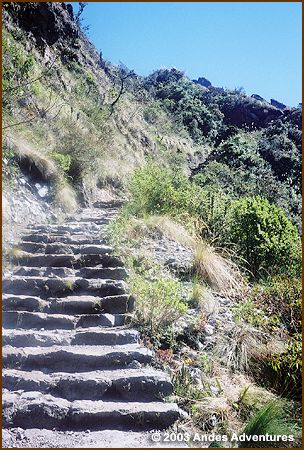
In terms of technology, a big thing that gets tossed around is that indigenous Americans never invented the wheel. This isn't true, they did invent the wheel, but it was only used on children's toys. This is because there was no use for the wheel in the Americas. The wheel is used primarily on carts drawn by horses, ox, or donkeys. These animals did not exist in the Americas, so the wheel would not have been very useful. South America did have llama and alpaca (large, domesticated animals), but the terrain (mountainous Andes) did not allow for easy cart travel. The llama and alpaca were used to carry things up and down the Inca Trail though. That's a massive engineering project... requires some advanced technology. Photo.
I hope that answers your question. If you have any further questions, feel free to ask!
When Europeans first came into contact with both the Native Americans and Africans they were well ahead of them technologically, culturally, etc
I have several problems with this premise. Here they are in no particular order:
1- You presume that North Africans/Egyptians are not Africans. Or, are not "real" Africans. When Dorian and Attic Greeks were trading with Egyptians circa 800 B.C., the Greeks were not "well ahead..technologically, culturally, etc."
If we were to skip ahead to the 15th century AD, when comparing the Kingdom of Spain to the Kingdom of Morocco, you would be able to note differences in language, religion, dress, and customs. However, you would note similarities in that both had cities, gunpowder, writing, law codes, monarchy, ships, coinage etc.
2- Even narrowing your definition to Sub-saharan Africa, there are still examples that negate your premise that "tribes" didn't form together to advance and prosper.
When Vasco Da Gama rounded the Cape of Good hope in 1498, he soon discovered an established urban culture along the eastern coast of Africa. The Swahili-speaking inhabitants of cities like Kilwa, Pemba, and Sofala had been sailing Dhows from these ports to India and beyond, exchanging goods such as African Ivory, Iron, Copper, Gold and Slaves for woven cotton cloth, porcelain, and other manufactured items. Adherents of Islam, the inhabitants of these cities on the Swahili coast had written language that they used to document the history of their respective cities.
What happened to these cities of the Swahili coast? Da Gama and subsequent Portuguese explorers extracted tribute, and sacked those cities that would not offer tribute. Subsequently, these cities were garrisoned as Portuguese colonies until the late 1600s, when an Omani dynasty brought the East African coast north of Mozambique under their control. However, the wealth of these Swahili states would never reach the same level as before the Portuguese arrival.
Or, let us look at the cultures of the Sudanic regions in West Africa. Similarly to East Africa, these cultures had trade contacts, in this case spanning across the sahara, exchangin West African gold and slaves for North African and Middle Eastern manufactured goods. Again, these were established, literate, urban cultures.
In the 1300s, the Kings of Mali (also adherents of Islam) were establishing madrassas to educate the Ulama (legal scholars) and Imams. Additionally, in Timbuktu there was a social custom for these educated and scholarly Ulama to display their learning and wealth through the accumulation of extensive private libraries. In this same era, King Musa I crossed the Sahara and went on Hajj to Mecca, carrying extraordinary amounts of gold, and bringing with him 1000 attendants, according to legend.
What happened to ancient Mali? that empire was defeated by Sunjata of Gao, who did much to establish the Songhai empire [incorrect, see /u/stander-j's remarks below]. The Songhai empire would disintegrate in 1591 when a Moroccan army bearing muskets and cannons defeated a Songhai army that lacked firearms. The Moroccans were able to sieze Gao and Timbuktu, but much of the rest of the former Songhai empire fractured into dozens of smaller, competing states. A Sub-Saharan African civilization defeated by a North African one.
3- Just as there are variations in Africa, technological development and social structures were not uniform across Europe or Asia. In Europe, Scholars at Notre Dame shared the continent with nomadic Sami reindeer herders. Similarly, Chinese Mandarins existed at the same time as Bedouin nomads. "Europeans" were not more advanced than "Africans".
So, finally, I will get to the answer that you seek. But, I will rephrase it, to take out unhelpful terms like "advanced" and "ahead" and "tribes"
Why, during the Age of Discovery, did European explorers have technology such as Firearms, Sailing ships, writing, with cities and kingdoms; when the cultures along the Atlantic coast and in Southern Africa lacked these technologies, often lived in villages, often led by chiefs?
Well, prior to European naval exploration, there was very limited sea-borne movement along the Atlantic coast. In the words of David Birmingham:
Central Africa's isolation was broken by the opening of the Atlantic Ocean (by the Portuguese). Until then the Atlantic had remained a closed sea, and Africa's western front, unlike its' eastern and northern fronts, had enjoyed no active communication with the outside world.
While the Sahel states of the Niger basin, and the coastal cities of East Africa and their immediate neighbors were exposed to trade and ideas from the wider world, these forces did not make their way overland to Central and Atlantic Africa.
However, when the Atlantic was "opened" by trade contact with Portuguese, and later Dutch, English, French and New World traders, the peoples of the Atlantic coast did adopt new ideas. For instance, the introduction of Cowry shells to the Yoruba lands of southwestern Nigeria in the 16th century was accompanied with a shift in Yoruba understanding of wealth, and economic changes.
Prior to the introduction of Cowry money, the Yoruba economy operated on a barter system of two types; goods for goods, and goods for services. Wealth was understood to be the ability to call upon a large number of people for services owed. Subsequent to the introduction and understanding of Cowry as money, wealth became signified in displays of bags of cowries, or ostentatious display of shells attached to clothing.
Some sources-
Central Africa to 1870, Zambezia, Zaire and the South Atlantic by David Birmingham, 1981. Discusses social, cultural, and technological changes in Central Africa from the Neolithic, through the Iron Age, and to the time of European contact and Colonization. This was the source of the quote about the "closed atlantic sea". Printed in 1981, it is a bit long in the tooth, and there should be newer works out there.
Port Cities and Intruders; the Swahili Coast, India and Portugal in the Early Modern Era by Michael M. Pearson, 1998. Pearson applies a world-systems approach to describe the connectedness of East Africa, Arabia and India in trade contacts from the 10th to the 16th centuries, and the realignments Portuguese arrival in the Indian ocean caused in the these relationships.
Culture, Politics and Money Among the Yoruba by Toyin Falola and Akanmu Adebayo, 2000. Chapter 2 addresses the introduction of Cowry currency, and its interaction with urbanization, changing economic and social structures.
African Bibliophiles; Books and Libraries in Medieval Timbuktu by Brent Singleton, in the Journal of Libraries and Culture, 39.1 (winter 2004). Singleton describes the civic culture of Timbuktu of the 14th-16th centuries, paying particular attention to the institution of private libraries, and the fierce demand for books imported from North Africa and Egypt.
Despite its many significant flaws, which have been previously alluded to in this subreddit, Jared Diamond's "Guns, Germs and Steel" is a very good primer for the lay man to answer just this question. The environmental determinism is a little strong, but his following work "Collapse" goes some way to remedying that.
The short synopsis is that through a combination of, unsurprisingly, superior weaponry, pathogens and metalworking, European and Asian societies were better equipped to conquer and subjugate others.
Essentially, what are commonly considered the first 'civilisations' (a loaded term) existed in an area known as the Fertile Crescent, extending through what we would now call the Middle East. These societies had excellent crops (wheat, rice and other cereals) that were well suited to farming, and also had useful animals such as cows, sheep and goats. These things in combination allowed them to produce a significant food surplus, which is the basis for any 'advanced' society. In traditional societies of course, almost every member must dedicate themselves to food production or face starvation. Freeing up some of the populace from this task allowed specialists and a state bureaucracy to emerge.
As people spread out from the Fertile Crescent, they primarily moved laterally west (to Europe) and east (to Asia). By avoiding moving too far north or south they maintained a similar seasonal cycle to that which they were used to and avoided serious temperature variation, allowing their precious crops and animals to survive.
The food production surplus is most of the story in broad anthropological terms, as a greater surplus allows societies to expand more stably without sudden major collapses due to famine or drought. This in turn allows more successful and powerful political systems to develop, which bring about or at least secure the technological advances you mention.
As a side note, implying that European and Asian civilisation was 'ahead' of Native American civilisation culturally tends to be frowned upon in historical contexts, as it implies a linear progression of culture, which is of course false.
Sources: Jared Diamond - "Guns Germs and Steel", "Collapse".
Why didn't these tribes form together to advance and prosper like people did in Europe and Asia?
I'm curious to know why you think that they didn't come together and prosper? Other people here have tackled this question from the "there were cities" angle already, so I wanted to focus on a different aspect and take a look at some of the culture in my region that weren't building cities.
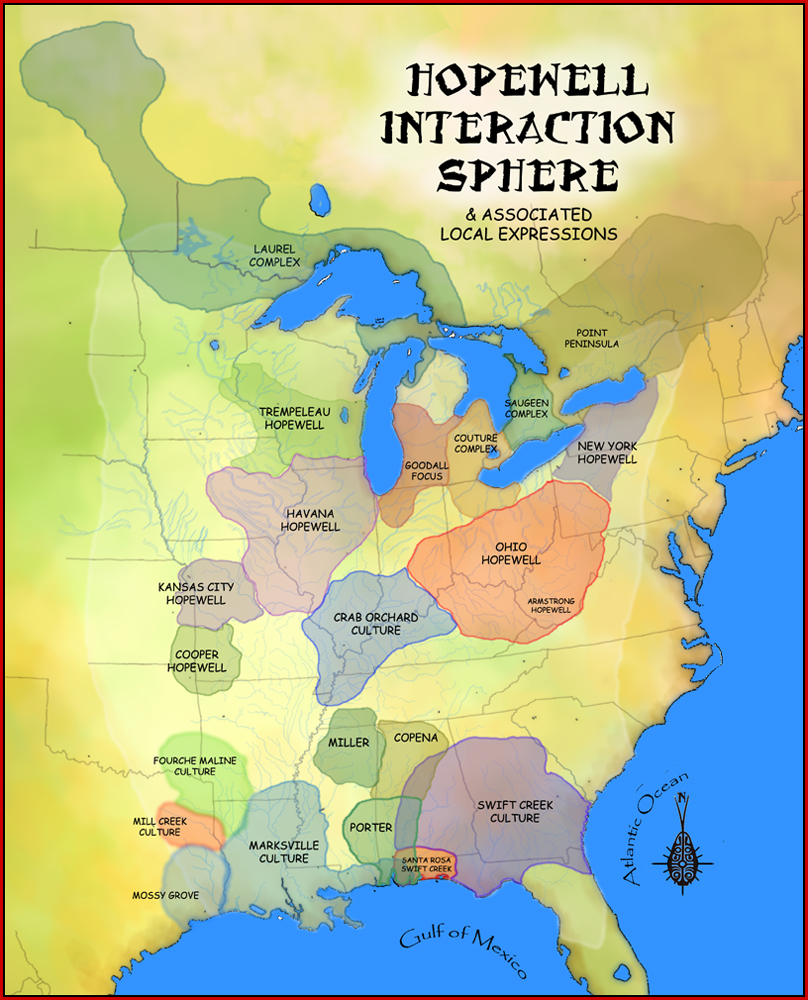
To start out with, I should briefly mention the Hopewell Interaction Sphere, affectionately known as the Pax Hopewelliana. The Hopewell are an cultural complex spread out along the Ohio and Mississippi River Valleys throughout the heartland of what is now the US (map). I should note here that the Hopewell were not, as far as we're aware, monolithic; this region would have been broken up into several large nations. The region marked as Hopewell Heartland corresponds to the Scioto / Ohio Hopewell, apparently the most influential of the Hopewell nations. Here's another map with a breakdown of the regional Hopewell expressions and neighboring Hopewell-influenced cultures (map).
They were contemporaries of the Roman Empire, the Han dynasty, and Teotihuacan; their ascent begins around 100BCE and their decline around 400CE. Hopewellian influences spread beyond borders of the various Hopewell nations, as mentioned, and their exchange routes went even further. Within Scioto Hopewell burials, we find silver from northern Ontario, copper from Lake Superior, shells from the Atlantic coast, alligator and barracuda teeth from the Gulf Coast, meteoric iron from the Great Plains, and obsidian from Yellowstone, among other items from distant lands.
The Hopewell, especially the Scioto Hopewell, are perhaps most famous for their monuments. Their architecture is immense--not so much vertically as horizontally. This image compares one of their monuments to several others that you might be more familiar with, and you can see how it would swallow them all. Keep in mind that's just one of several that they built in the same general area based on alterations of the same general plan. The Hopewell were expert surveyors, geometers, and astronomers.
At their largest single complex, the Newark Earthworks, they appear to have aligned the Circle-and-Octagon section in the northwest with the Northern Lunar Maximum, a point on the horizon to which the moon returns once every 18.6 years. No small feat considering the lengthy observations that would need to be performed before the monument itself could be designed and constructed. The circle in that portion of the complex is the same size as those built at the sites previously mentioned. Here's what that portion of the site looks like today, fortunately preserved, unfortunately a private golf course. Seeing how tiny the houses and cars in the area look in comparison should also help give you a sense of the scale. The math that goes into constructing these two shapes, carries forward through other elements of the complex. It's six Observatory Circle Diameters from the center of the Observatory Circle to the center of the Great Circle, as well as from the center of the Octagon to the center of the Square. The Observatory Circle's area is equal to the Square's area, while the Square's Perimeter is equal to the Great Circle's circumference.
The reason I bring up the Hopewell is because they achieved all this without cities (or even villages for the most part; they apparently preferred relatively isolated homesteads), without kings or emperors, without armies, without currency, without writing, without livestock, and with domesticated plants making up a relatively small portion of their diets. Without all the 'advanced' accouterments associated with civilization, they created a vast, interconnected, peaceful society (throughout the Hopewell period, evidence for violent death is vanishingly small). They were certainly prospering, even without following the small model applied elsewhere.
When Europeans first came into contact with both the Native Americans and Africans they were well ahead of them technologically, culturally, etc.
At the time of contact, the Haudenosaunee (Iroquois Confederacy) was one of the most influential and powerful Native nations and continued to be so until the American Revolution. I find it interesting that you say that Europeans were "culturally" more advanced at the the time of contact, considering that modern citizens of the United States (among other nations) would find European society oppressive and backwards compared to the liberties enjoyed by the Haudenosaunee and neighboring peoples.
For one, the democratic process was alive and well among the Haudenosaunee at the time of contact, with men and women both being politically active and holding prominent offices. Townspeople elected local representatives who appointed national representatives, who in turn, might return to their local constituents for a national referendum on particularly serious matters. The Gayanashagowa, their Constitution, includes numerous checks-and-balances to ensure no one can abuse the power the people have entrusted them with. The Haudenosaunee were (and continue to be) very proud of their political system and encouraged others to adopt similar methods, including pitching the idea to the English colonists in 1744 (probably at other times as well, but this is the most discussed instance because there's a chain of events leading from Canasetego's proposal to Ben Franklin and early pre-Revolution attempts to form a united colonial government).
The necessity for everyone to become informed and politically active citizens was one of the reasons they resisted either sending their children to Euro-American schools or having such schools established within their nation during the colonial era. Such schools did not teach the skills necessary for a successful political career (you may notice that the Gayanashagowa actually has a clause about education). As the aforementioned Canasetago said "But when [our children] came back to us [from New England schools], they were bad runners, ignorant of every means of living in the woods, unable to bear either cold or hunger, knew neither how to build a cabin, take a deer, or kill an enemy, spoke our language imperfectly, and therefore were neither fit for hunters, warriors, nor councilors. They were totally good for nothing." Before you start thinking that Canasetago was foolish for rejecting the Euro-American lifestyle, keep in mind that Iroquoian hunting and farming was already highly productive. In the 1680s, during a French expedition against the Seneca, Denonville's force reportedly destroyed 400,000 bushels of corn collected from four towns; a hundred years later, when Washington sent his own men against the Haudenosaunee, the Revolutionary officers likewise destroyed huge amounts of crops--160,000 bushels here, 200-acres there, 1500-tree orchards, and so on. And as the economic system of the Haudenosaunee was set up in such a way to distribute their produce equitably, none went hungry, at least when they weren't traveling. When Canasetago speaks of enduring hunger and cold, he's talking about the winter hunts, which are a special case, since the hunters had to travel light and their goal was to bring as much food home as possible rather than eat all their profits, so to speak.
Another reason the Haudenosaunee were reluctant to welcome Euro-American education was the Haudenosaunee attitude regarding punishment, especially of children. Euro-American educators infamously followed the adage "Spare the rod, spoil the child" and the Haudenosaunee were aware of this. They would not tolerate such abuse of children. Children simply weren't punished in such manner among the Haudenosaunee (and the Iroquoians and most other Native peoples for that matter), and such methods of punishment were regarded as barbarous cruelty. Luckily, most Euro-Americans have come around to the Haudenosaunee way of thinking about that, and now regard striking a child as abusive. Sadly, there's still a vocal few who bemoan the loss of that weapon.
Haudenosaunee women, too, enjoyed liberties uncommon to their counterparts in European society at the time of contact. Not only were they prominent politically and economically, they also had access to herbal birth control, a free choice with with regards to abortion, and legal protections against spousal abuse. Such freedoms and protections were (in some cases are) a long time coming in Euro-American society.
Does that make the Haudenosaunee more "advanced" than their European counterparts, thought? Certainly it seems agree more with our modern lifestyle than that of the Contact-era Europeans, but must we considered ourselves more "advanced" than them? But really, it's a value judgment. At best it can be an informed value judgment.
They way you phrase the question is problematic at best. I'm no historian, but I suspect that most academics wouldn't make the kinds of comparisons you're making because comparing the civilizations which came out of Eurasia to those which came out of Africa and the Americas is, as they say, apples and oranges. Additionally, assuming that all civilizations should have advanced in the same way as Eurasian civilizations is extremely Euro-centric and implies that American and African civilizations were/are inferior.