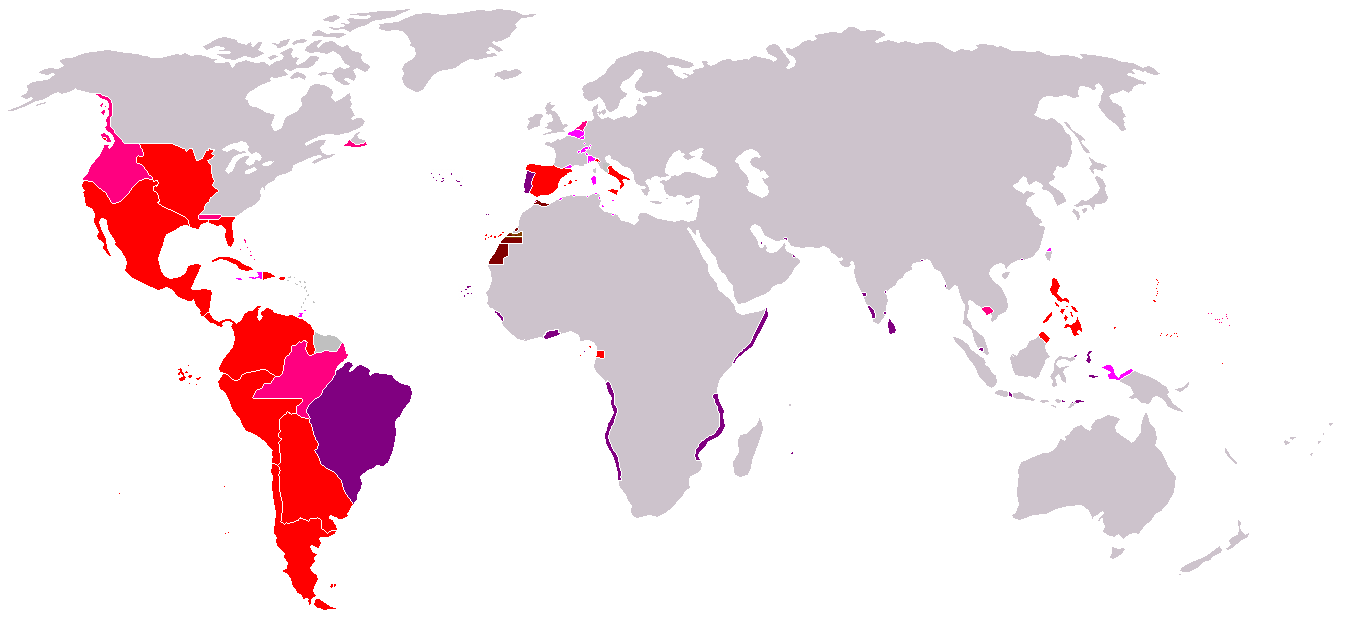
Charles V ruled one of the largest Empires in European history:
What was the process of him becoming heir to so many territories?
Was he raised as an heir to such a vast kingdom/empire? Did his early education prepare him to be such a mighty sovereign?
Why did he abdicate in favour of his son and brother?
I would be very interested to hear about any relevant historiography or biography around Charles V.
What was the process of him becoming heir to so many territories?
The Habsburgs were probably the most successful dynastic family in the Medieval period. Their dynastic actions brought them from minor barons to Holy Roman Emperors on the thrones of major realms throughout the Empire over the course of four centuries. In this particular case, the background for the rapid expansion of Hapsburg power leading up to Charles' reign were thanks mostly to the work of his grandfather, the Emperor Maximilian. Maximilian married the Duchess Mary of Burgandy, gaining vast (and highly productive) territories in the Lowlands and in Burgandy itself. From that marriage, he married his son Phillip to the Queen of Castile, Joanna, whose parents were the Queen and Kings of Castile and Aragon respectively (and she inherited the later title following her father's death). Enter Charles, who represented the merging of the lines of Castile, Aragon, Burgandy & the Low Countries, Austria, Naples, and the HRE under the paternal line of the Habsburgs. They were not the first to have such success of course; the Angevin's of England/Normandy created their empire in much the same manner.
Was he raised as an heir to such a vast kingdom/empire? Did his early education prepare him to be such a mighty sovereign?
Charles was educated in the Lowlands, and his education certainly would have prepared him to govern and be an effective military leader, but there is not much one can do to completely prepare for controlling such a large realm. However, even as he was being raised, it was not entirely clear he would be able to inherit the entire territory. His maternal grandfather, the King of Aragon, attempted to will his territory to another. The title of HRE at this point could very well gone to Francis of France, and Maximilian had to undergo a significant effort to maintain the Habsburgs on the throne of the Empire. Charles would have inherited the throne of the Archduchy of course, but control over the Empire was still a significant power to have. It's even possible someone else in his family could have taken over Austria as had happened in the past. Indeed, at birth, the only territories that Charles was 'guaranteed' to inherit were the Duchy of Burgandy and the Crown of Castile, both of which he had clear and relatively uncontested title to. He vigourously campaigned in Burgandy and the Low Countries to expand his power there for example.
Why did he abdicate in favour of his son and brother?
So there's the why did he abdicate, and why didn't he make his son his only heir. To answer the first question: health. Constant campaigning, combined with congenital illnesses thanks to the Habsburg's penchant for inbreeding, meant he was never meant to live a long life, but constant campaigning did him no favours.
Of course, the why of the first is also linked to the why of the second. Charles's empire was vast, yes, but it was culturally, religiously, and geographically divided by wide gulfs. Holding together the empire even without external forces would be a difficult task. Obviously though, given that Charles was at war almost his entire reign, external forces were also in play. France and the Ottoman's in particular were keen on ending this large empire, and should it have continued, we can assume other powers neighboring him would also have jumped in (Of course, those two alone are enough to create real havoc). Although Charles held his own during his reign, the constant warfare bankrupted almost every realm he controlled, adding to the internal strife. So, dividing the Empire would create tighter geographical units that could better cope, but also would still share familial ties and thus theoretically cooperate together (in this case, the obvious target would be France since the Ottoman threat was essentially contained). So from a geopolitical viewpoint, dividing the empire makes sense. The two main units he divided it into were the Spanish possessions, which included the Kingdom of Naples (which he granted to his son well before he officially abdicated, mirroring his own control over the Low Countries before he gained more power) and the German posessions; basically the Holy Roman Empire. The one that might appear strange is his son receiving the Lowlands, territory that probably would have been better off in the hands of the German side of the house under his brother. However, the Pragmatic Sanction of 1549 necessitated that they be inherited as a single unit by his son. This was signed to formally organize and guarantee Charles's earlier conquests and their integrity, but it had the side effect of preventing him from willing them away to his brother or dividing them in a more fair fashion. Having them as part of the crown of Spain made little sense though, although they do give a lesson as to what might have been the eventual fate of Charles' Empire had he tried to keep it, given that they revolted within a couple generations against their culturally and religiously dissimilar overlords.
The reason for two realms was also not just borne out of geopolitical necessity, but dynastic as well. The Habsburgs had in the past demonstrated a penchant for dividing their territory among various parts of the family, and with a family as large as this, infighting between members for such a large prize could be seen as almost inevitable. The territories themselves would have been ripe for such plucking by a coniving heir; if it had gone all to his son, you can bet that another Habsburg or even another German noble would have been able to claim that a Spaniard ruling over a German was no good. If his brother had gotten it all (or if his son had chosen Germany to focus on for himself and his heirs) the Spanish would have become resentful and another more Spanish Habsburg or domestic noble house would have placed themselves into power. It already almost happened in Aragon before Charles took power. Dividing the territory of the house to placate various claimants was standard practice in Europe. It wasn't ideal, but it often was prudent given the alternatives.
Oh he owned allot more than just half of Europe, try half of Europe, half of the Americas, the Philippines and a little bit of Africa.
European holdings-http://talal-9b1.weebly.com/uploads/6/7/5/4/6754229/6508821.jpg Global Holdings(Red)- http://upload.wikimedia.org/wikipedia/commons/a/a2/Spanish_Empire.png
QUESTION I: Charles V has two names, he was Charles V of the Holy Roman Empire and Carlos I of Spain.
He amassed so many territories thanks to his heritage, he had one of the most complex familial lines in European history but I'll do my best to simplify for you.
Mom- Juana la Loca (English Joanna the Mad) the heiress to the crowns of Castille, Aragon and Trastámara who passed them on to her son.
Dad- Phillip the Handsome. Son of Holy Roman Emperor Maximilion I (the Emperor preceding Phillip)and King of the Burgandian Netherlands who passed on his Valois-Burgundy and Habsburg crowns to his son.
Castille/Aragon/Trastámara gave him control of Spain, all western mediterranean islands, all of Italy that wasn't Papal State territory and the entirety of the Spanish Empire stretching from the modern day Argentina to Los Angeles with other Islands around the world.
Valois-Burgundy gave him the Netherlands in addition to the lands his father annexed by war.
Habsburg blood is the most important here as it gave him a claim to become the Holy Roman Emperor.
So what happened was, upon the death of HRE Maximilian I, the HRE electors looked at the qualifying monarchs and choose Charles/Carlos as Holy Roman Emperor over prominent names like Francis I of France and Henry VIII of England, it was at this time that his inheritances kicked in and he also gained the lands of his parents.
QUESTION II: Not in the least, his parents had no Idea that he would be chosen as Holy Roman Emperor or even a possible candidate, in fact, I don't think his mom had any ideas at all (she really was crazy). His early education actually stiffened his ability to rule. See, he was raised in the Burgundian lands of his father, so he grew up speaking French. Which was a huge problem as the majority of his territories spoke Spanish. Despite being the Spanish sovereign, he never really learned to speak Spanish well and wasn't much interested in Spanish culture to begin with. If you've ever compared the Spanish of a Latin American and a Spaniard from Spain, you'll notice a lisp-esque accent from the Spaniards. A popular theory for this was that since Charles V spoke Spanish with a lisp, that he could speak it at all was a miracle, he forced the Spanish to do as he did. This is however, under much debate but a fun and interesting possibility. His love of French culture ("Paris isn't a city, its a universe"- Charles V) also played against him as the French and Spanish were traditional rivals. And he had almost no connections to the German speaking HRE states like Saxony due to his lack of exposure to German/Austrian culture. However, the one part of his upbringing that did do him some good was his religion. Charles was a devout Catholic and it made the Papal states favor him deeply, which was part of the reason that he was made Holy Roman emperor.
QUESTION III: The simple answer? He got tired. The complex answer? A combination of age, stress, political upheaval and constant warfare prevented him from enjoying even a second of his rule. The French, the traditional enemies of the Spanish, now had twice the reason to oppose Charles as the HRE holdings + Spain put Francis I into a vicegrip. The Protestant Reformation also turned violent at this time and Charles due to his close ties to the Vatican had to put down rebellion after rebellion that arose in his own empire. Very rare was it that the Emperor of half the known world ever had but a moment of peace. And even rarer did he receive a hint of gratefulness from his own people. The vast majority of his subjects from peasants to princes hated him, half of them wanted him dead for religious or political purposes and all of them demanded his full attention. And don't forget all that was expected of him as the Soverign of each of his domains. Charles lead a life of nothing but fixing problem after problem, not all the power in the world could make his reign enjoyable, and all the power in the world he had.
This part is personal, but I believe that the responsibility of governing an empire of such size while dealing with seemingly endless wars combined with mental/physical deterioration due to age simply broke Charles. He couldn't handle it, I don't know how many people if any could have.
To add to the great answers here.
Question 1: Why all the inheritances?
It is insightful to go back 2 generations, to the days of the Catholic Monarchs Isabella and Ferdinand. They inherited the crowns of Castille&Leon and Aragon respectively, with a pre-nuptial agreement to rule at practically equal levels. And indeed, they worked together quite well in harmony. During their joint rule, they pursued alliances with various other powers: Portugal, England, Burgundy, Austria, and to some extent even the French. Alliance with Portugal was key in order to secure peace in the Iberian peninsula, especially with certain anti-Isabella factions having strong Portuguese support. With Burgundy it was because of the trading relations between northern Castile and the Low Countries which were in Burgundian control at the time. The English wanted Spanish support against France as they just concluded the Wars of the Roses.
So Isabelle and Ferdinand married off their children accordingly:
Eldest daughter Isabella married Alfonso of Portugal, but Alfonso died before they had children. She then was married to Manuel of Portugal who was named heir, but died while giving birth to son Miguel. Miguel was then heir to the thrones of Castile and Portugal until he died aged 2.
Eldest son John married Margaret of Austria, but died young and didn't have issue.
Joanna ("The Mad") married Philip I son of Maximilian I Holy Roman Emperor, who inherited Burgundy from his mother Mary.
Maria was married off to Manuel of Portugal, even though she was originally supposed to marry King James IV of Scotland. Her son John III became King of Portugal.
Catherine married Arthur, heir to throne of England who then died young with no children. She was then married to Henry VIII eventual King of England.
The first two children basically died young and all their issue also died very young, thus somewhat unexpectedly the inheritance of Castile went to Joanna and her husband Philip the Habsburg.
Initially the heir apparent was the oldest son John who had married Margaret of Austria. However, he died soon after the marriage, with no issue. Succession then passed to oldest daughter Isabella and Manuel of Portugal, but neither this Isabella nor her son survived long. Succession then fell to Joanna and husband Philip, but not without protest from many factions. The Cortes of Castile considered enacting a Salic law but eventually accepted Joanna as heir, but the Cortes of Aragon outright refused to accept her. Further, at this point Joanna's frequent instability meant that Philip would be the de facto ruler.
When Queen Isabella passed away, King Ferdinand tried his best to maintain control over Castile lands however he was rebuffed by the Cortes of Castile who preferred Philip who was considered more pliant. Eventually an agreement was reached that Ferdinand was to be regent after Philip I died, until such time Charles V would be king of Castile.
During this time Ferdinand married a much younger Germaine of Foix as part of an attempt to sire his own heir that would inherit the Crown of Aragon. Unfortunately this did not come to fruition.
Basically, even before Charles V became King of Spain among other titles, the situation in Spanish lands was already complicated and full of tension, and many factions in Spain viewed him as a foreigner.
When the time finally came that Charles V was to be king, the Crown of Castile passed to him in a relatively straight-forward manner while the established Aragonese swore allegiance to his then still-living mother Queen Joanna instead. Eventually he was elevated to be a joint King of Castile and Aragon with his mother Queen Joanna. Not that the Castilians were meek: as a condition Charles V had to learn to speak Castilian.
After all this, upon Charles' election to Emperor of the HRE in 1519, the Castilian revolted in protest of what they saw as foreign encroachment and expectation of heavy taxes to find Charles' foreign adventures.
So in this long post I've only covered the complex situation of the Spanish side of Charles' empire, and only up to when he finally managed to pacify the populace. Imagine how complicated things are in Austria, and in Italy, and in the Low Countries.
Question 2: Why not give everything to Philip II
On the German side, at the time of his election to HRE in 1519 the young Charles was merely Duke of Burgundy, not yet Archduke of Austria, even though shortly before the election he was King of Spain before it was Spain. That election was extremely hotly contested, with the two leading candidates Francis I of France and Charles.
Charles V was traveling from court to court as was the custom of that time. While was not in German lands, his brother Ferdinand was put in charge of governance in his absence. At this point Ferdinand didn't have much in terms of personal dominion. So in 1521 Charles made him Archduke of Austria to give him more authority in the eyes of his (or their) German subjects.
However, in 1526 he unexpectedly became King of Bohemia and Hungary with the death of his brother-in-law in the Battle of Mohacs, without issue. This means he inherited lands that were contested by, and under attacks from, the Ottomans. This was also the first time a Habsburg was nominally the Holy Roman Emperor while also King of his own personal dominions; previously they were merely Archdukes of Austria and Dukes of Burgundy.
Among other things, Ferdinand was able to be more assertive than he was previously. In 1531 he was elected King of the Romans, which usually leads to HR Emperorship. Further, at the Peace of Ausburg in 1555, he inserted the infamous "Ferdinand's clause" that exempted knights and some cities from religious uniformity. Given all that, it wasn't very hard to imagine that when Charles retired as HR Emperor, Ferdinand took over.
If you were Charles V, having to fight constantly all the time and putting up with all sorts of different laws and ambitious allies and enemies alike, would YOU want to insist on keeping the empire under one rule? I wouldn't.
All of the above, other than the last paragraph which is pure conjecture, are from J. H. Elliott's excellent "Imperial Spain: 1469-1716".
Question 3: Why Spain, Sicily and Naples, Low Countries, Burgundy on one side, and HRE, Hungary, etc. on the other?
Well perhaps some are obvious (Castille & Leon claims, Aragon titles, etc.), but that the Low Countries went to Philip II is still not clear to me and I'd love some input.
I know that Charles V declared the Pragmatic Sanction that converts the various fiefdoms of the Low Countries into one dominion that has to stay integral. Maybe he was born there, so he wanted his son to have it. And if Philip II were to keep the Low Countries, it makes sense for the Burgundian lands to go to him, too, since they all used to be one parcel thanks to Mary of Burgundy. Plus, Philip will need land access to send his Army of Flanders there to keep the Dutch under some control.
Anyway, fascinating era and now my lunch break is over. Enjoy!