Hi everyone,
I'm watching Saving Private Ryan and I was wondering how the soldiers that entered the beach on D-Day survived it. The way the film portrays it is that there were a lot of bunkers and machine guns firing. Now I know of my history lessons that that's true, they build bunkers on the beach.
But how could the allied win if they were being gunned down everywhere? Was it that there were so many soldiers that the ammo ran out of the Germans or were there other advantages to the allied forces.
I searched about it on /r/AskHistorians but I couldn't find this question or one that looked alike it. If it's already been asked, sorry for posting this one.
Cheers!
The Allies had arguably one of the best counter-intelligence programs in the world and they put a great deal of effort into deceiving Germany about where the actual landings would take place.
They also implemented a massive bombing/naval bombardment in order to soften up the beaches. Unfortunately a lot of this bombing was ineffective since most of it landed well behind the beaches. I believe another user mentioned that some destroyers moved closer to shore to provide more effective support for the infantry. There was also a limited amount of armor that successfully landed on the beaches. They split their time between providing cover for the infantry and taking out emplaced positions.
The Wehrmacht along the coast was a mix-match of different nationalities which helps explain why some units were more eager to surrender than others.
The entire landing area wasn't fortified to a consistent degree. Some places would be a blood bath while some of the landings were virtually unopposed. Where there wasn't bitter fighting happening, the landing forces were consolidating and pushing inland to seize key objectives (towns, bridges, etc.) It was confusion and chaos for the Germans as much as it was for the Allies.
The German command wasted precious time responding to the invasion. A big reason for that can be traced back to Hitler and his insistence on being heavily involved in the strategic aspect of the war.
The book I got this from, D-Day by Antony Beevor, goes into much more detail than I did.
Firstly, you have to recognise that the film depicts Omaha Beach. This was by far the bloodiest landing beach and the one where the assault came closest to failing. The terrain there was much tougher, since there were great bluffs overlooking the beach, and there was both a lack of space on the beach and very few points where the attackers could get off the beach. Due to these difficulties it was only reluctantly that the planners decided to attack Omaha at all, and it merely served to provide a link between Utah and Gold beaches. Things went much more smoothly at the other beaches, and one of the major factors in this was the use of armour.
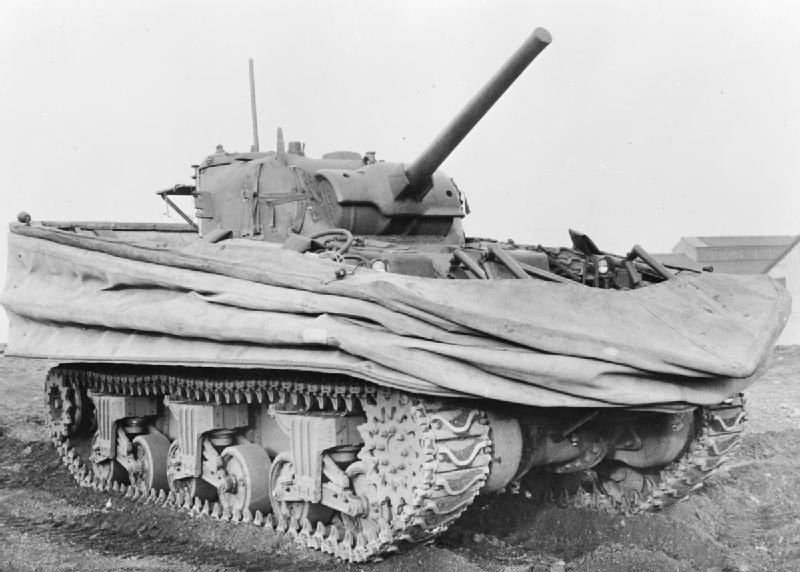
The Americans made use of DD (Duplex Drive) tanks, based on the Sherman, which could swim up to the beach. On Omaha, rough seas combined with the fact that the DD tanks were launched 5000 yards from the shore (i.e. too far) caused 27 of the 32 tanks to sink. No DD tanks sank at Utah, and along with the much flatter terrain, and the efforts of the airborne divisions which had been dropped in that night, this made the assault there much more successful.
The British had even better armoured support, in the form of 'Hobart's Funnies', named after Major General Percy Hobart, a pioneer of armour who had been brought out of retirement for the purpose of designing vehicles to crack Hitler's 'Atlantic Wall'. These included the AVRE (Armoured Vehicle Royal Engineers) armed with petard mortars capable of demolishing the toughest German defences, bridge-layers, ARKs (Armoured Ramp Carrier) and 'Crocodiles' armed with flamethrowers. Although the German defences on Gold, Juno and Sword were tough, incorporating the existing sea-wall and terraced housing along the seafront as well as purpose-built concrete bunkers, the AVREs allowed these defences to be overcome with relative ease. These vehicles were offered for American use, but declined.
So the lack of armour on Omaha was the most obvious factor which distinguished it from the other beaches, and as a result the assault went much less smoothly there than it did everywhere else. There's a strong strand in the historiography of D-Day that hold that had armour of any kind, but particularly AVREs, made it onto Omaha beach, the assault would have gone off with only the most minor of setbacks, as it did everywhere else. In the end, the situation at Omaha was saved through the extreme courage and tenacity of the assaulting troops and direct naval fire support from destroyers just off the coast.
The pre-landing bombardment effectively neutralized four of the five beaches; only at Omaha did the defenses survive largely intact. Omaha possessed bluffs, broken by narrow draws, at which the Germans could concentrate defenses. Further, Omaha was the only beach garrisoned by a regular infantry unit, 916 Infanterie Regiment. The other beaches were defended by static garrison troops of lower quality. This combined to result in the first wave of attackers being virtually wiped out, but as further waves arrived, men worked their way forward until they were close enough to begin assaulting German positions. The beach wasn't fully cleared until the next day, when the remnants of 916 IR withdrew.
The german forces defending the area of invasion were NOT the best forces.
Take a look at one German force defending. The 716th Infantry Division was a static division, meaning it wasn't designed for movement. Further is was created in the 15th wave of mobilization in 1941, at this point the German army had taken most of the people best fit for service, this division was made up of German soldiers who were not fit for the western front for medical reasons or older, conscripted Polish nationals, and Russian POW's. They had no previous experience fighting. These were some of the soldiers at Gold, Juno, Sword, and Omaha.
Well one reason is that there wasn't many blockhouses on d-day landing site. They were mostly concentrated further north where France and England are closest. At Omaha beach there were a few and killed enough people to make the general in charge of the beach almost abort the landings. Luckily destroyers were able to move In very close to shore and suppress them with 5in shells