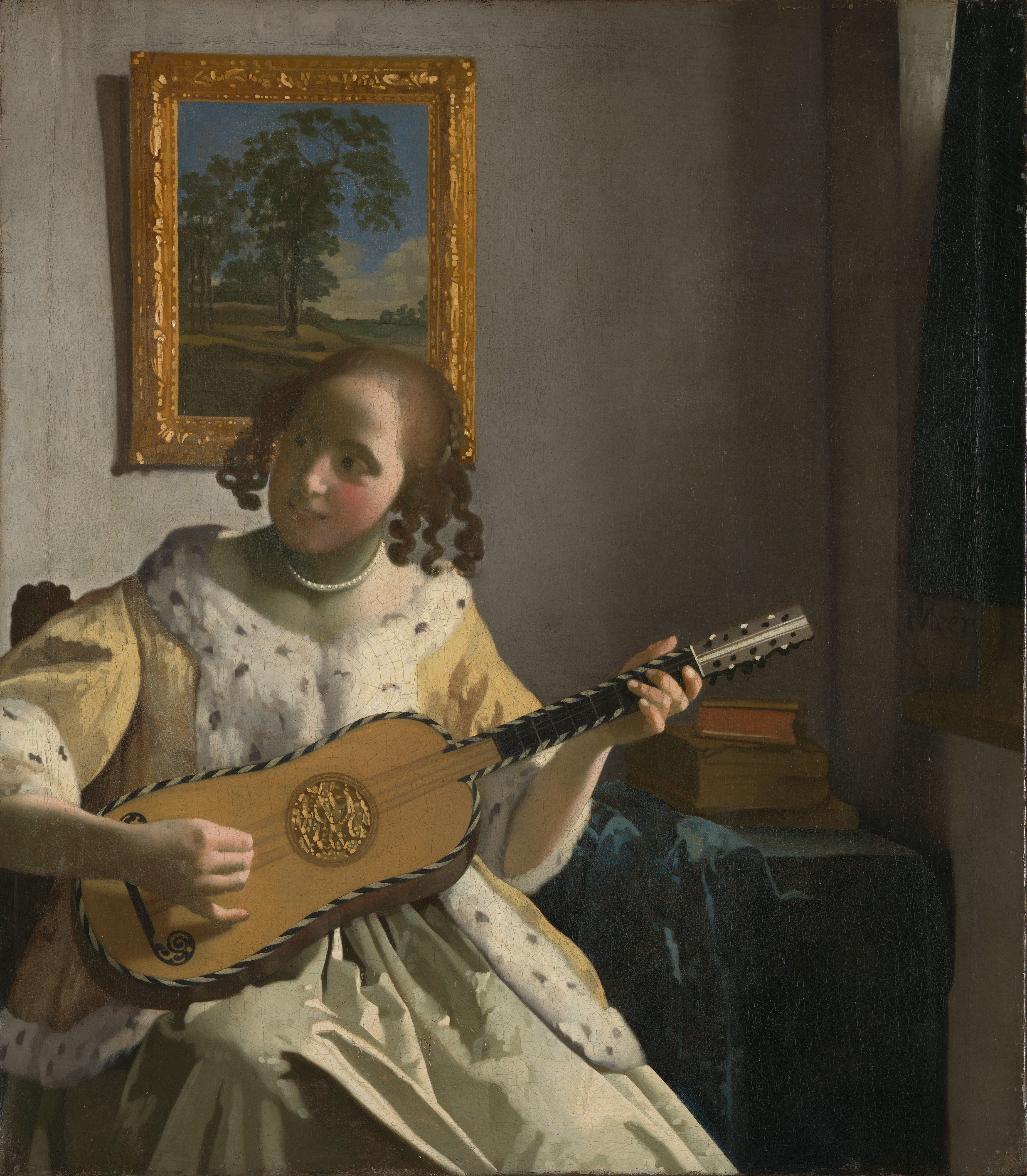
I have been playing classical guitar for about 4 years, and there is a generally accepted method of how to sit/orient the guitar/etc. that has been written in works such as Christopher Parkening's guitar method book. Was that different with the Baroque guitar, and is Vermeer accurate in his depiction of a Baroque Era guitarist?
EDIT: Here is the painting in question.
Vermeer's portrait is clearly posed and it's possible that the subject doesn't actually know how to play the instrument or doesn't play very well (the thumb over the top of the neck is a bit of a giveaway of bad technique, although it could just be a concession to comfort while sitting for the portrait), but other than that, it appears to be more-or-less accurate. For reference, here is a video of a modern performance on a Baroque-era guitar.
As you can see from both the painting and this video, the body of the Baroque instrument was narrower and smaller than a modern classical guitar, and it had five doubled strings (so ten actual strings total, but paired up so that there were only five discrete pitches for the open strings).
The bottom two strings of the Baroque instrument (A and D) were often tuned an octave higher than they are now (source). The addition of the low E string and the removal of the doubling strings on the modern instrument were late 19th century Italian innovations.
Because of the smaller size, the modern playing pose — with the butt of the instrument resting on the right thigh and the body supported by the raised left knee — wasn't possible, so it was either rested entirely on the right thigh or supported by a shoulder strap (or both).