A question like this was posed in r/AskPhilosophy, but I'd be interested in a historical perspective. Throughout Plato's writings Egypt is portrayed as a country that serious seekers of truth needed to visit in order to cultivate wisdom. Near the end of his Phaedrus dialogue is one of my favourite passages in all Plato's works, where Socrates recounts a myth of Thoth presenting his invention of writing to the god-king Amun as a way to improve memory, and Amun criticizes it, suggesting it will do just the opposite.
It's not just Plato though, other Greeks such as Pythagorus and Thales are reputed to have traveled to Egypt to be instructed by the priests.
The thing is, I have never once heard of an ancient Egyptian philosopher, or a philosophical text from ancient Egypt. When I say "philosophy" and "ancient Egypt" I'm thinking in of both those terms in a broad sense. By philosophy let's say any sort of instruction, debate or writing about the nature of reality, knowledge or ethics. Something like the Thoth/Amun myth I mentioned earlier would count as philosophy for the purposes of this question. By ancient Egypt let's say any period of time in Egypt prior to Alexander the Great's conquest.
If there was something like philosophy in Egypt, what form did it take? If there was no philosophy, why not?
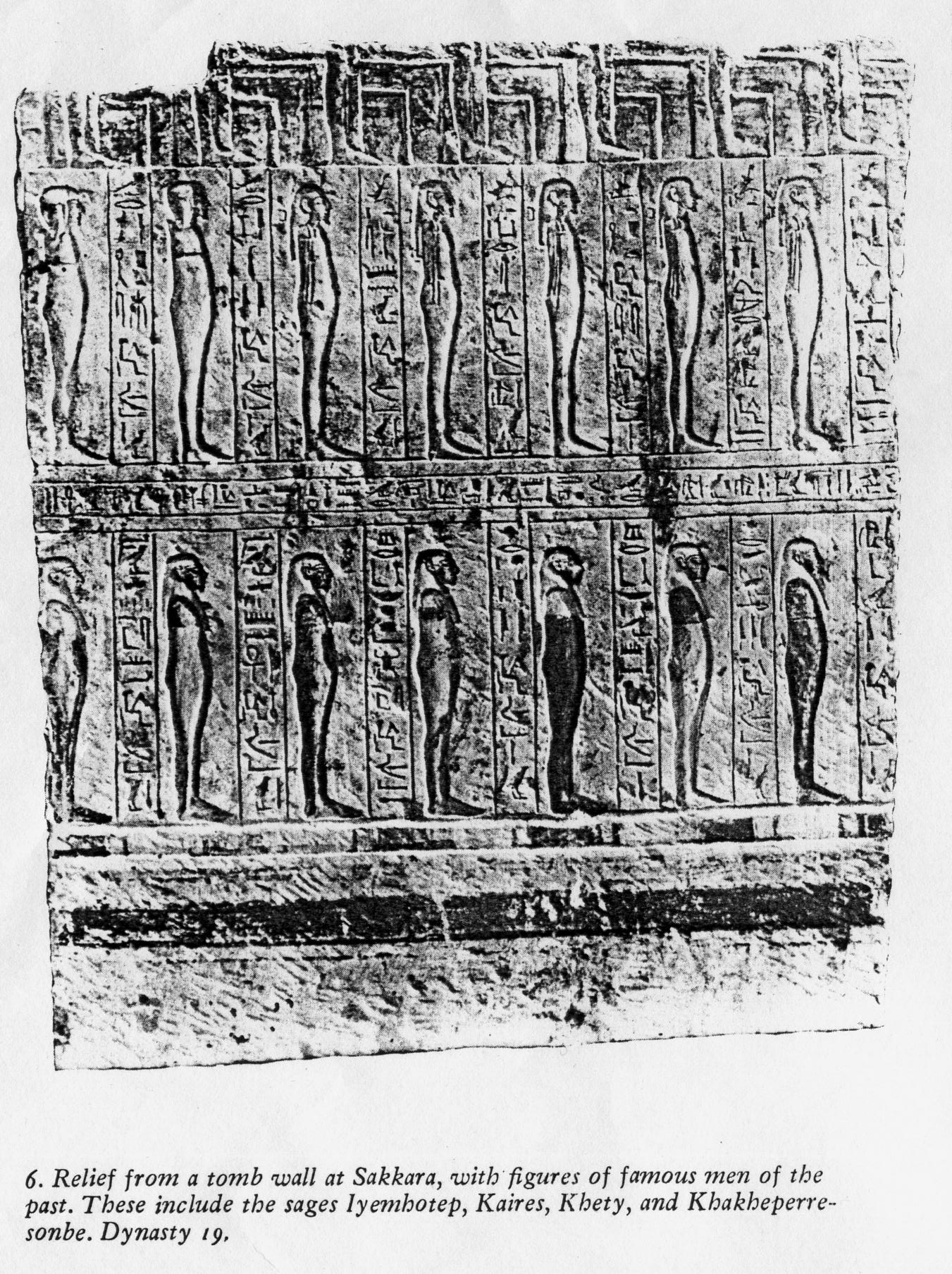
"Is there one here like Haredef? Is there another like Imhotep? None of our kin is like Neferti, Or Khety, the foremost among them. I give you Ptahemdjehuty, Of Khakheperre-sonb. Is there another like Ptahhotep, Or the equal of Kaires? Those sages foretold the future, What came from their mouth occurred; It is found as pronouncement, It is written in their books ... It is read in their Instructions. Death made their names forgotten But books made them remembered! (P. Chester Beatty IV)
...and here they are: meet the great 'sages' of Ancient Egypt. Of the 8 mentioned in the oration, we have texts attributed to 5 of them:
These authors were myth, there is no definitive proof of any of them (some people have made a case that Ptahhotep has a tomb at Memphis but the argument is weak - the language of the teaching is 12th dynasty with a few linguistic archaisms and the tomb is 5th dynasty). Egypt had an effective manuscript tradition and texts are usually anonymous, the remaining versions we have of these texts are often a lot later than their estimated composition date. However for some reason these texts were maintained and copied repeatedly for hundreds of years - valued in the metaphorical classroom for education trainee scribes and preserved in private library(s) (cf. the library of Qenherkhopeshef from Deir el-Medina).
Under modern scholarship these texts fall under the banner of 'wisdom literature', a rich collection of texts when compared to the entire corpus of texts we have from Egypt. There are two approaches of a wisdom text: what you should do (teachings/instructions etc) or a fictional 'look what happens when you don't follow the rules' (lamentations). Both approaches have the same aim to proselytize and educate the reader about the ideology of Maat - I'd like to call Maat a philosophy but you can be the judge of that.
Maat, usually translated as truth, is the thought-process that all Egyptians were supposed to live their lives by. By living your life in line with the tenets of Maat, order kept chaos at bay, Egypt marched onwards and the individual was rewarded. Its all fairly standard stuff - don't fight, listen, respect your elders and betters, manage your family etc. Its all about reciprocity, a good son buries his dad properly and sends him off into the afterlife with everything attended to. In return dead dad will beseech the Akh.w (eternal beings) to help out his family and when it comes son's turn to die and his heart weighed against the feather (symbolic of Maat) its extra points on his side of the ledger.
The teachings were didactic texts on the application of Maat to the everyday life of an elite man giving advice on exactly how to deal with different situations and people so everything works out ok. The lamentations were a little bit different, they were fictional texts investigating a world without order, without Maat. The Dialogues of Ipuwer for example are an interesting interpretation on the first intermediate period as a time of famine, rampant crime and injustice and general misery. Between these two extremes Maat was maintained will into the Graeco-Roman period.
These instructions and lamentations would cover your ethics and knowledge criteria - I particularly recommend reading 'Discussion Between a Man and his Ba' which is a debate between a man's head and his heart/soul as to suffering and existence. For the nature of reality we can turn to theological texts. Egypt had a great many different theologies and cosmologies which had their focus in different areas of the country at different periods. The Heliopolitan theology for instance which foregrounded the role of Ra was popular at the end of the Old Kingdom, the Amun focussed Theban theology had rise in the New Kingdom and Third Intermediate Period. These theologies covered creation myths, the layout of the pantheon and which deities had which roles and through these means difficult natural phenomena were debated and explained by the Egyptians. I would take a look at the Onomasticon of Amenemopet too - an ambitious project to list everything in existence - its philosophical merit comes from the fact that it is a ranked list so you can see where things were placed in the Egyptian cosmos and the order they were placed in.
Does this count as philosophy?