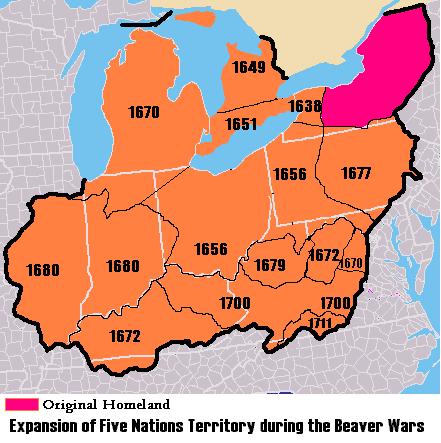
Although many of the motivations of Native American First Nations would be similar to our more familiar concepts of war, like the need for expansion and the want of more land, I am not quite sure why any of the Native American [against other Native Americans] wars actually happened.
What are some examples of why one tribe in the US, at any time in the Native American growth before colonisation by Europeans, would go to war against another tribe? Why'd they do it?
The Erie-Haudenosaunee War in the 1650s might serve as an example. It's not pre-colonial, but Europeans only heard about it second-hand as they had no presence in the area.
In the 1650s, the Erie (located along the southeastern shore of Lake Erie from about Buffalo, NY to the outskirts of Cleveland, OH) seem to have harbored Wendat refugees fleeing from Haudenosaunee conquest of Wendake (or as the Haudenosaunee would have put it, the liberation of Wendake from French control). These Wendat refugees brought French firearms with them and instigated a new war with the Haudenosaunee. By 1653, the Erie were burning Seneca towns (the Seneca are the westernmost of the Haudenosaunee). The timeline of the Erie-Haudenosaunee conflict from here is a bit confused. We know several major events, but not precisely when they occurred. What follows is thought to be the most likely sequence, but is by no means certain:
After the Seneca towns were burned, a delegation of 30 Erie ambassadors were sent to the Seneca to help negotiate peace. At the peace summit, a confrontation occurred, beginning with an Erie killing a Seneca and resulting in only five of the Erie ambassadors escaping with their lives. Not long afterward, an Onondaga (the central-most members of the Haudenosaunee) war party passed through Erie territory on their way home from Lake Huron and were attacked. Two of the Onondaga were captured and one was presented to the sister of one of the deceased Erie ambassadors. This was standard procedure in an Iroquoian society; if your relative was killed by an enemy, the proper response was to capture a member of the enemy and give him or her to the women of the deceased's clan to determine how justice should be carried out. Usually, the captive would be adopted as a surrogate for the deceased and the matter considered resolved. More rarely, the captive would be executed. Unfortunately for the Onondaga captive, the ambassador's sister opted for execution despite prior promises of adoption. Unfortunately for the Erie, the captive was Anenraes, a prominent and popular leader among the Onondaga. The Erie-Seneca conflict had now expanded into an Erie-Haudenosaunee conflict.
In the summer of 1654, four of the Five Nations of the Haudenosaunee convened a war council; the Mohawk don't seem to have attended, but joined the fight later, adding 700 men to the 1200 that the Onondaga were fielding (we don't know the numbers for the other nations). The campaign against the Erie in the early fall of 1654 was successful, but not complete. The Erie were regarded as a numerous and formidable opponent (French reports estimate that the Erie could be guaranteed to have 2000 fighting men of their own during the initial conflict), and in 1655 the Onondaga were requesting military aid from the French to assist their continued campaign against the Erie. Unfortunately, 1655 is also a blank spot on the historical map for this area, as the Jesuit Relation, our main historical source for the area, is missing for that year. The record picks up again with the Jesuit Relation of 1656, which shows the Erie-Haudenosaunee War still ongoing, but the tide was turning in the Haudenosaunee's favor. By the end of 1656, the Haudenosaunee were victorious and the Erie scattered. The Erie diaspora likely accounts for the far-flung reports of Erie as far west as modern Toledo and as far south as Pittsburgh that show up on maps occasionally. The latest surviving post-diaspora Erie settlement surrendered to the Haudenosaunee in 1680 in (West?) Virginia, though it's possible some went further south and were known by a different name there (this being one of the leading explanations for the sudden and rather mysterious appearance of the Westo).
I should take a moment to mention the Beaver Wars, which the Haudenosaunee-Erie war was part of, in general terms at least. During the Haudenosaunee-Erie war, many Erie were taken captive and adopted into Haudenosaunee communities. As mentioned, adopting captives was a standard practice. In older times, the Haudenosaunee fought mourning wars. These were usually small scale conflicts meant to take captives to restore balance to a community after a sudden death (or bring justice to an enemy that had inflicted that death). In a sense, the Beaver Wars were a mourning war writ large, as one of the reasons that encouraged the Haudenosaunee to choose war as readily as they did during the latter half of the 17th Century was a desire to replace citizens lost to the waves of epidemics sweeping over the land at that time. There were also economic incentives, as the Haudenosaunee claimed a sizable region in which to hunt and gain the furs needed to fuel trade with Europeans. These two factors--the quest for adoptees and hunting territory--encouraged the Beaver Wars, but each phase was had its own separate trigger, as with the Erie example here.