It seems like any time drones are mentioned on a public forum, a handful of people champion the idea and point out all the things they'll soon revolutionise while the majority of people are terrified that they'll soon be under constant surveillance or at the receiving end of a hellfire missile.
A century ago when aeroplanes started coming onto the scene, was there similar panic and debate? What were the big fears of the time in regards to them?
I think that you first need to establish your premise that drones have caused "public hysteria and debate" beyond a few people on the web. Surely if it was the case there would be some evidence of significant public pressure for policy change? (And establishing that risks running afoul of the "No current events rule", bit of a catch 22 really.)
It might be easier to establish that there has been "public hysteria, etc" in target countries rather than the West.
I can't speak to the public debate, but I can address how some reacted to the employment of airplanes in the interwar period.
You may be interested in Giulio Douhet. He was an Italian General and an advocate of air power and strategic bombing. After WWI ended, he wrote The Command of the Air. This book advocated the use of huge fleets of bombers to attack your enemy's cities. According to Douhet, the horrors inflicted using conventional bombs, incendiary devices, and poison gas would cause the enemy's civilian population to rise up against their government and demand peace. Douhet had equivalents in other nations, including the American Billy Mitchell, the British Hugh Trenchard, and the German Walther Wever.
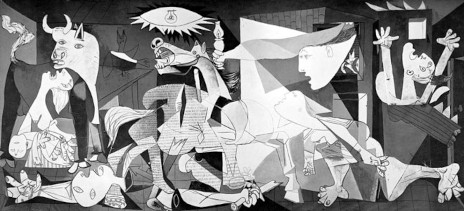
As with any other military expenditure, the acquisition of bombers was debated by every military that could afford the expense. Targeting civilian populations with bombers was practiced before WWII began--most notably in the 1937 bombing of Guernica but there were also bombings in the Second Sino-Japanese War starting in that same year. Most newspapers around the world condemned the bombings, and many heads of state also spoke out against the targeting of civilians. To retreat to my own specialty, the Vatican was an early opponent of the concept of strategic bombing and remained opposed to the idea throughout WWII.
The horrors of strategic bombing were seen as novel in the 1930's. This was exemplified in Picasso's Guernica, as well as photographs and accounts by journalists. There were certainly fears that in the next war, cities would be wiped out from the air. These fears were later realized in thousand bomber raids featuring incendiary bombs, and later by single planes carrying nuclear ordinance.
So, my answer doesn't address the reaction to the first uses of the airplane, but it may give you some idea of how airplanes were viewed in the period between the two world wars.
Strictly speaking i'm off-topic, but before the advent of planes the proliferation of airships caused 'panics' and 'scares' in the US in the last years of the 19th C, and in the UK in the early years of the 20th C.
The UK 'sightings' are discussed in this paper, from 1980 - http://magonia.haaan.com/2009/airships-and-invaders/ Quote: The ambiguity and bizarre nature of some of the airship sightings, the fear of alien invasion, the existence of foreign spies and mad inventors, allied with secret government investigations, in the 1900′s, parallels the modern day UFO phenomenon, which also presents witnesses with strange encounters, the fear of alien (extraterrestrial) invasion, men in black, and secret government involvement.
Somewhere I've got a paper on the American airship 'sightings' - I'll see if I can find it.