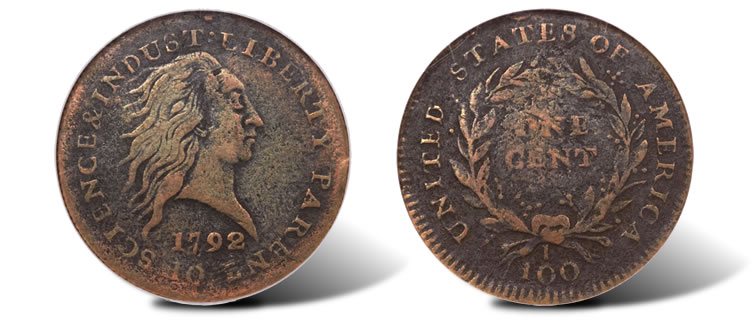
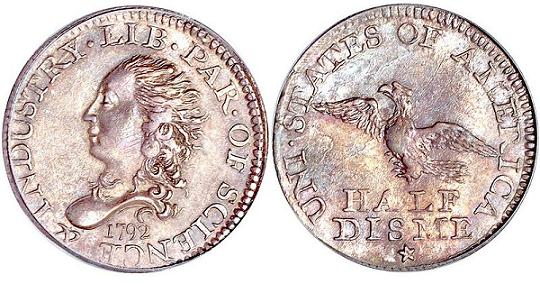
The US started minting its own currency in 1792 under the Coinage Act of 1792
Alexander Hamilton, the first Secretary of Treasury was charged with job of establishing a US currency and mint. Hamilton was a firm believer in a bimetallic standard (gold and silver)
Hamilton's denominations were copper half cents and cents; silver half dismes (5 cents), dimes, quarters, half dollars and dollar; also were gold eagles (being worth $10), half eagle ($5) and quarter eagle ($2.50).
The people were willing to accept literally anything as currency. Copper, not considered legal tender, was made into tokens by private mints and circulated. Even farther fake copper tokens were readily accepted, the people did not care they wanted anything.
Lastly the coins were made out of the precious metal, the value was intrinsic. The copper, silver and gold respectively were worth if not all their weight an acceptable amount at least.
Tl;dr How the Coinage Act of 1792, The Worth comes from the intrinsic value and also the desperate need at the time for an medium of exchange.
History of the United States mint and its coinage, David Lange
The US constitution gave Congress the power to manage and regulate currency. It might be wiser to dip back to the colonial period though, as the history of currency in the US starts before the US. Even after the establishment of the US, you still had Texas running it's own currency till it was admitted into the union. The confederacy had it's own currency. I could go on.
Currency in traditional thought can only ever derive value from one of three (or four or five depending on how you organize and categorize things) sources- inherent value or economic value.
A very common method of establishing the value of a currency, especially for new states in the industrial period, was to set the state's currency against a given quantity of something. Silver or gold were the most common methods- hence the "gold standard" term- because even if there was doubts as to how stable a currency might be- economies could boom and implode in a matter of hours, and the Great Depression wasn't the first or last time it'd happen so suddenly- gold always held a value because there was always someone who wanted it. Another state, another bank, would recognize and honor it's value. Paper money initially wasn't terribly popular because it was basically seen as buying on credit, except that for the average consumer it wasn't entirely clear the US government and banking establishments would be able to honor the value of the paper currency properly.
Today, another application of this idea would be the Petrodollar. It's not exactly my wheel house so I won't go into it, but needless to say, it essentially set the value of X barrels of crude oil from participating middle eastern countries to Y US dollars.
Another method was to make the currency valuable in itself. In 1792 when the US Mint was established, the US dollar (a coinage in the Spanish Milled Dollar tradition) was to contain "three hundred and seventy-one grains and four sixteenth parts of a grain of pure, or four hundred and sixteen grains of standard silver". Every coin in US circulation has at least some value, and ironically it's often the case that, say, a penny, is actually worth more than the cost of production. The US looses money simply because the value of the copper in a penny is higher than the penny itself. US quarters used to contain silver, Silver Dollars, as the name implies, had silver in them. Gold dollars have some measure of gold in them, and so on.
The last (two) method of how the US dollar, and the most applicable today, is the value of the currency in it's own market. Which is to say, the value of the country's labor, and the value of what the country physically produces. GDP. In a rapidly modernizing globalized economy, it's important to understand the value of the US dollar in her own market, because it sets values. If you're a Japanese car maker and you sell your econobox in the US much to the loathing of domestic industry, you need to know what the US dollar actually goes for so you don't bankrupt yourself. Visa Versa when your country buys 10 Boeing aircraft, you have got to have some idea of what the US dollar is worth, because you're signing a loan for the thing that'll run you millions. And since the economy isn't controlled, there's no standard for how many dollars a man-hour is worth.