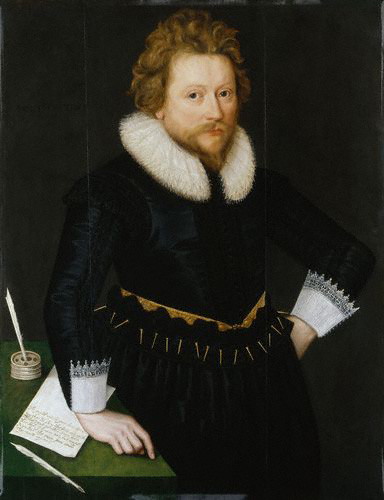
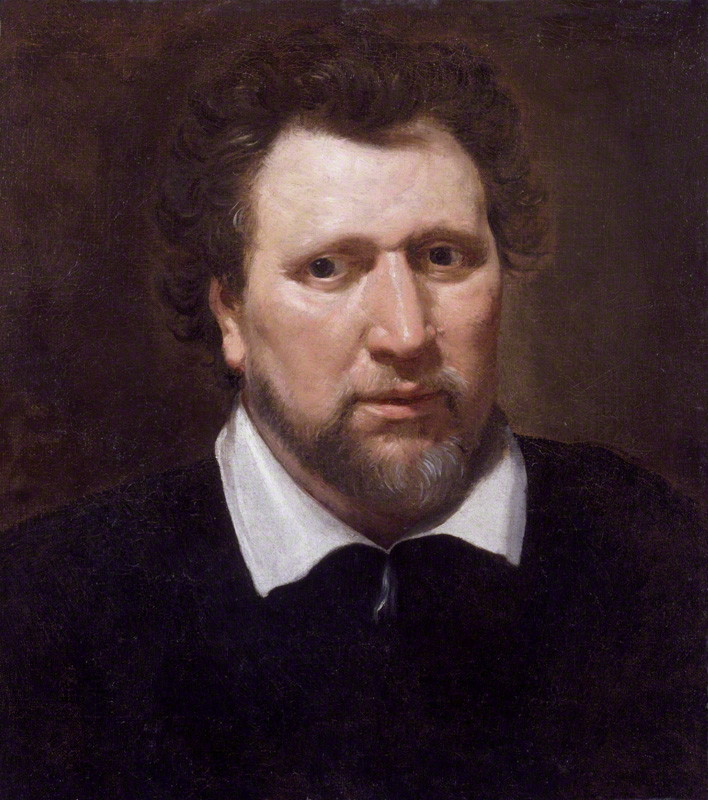
There are many examples, but here are some of the most notable:
John Fletcher wrote a number of plays for The King's Men and would eventually replace Shakespeare as their house playwright. It is widely assumed that he collaborated with Shakespeare on Henry VIII and The Two Noble Kinsmen. Drawing on Shakespeare's late Romances, Fletcher was highly influential in the Comedy of Manners style that became popular during the English Restoration period. His most popular play is The Faithful Shepherdess.
Francis Beaumont is often mentioned in conjunction with the aforementioned John Fletcher. Fletcher and Beaumont are believed to have collaborated on about 50 plays during their careers, but only 13 of them exist today. Beaumont is famous for his comedies, especially the hilariously low-brow The Knight of the Burning Pestle written in 1607. Pestle is now playing at the Sam Wanamaker Playhouse in London.
John Webster was a dramatist known for his dark, violent stories. Much of his early work is lost to us, but The White Devil and The Duchess of Malfi are both famous tragedies that still get produced from time to time. Malfi was also produced at the Wanamaker in the 2014 season.
Thomas Kyd was considered something of a pioneer in early Elizabethan drama. The Spanish Tragedy was very popular in the 1580s and its influence can be heard in Titus Andronicus, Hamlet and King Lear. The Spanish Tragedy played at The Blue Elephant Theatre, London last fall.
Christopher Marlowe has stood the test of time better than anyone else on this list. That is partly due to a stubborn and persistent conspiracy theory that Marlowe was Shakespeare. His career was brilliant and short. Killed in a drunken brawl at age 29, his early death lent a kind of romance to his memory. Of the seven that survive, the two Marlowe plays that you are most likely to see today are Tamburlaine and Doctor Faustus.
Thomas Middleton was believed to have collaborated with Shakespeare on Timon of Athens. He was a remarkably prolific writer and most famous in his own time for his comedies. However it is his late tragedies (Women Beware Women and The Changeling) that get all the attention today.
Ben Jonson was every bit as famous (more so in certain circles) as Shakespeare in his own time. We know that Shakespeare himself was one of the actors that performed in the premiere of Johnson's Every Man In His Humour at The Globe. Johnson plays that are sometimes produced today are Volpone and The Alchemist.
I'm sure that I'm leaving some people out, but these are some of Shakespeare's professional contemporaries.
So the book you're going to want to read is Shakespeare & Co., written by perhaps the preeminent living Shakespeare Scholar, Stanley Wells. It details the careers of the most notable and well-remembered contemporaries of Shakespeare...
Chief amongst them in the collective cultural memory is certainly Christopher Marlowe... His major works - Edward II, Doctor Faustus, and Tamburlaine have proven popular and been well studied next to Shakespeare's fairly since the Restoration. He gets bonus points in that he lived an interesting and mysterious life - there's a very popular theory (the academic bona fides of which I'll leave to more specialized scholars) that he actually worked as a spy for Queen Elizabeth I, which led to his premature death in a "tavern brawl". Whether he was the James Bond of the early modern period or not, it is fairly certain that had he lived long enough to create a larger body of work, he might be a household name today.
The other contemporary of Shakespeare whose name comes up fairly frequently is Thomas Kyd whose ultra-violent and melodramatic The Spanish Tragedy is still regularly produced at universities and Shakespeare theatres.
Also of some significant note is [John Fletcher](http://en.wikipedia.org/wiki/John_Fletcher_(playwright)), who succeeded Shakespeare as the resident playwright of The Kings Men, and is thought to have collaborated with The Man Himself on AT LEAST some of his minor works - Two Noble Kinsmen, Henry VIII, and the lost Cardenio, though there is very real academic debate about exactly what hand he may have had in many other pieces traditionally attributed solely to Shax (when someone talks to you about an "authorship question", this - and things like Edward III, Edmund Ironside, etc. - are hopefully what they're talking about. If not, best to move on and not encourage the crazy).
I've been fairly scattershot here and hardly provided a comprehensive overview of the "scene" back in Elizabethan/Jacobean London... the Wells book goes into far greater detail... and if you're still curious I could pull it off the shelf and expand this when I get home from work... but for now, TPS reports await.
Shakespeare had quite a number of contemporaries who were writing plays at the same time as he was. It's difficult to think of them as "competition" per se, because of the way plays and theater companies were funded and sponsored, but let me list a few of the ones I know off the top of my head. Doing this is a fascinating exercise in the fickleness of posterity and the ever-changing state of fame.
Thomas Kyd was a well-known and highly regarded playwright of the time that would have corresponded with Shakespeare's early career. His most well-known work is The Spanish Tragedy, a play that was quite important in the development of the techniques and tropes of Elizabethan dialogue and plotting.
Robert Greene was a somewhat less well-known dramatist, but was significant in his time, and is interesting because of his pamphplet "Greene's Goat's-Worth of Wit, which contains an attack on a young actor and playwright who we believe to be William Shakespeare.
Christopher Marlowe was and is a highly regarded playwright, famous for works like Tamburlaine and Doctor Faustus, who was an enormous influence on Shakespeare and all of Elizabethan Drama. He died under mysterious circumstances early in life, and made way for Shakespeare to become the leading dramatist of his day, but his influence was certainly seen through much of Shakespeare's work.
John Marston was better known as a poet than a playwright, but was fairly well known for his work The Malcontent, and was active in Shakespeare's heyday.
Perhaps the most famous and highly regarded of all Shakespeare's "competition" is the poet, critic, and playwright Ben Johnson. He was best known for his comedies and satires, but was a fantastic tragic poet, and an incisive critic. His influence on poets and playwrights of the immediately succeeding generations far exceeded Shakespeare's -- it's hard to believe anything could exceed the influence of Shakespeare today, of course, but it's true.
Thomas Middleton was a playwright active late in Shakespeare's career, whom Shakespeare was rumored to have collaborated with. He was very prolific, and worked with Ben Johnson and another well-regarded Jacobean playwright named John Fletcher. Among the three of them, together and separately, a gigantic slew of plays was produced, many of them famous in their day and still read in some circles today.
Now, of course, we have to decide what we mean by "competition." As amateur historians, we must try to be taste-neutral, but even the greatest of this list, say Johnson and Marlowe, cannot hope to so much as touch the magnificence of Shakespeare at his acme, so there was never, from that perspective, any true competition. However, in terms of everyday things like popularity, box office (so to speak), etc., you can see that Shakespeare definitely had to dance for his bread as well as anyone else.
I would recommend reading "Playing Companies and Commerce in Shakespeare’s Time" by Roslyn L. Knutson. Wonderful scholar on drama of that period.