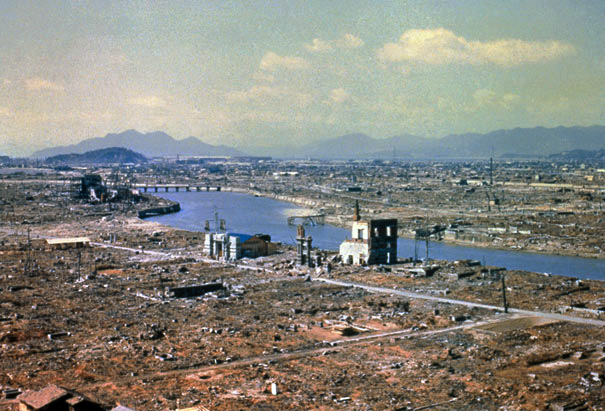
The mental image that most people see when they think of the damage caused by Little Boy and Fat Man being dropped on Hiroshima and Nagasaki is something like this: a wide expanse of rubble, debris, and hollowed out buildings; with the bodies of the victims vaporized by the immense destructive power of the nuclear explosion. This however, is a misconception. The vast majority of deaths caused by the nuclear bombs in Hiroshima and Nagasaki were due to severe burns, lacerations, and crushing damage from falling debris and collapsing buildings. About 85% of the deaths could be traced to these causes, no different from a normal bombing raid that Japan was subject to. Only about 15% of deaths would be due to acute radiation poisoning, something unique to the atomic weapons. But these people would not have been vaporized or obliterated. Their burned and battered corpses would have littered the rubble of the destroyed cities; some 90,000 corpses in the case of Hiroshima, with a further 75,000 in Nagasaki.
The reason most pictures of the ruins don't show these tens of thousands of dead bodies is that they were almost all taken months after the attacks, during the US occupation of Japan. The photo I linked above was taken in October of 1945, two months after the bomb was dropped on Hiroshima. The Japanese civil defense forces had already recovered and buried the vast majority of the dead from among the rubble at that point. There are few pictures of the immediate aftermath of the attacks, but the Japanese military photographer Yosuke Yamahata did take a few pictures on August 10th in Nagasaki, the day after the bombing. warning, pictures of severe injuries and corpses at the links Here are some examples. The photographer would later die of cancer of the duodenum. From these pictures, you can get some idea of the massive number of burial parties and medical teams that would be necessary to comb through the wreckage of the cities and recover the dead, and treat the wounded.
While the atomic bombs were unique in their destructive power, as one bomb could now do the job of an entire air wing, the Japanese had already endured dozens of cities being similarly destroyed by the saturation bombing of the US air force. The Japanese military and civil defense forces were thus well drilled in fighting the fires started in the wake of bombings, treating the wounded, and burying the dead. These are the primary tasks that would have been conducted in the first days and weeks after the bombing. On August 7th, a Hiroshima Security Headquarters was established under the command of a Vice Admiral, with the goal of medical services being provided and the dead disposed of within 3 days of the attack. After the dead had been buried and the wounded had been sent to whatever medical facilities were available, the task of surveying and clearing the vast fields of rubble and debris began. This process took the better part of 2 years to complete. First, the rubble was cleared from the major streets, allowing trucks and heavy equipment better access to the site. Here we can see the progress, as by March of 1946, the main roads have been cleared of debris, and many of the ruined buildings have been demolished and cleared away. This being done, it was possible to start restoring the infrastructure necessary to rebuild the city; water and sewage lines, electrical lines, food distribution, etc. By August of 1947, two years after the bombing, the majority of those living in Hiroshima were still in temporary shelters, but there were stores and homes being rebuilt already. This can be seen here in a series of panoramic photos by Shunkichi Kikuchi.
A small number of the City of Hiroshima staff were still in place after the attack, and worked hard to ensure food distribution and production in the city. They went so far as to distribute seeds and promote gardening on a small scale as starvation was a real possibility. On August 21 1945, they met the in the ruined city hall with the occupying US forces, who laid out a program of privatizing military resources and demobilizing students and soldiers in the area.
The pace of reconstruction was slow, as the city was estimated to require some 2 billion yen to rebuild, and the city's reconstruction budget in 1947 was only 56 million yen. In the absence of city or federal investment, most of the early reconstruction in Hiroshima was done by private citizens acting on their own initiative.
The simple answer is there was no cleanup, if I am correct in assuming that by "cleanup" you mean a special set of actions to deal with nuclear radiation. That kind of "cleanup" did not proceed in any way, shape, or form.
Both locations were left to recover and deal with the consequences of radiation and the destruction of the bombings on their own. Neither the Japanese government, nor the US Occupation provided any special aid to either city before 1949 (well after recovery was already underway, and radiation had dissipated). In 1949, some Hiroshima city officials bypassed the bureaucratic structure to appeal directly to the Occupation authorities to endorse the Hiroshima Peace Memorial City Construction Law (note that they explicitly did not include Nagasaki). The Occupation authorities liked the idea as good PR, and more or less forced the Japanese government to grant Hiroshima special funds. Nagasaki officials had to lobby for their own law in Hiroshima's wake.
Before that, the closest thing to an organized body dealing with atomic bomb survivors was the Occupation's Atomic Bomb Casualty Commission (ABCC), which arrived over a year after the bombs were dropped, in November of 1946. The ABCC was not there to care for people though, they were there to study what happens when you drop an atomic bomb on a city.
So, for the most part, people just lived through it. Nobody went to special effort to clean up radiation. All that happened were typical reconstruction efforts that looked like those in any other city destroyed by war or natural disaster. In Hiroshima, first came grieving families, looking for their loved ones. Then came the looters, looking for copper tubs in particular. Then came people trying to move back in, drilling into old water pipes for sustenance. Then came the water companies and police, beating anyone who drilled into the pipes. Then came the city government, telling people the houses they had rebuilt had to be destroyed again in the name of a peace park. Eventually you had something resembling a city again, but the a-bomb slums housing people displaced by the bomb lived on in Motomachi until the late 60s. After that, a somewhat suspicious fire broke out, and they built a shopping mall where the a-bomb slums used to be.
EDIT - A few references: Robert Jungk, Children of the Ashes; Hamai Shinzo Genbaku Shichō, Lisa Yoneyama Hiroshima Traces.
EDIT 2 /u/Danegeld87 's post is quite good in dealing with the progress of the more conventional "cleanup."