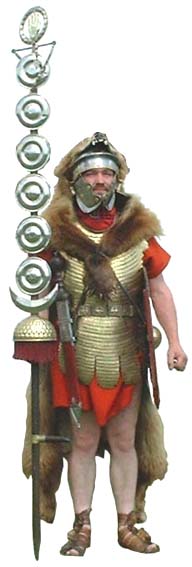
The purpose of a standard bearer was to give the unit's member a visual signal as to where the unit was. If in the course of a fight, you were separated from your unit, one looked around until you saw the standard and then tried to get back close to it. The standard bearer normally was in close proximity to the unit leader. When the standard 'fell', the unit members did not have a visual point to rally around or return and the possibility that the leader had fallen was great. Loss of a standard in battle was considered to be one of the worst things to happen - the Honor of the unit was lost. By the same token, capturing a standard by an opponent was considered to be a tremendous act of courage.
In the Early Modern Age, a flag served as a rally point and identifier. Such as with the flamboyant uniforms, a flag would say "I am with this nation/kingdom/etc" so it would help to keep friendly fire at a minimum. Further, a flag can be a point of honor for the regiment where battle honors could be added such as with the 1er Grenadier a pied de la garde imperiale which has the battles they had shown particular valor and skill.
In formation, they were generally in the middle of the company they were attached to, usually the First company of a battalion, which may be a Grenadier company in the French Grande Armee.
When a flag bearer was killed, it was generally the duty of any survivors of the company to pick it up and carry it. The colors are your life, and just as with the Romans, the lost of the colors was a shameful thing, showing that the regiment/battalion were cowards and didn't fight hard enough to recover them. Conversely, the capture of an enemy's flags was an honorable and courageous thing; in Les Miserables, Marius Pontemercy's father became a baron of the Empire and promoted to Colonel for capturing several British flags and presenting them to Napoleon.
However, when things were really bad, it was the duty of the highest ranking officer to burn the flag and dispose it in some manner. There is a story where the 84e Line Regiment was retreating from Russia, they destroyed their Eagle but the Colonel of the regiment had saved a plaque that named their regiment un contra dix for their valor at the Battle of Wagram.
In the American Civil War the Color Guard was the "elite" portion of a unit. For the Civil War era the infantry color guard probably had the most dangerous job. By the nature of the combat they were veritable bullet magnets because once the smoke started to rise the flags were the one thing still visible to aim at. The color guard consisted of nine men (2 Sergeants and 7 Corporals) in the North and I believe the same in the South (though one less Sergeant and an additional Corporal). Union regiments carried two flags (one national and one regimental) while Confederate regiments typically carried only one (the famous battle flag) and some units may have carried the national flag as well.
During a battle they would be positioned in the center of a regiment with 5 companies on either side. The exact number of men would vary with the size of the unit. I've found photos with 4,6,8 and 9 men as the color guard. They were selected from amongst the men in the regiment and it was a fairly prestigious job since the flags were the symbol of the unit. If you lost your flag it was devastating and if you captured one it was a great honor.
The loss of life in the Color Guard was generally high. When one man went down a member of the guard would drop his rifle and take up the flag. If the entire Color Guard was lost then the men from the adjacent companies stepped forward to take up the standard. I don't know of any case where men had to be told to pick up the flag they just reached for it by instinct.
I can close with one extreme example. On the first day of Gettysburg Pettigrew's NC Brigade was up against the famed Iron Brigade on McPherson's Ridge. Both of these units would sustain horrific casualties. The Iron Brigade has the distinction of the most losses (percentage) over the course of the war. Within Pettigrew's Brigade was the 26th NC. Here is a map. Pettigrew's Brigade is at the bottom (the 52nd up to 26th NC) and the Iron Brigade is the bulb of blue troops to their north. In the 7500 feet from Willoughby Run to the crest of the ridge the 26th lost 13 color bearers, including their Colonel mortally wounded, and the executive officer horribly wounded (although he would make a full recovery and return later). Crossing the stream alone they lost 3 color bears, one on each bank and one in the stream. I forget the exact numbers but the 26th suffered one of the heaviest losses of the war during the three days at Gettysburg. They went from being the largest regiment to a normal sized unit. The 11th it's sister unit suffered the next most at 366 killed and wounded (61% of its total number) Obviously this is an extreme example but it gives you an idea of how dangerous it was.
Do forgive me since I'm no real expert on thesubject, but for early/mid nineteenth century armies at least, you'd have the standard-bearer acting as a moving rally point when you had regiments on the move. Each battalion had their own banner, and to use a visual example, you'd have both a union jack (the king's or queen's colours) and a regimental flag (the regimental colours) with an ensign that could be used as a rally point. Let's say you have the 1/24th regiment of foot, that battalion would have a colour sergeant at the flag bearer's side, and unlike other officers, he got to have a pike. The colour sergeant's job was to protect the flag at all costs
From what I know, flag bearers did not fight, although in the British Afghanistan campaign, there was an instance of a sergeant tieing the Queen's colours around his waist after the standard bearer fell, but that's all I know
In the British army during the 17th and 18th centuries a regiments colours where carried into battle by the two junior most ensigns and protected by a colour party with pikes. When the battalion was in a line formation they would be position end close to the centre and when the battalion formed a defensive square they would be positioned inside the square.
As ensigns fell during battle the next most junior subaltern would be called to take up the standards. In at least one occasion a battalion suffered such heavy casualties that they ran out of subalterns and the colours were withdrawn. Source: Redcoat by Richard Holmes