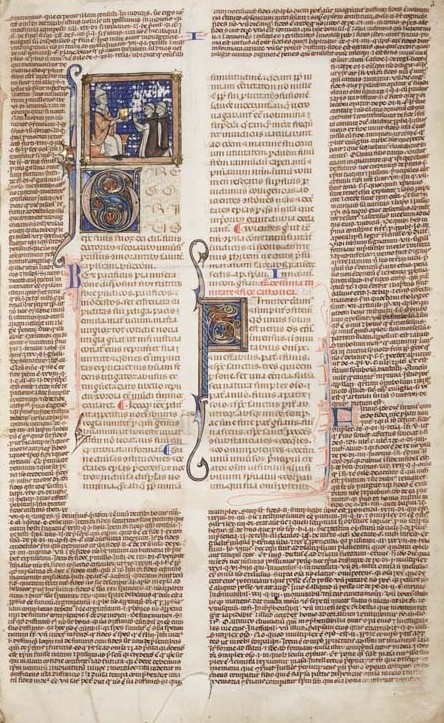
While there are sporadic examples of wide manuscript margins dating back late antiquity, their consistent appearance in manuscript production, and explanation for them, show up in the 11th century.
The answer suggests itself when we look at manuscripts like this one - this is a compendium of theology by Peter Lombard from the mid 12th century with notes from theologians. Another example is this 12th century Decretal (part of the Roman Church's canon law which has been annotated by legal scholars.
The texts with their simple illuminated letter have left a lot of room for [glossing](http://en.wikipedia.org/wiki/Gloss_(annotation)). Glossing can be explanatory notes and elaboration of ideas (biblical exegesis), definitions, pointers to other works or quotations from other works. Although glossing is an ancient habit which can be found in the oldest of scrolls and manuscripts, glossing becomes a consistent form from the 11th century onwards, in particular in biblical and legal works which theologians and legal scholars wanted to expand, explain and connect with other works. These scholars were often called glossators because of their method of work.
So, historians have tied the formalization of consistently large margins for glossing to the blooming of academic inquiry with the invention of the university in the 11th century (the so-called 'medieval renaissance'). The practice then became standardized with universities controlling large productions of manuscripts for masters and students in Paris, Bologna, Oxford, etc. This practice is then said to have spread with the movement of manuscripts for copying in and out of scriptoria, both secular (scribes) and ecclesiastical (monks). An academic habit became part of the form of manuscript production.
Ironically, by the late 12th century we see these large margins, which were very common at this point, starting to be filled in at the point of production by illumination. That illumination includes the famous 'marginalia', famous because of images like the fart trumpets, bag-piping monkeys, beheading rabbits and knights fighting snails.
And then with this image here we can see the white space of glossing margins have been formally appropriated to illumination and design (this is 14th c manuscript of the tales of Arthur and Guinevere), yet it retains the formal design idea of white space. We can see in this the inheritance of production methods started for margin glossing which have been taken up in manuscripts which would never be glossed.
And in fact the large margins did not disappear with the advent of printing presses and cheaper production. In fact, a fairly famous study by Jan Tschichold suggested the persistence of large margins into the age of the printing press became mathematically formalized (golden section) and then promoted as 'good design'. Here you can see an example of large margins and a bishop's glossing in a 16th century book from a printing press.
Reading about manuscript production:
Jonathan J. G. Alexander, Medieval Illuminators and Their Methods of Work (Yale University Press, 1992)
Michael Camille, Image on the Edge: The Margins of Medieval Art (Reaktion Books, 1992)