Absolutely not. Vice Versa: Absolutely not.
Let's pretend that by ancient play you are talking about Ancient Greek plays, which are the earliest Western plays, and probably the earliest theatre in general. According to Aristotle, Thespis was the first actor (his name is where we get the word "thespian."). You often hear the term "Since Thespis stepped out of the Chorus." This refers to the moment that Thespis stepped onstage and acted by himself as a character. Before that there were groups of men onstage telling a story in unison (a chorus) or a singular man orating at the crowd, not in character. So-- now we get to the question at hand. Would the Greek crowds appreciate Liam, Tom or Judi, and would we appreciate Thespis?
First of all, Greek crowds would not tolerate Judi Dench for the mere fact that she is a woman. It is probable that women were not allowed to even attend the theatre, much less be onstage. Men would wear female masks and wooden breasts. Many places in the world did not tolerate women onstage until the 1800s. The word "actress" even started as a derogatory term, and these women were considered loose. That's why you will find most of the early actresses at reputable theatres were referred to as "Mrs. So-and-so." The thinking was that if they were married they weren't prositutes.
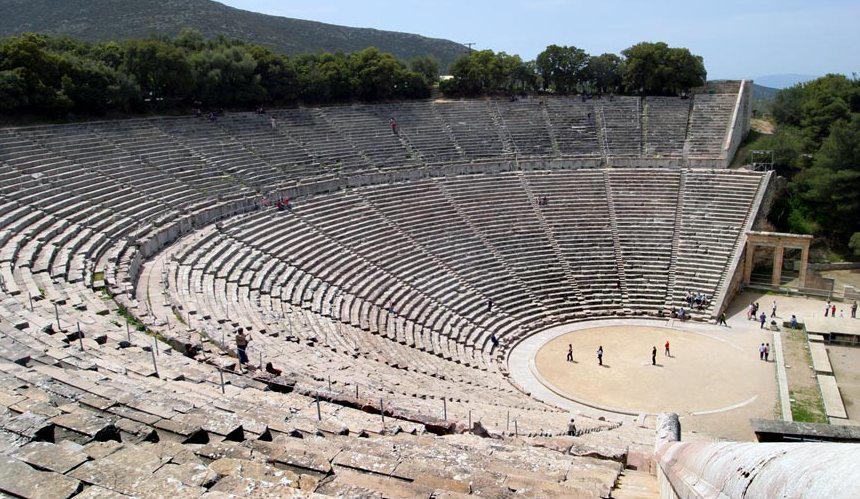
But Style! You want to know about style. Well, first of all: take a look at an ancient theatre. That sumbitch is huge. So, the acoustics alone would prevent modern style. Many scholars have argued ways that the shape of the theatre, or the masks or what have you are how the back seats could hear. The fact is that no matter what the body of the actor did a lot of the work. Ancient Greek acting was much more physical. In fact, the audience sat in a "theatron" (seeing place) rather than an "auditorium" (hearing place). These stories were all familiar to the men who can to see it. They know they are going to see "Oedipus Rex" and they know that the person wearing the crown was King Oedipus, and the woman wearing the crown was his wife/mother and the man wearing a blindfold was the blind seer Tiresius. So, though there were lots of words that the cheap seats could not perhaps hear, they could follow the story through the exaggerated motions of the main actors. Also, the chorus would give updates. They were a gang of men who would recap the story during every scene, speaking loudly and in unison. Those voices would probably hit the cheap seats.
Second, Ancient Greek actors acted with exaggerated masks on their faces. (the mask in this picture is about right, but the real masks were made of linen and natural stuff, so they've all disintegrated by now)/So, no facial expressions. And modern film acting is predominantly facial expressions. The closeup is really what you go to theatre to see. This is where we get the comedy/tragedy mask symbol for theatre. The mask would be full face, and include a wig. The masks allowed for one actor to play many parts. And actors did not have to be the same age as the part.
One last thing: Ancient Greek audiences did not see violence onstage. This was for aesthetic and religious reasons. Oedipus went offstage to poke out his eyes, Madea killed her kids offstage, Antigone and Haemon died offstage, etc. Often the dead bodies of the characters would be brought out on an ekkuklema. And I don't think that modern audiences would appreciate not seeing the money shot, know what I mean/
And would we appreciate the ancient greek acting style? Well, I know a couple experimental theatres that may, but the majority of audiences would consider it hack. In my opinion, obviously.
Sources: History of Theatre - Wikipedia
[GUYS, "THAUMASTOS OF BOEOTIA" IS LITERALLY TOM HANKS. I MADE HIM UP. "SEIRENE" MEANS MERMAID. "AKRINAS" MEANS FOREST CARETAKER. I WAS DESCRIBING THE PLOT OF "SPLASH" AND "FORREST GUMP". PLEASE DON'T BELIEVE STUFF JUST BECAUSE IT HAS A LOT OF BIG WORDS AND LINKED SOURCES. ACTUALLY CHECK THE SOURCES BEFORE YOU BELIEVE STUFF.]
/u/Emjoyable's answer is excellent! However, just to add on regarding whether an ancient actor transported forward could be recognized by modern audiences in the same category as Liam Neeson, etc - there is one actor in particular mentioned in some fragmentary texts from the Hellenistic period who might have been able to do so, as he achieved near-universal acclaim while he was alive. It caught my attention when we studied him in my Greco-Roman comic drama class, because very few actors get mentioned by name - the other post mentioned the apocryphal Thespis, after whom the profession was named, for example.
In the Hellenistic era, though, there was Thaumastos of Boeotia, mentioned in sources as wide ranging as the fragmentary history of Greek theater written by Duris of Samos - On Tragedy - to a mention in the Oxyrhynchus Papyri. Though the evidence is, as mentioned, pretty fragmentary, we do know that he was noted, rather uniquely, as both a comic and tragic actor. The first record we have of his work is in production of a play by Hegemon of Thasos called "Seirene". Like many of the lesser-known Greek plays it comes to us only through its description, with the actual work now lost, but Theopompus of Chios describes it as the humorous tale of a mermaid who falls in love with a sailor and has her tail stolen from her by Poseidon as punishment. It was particularly popular, as you might imagine, in port cities around the Hellenistic world, and as the play's popularity spread so too did word of Thaumastos' brilliance.
However, what cemented Thaumastos' place in history was, as far as we can tell, his turn as a tragic actor in Aphareus's "Akrinas" - another lost play, though I know a fair few theater historians who would pay a lot of money to get their hands on it if anyone ever manages to find anything more than a few fragments. Apollonius of Rhodes, a prominent Homeric scholar, compared it with the Odyssey in its sheer scope - in the play, Akrinas ranges across most of the empire of Alexander the Great searching for, finding, and then losing again, the woman he has loved since childhood, meeting a great many characters along the way. In the end, he gives up hope only to have his lover return to him - but just as she returns, she dies of the plague the gods have cursed her with due to her infidelity. When Akrinas weeps, though, Aphrodite takes pity on him and transforms her body into a great myrtle tree, that he and his son might have her beauty remain in their lives. Apollonius of Rhodes is said to have sent a copy of the play to his mentor Zenodotus, curator of the library of Alexandria. (Another tragic loss in that damn fire! AUGH.)
In any case, Thaumastos is said to have performed "Akrinas" in theaters around the Hellenistic world, and his performances remain as one of the first examples of actors being truly known for their craft. With the diversity of audiences for whom he performed, I think it's at least somewhat credible to suggest that his work would be appreciated in the modern day - maybe not as much as a Tom Hanks, say, but still. He was definitely the Tom Hanks of his day.
As an interesting aside, even just a generation ago the acting styles were very different. Watch the two film versions of Henry V - Olivier from 1944 and Branagh from 1989.
Olivier was one of the great actors of his age, but his acting to modern audiences can come across as "stuffy" and mannered compared to the more naturalistic school that held sway among our generation.
Without submitting an entirely new question, I'd like to ask a couple follow ups.
What about Roman theater? Shakespearean age?
How far back would you have to go before LN would be appreciated?