tl;dr: based on past records of re-routing rivers-- or of digging deep, long trenches-- and using medieval technology, how long would it take to re-route one mile of a deep, fast river of 100 feet width? For manpower, assume a unit of one man with one shovel, and approximately 20,000 equipped men to do the job. Period-appropriate variations (e.g. oxen-pulled equipment) welcome.
Hey /r/askhistorians. /r/engineering sent me here when I admitted why I was asking them how much dirt one man could dig in one day. They suggested folks here might know, based on records of similar projects in real history: Erie Canal (or other canals), digging foundations for the Great Wall of China, etc.; and also that folks here might be able to comment on the validity of the hypothetical project outlined below based on known historical attempts.
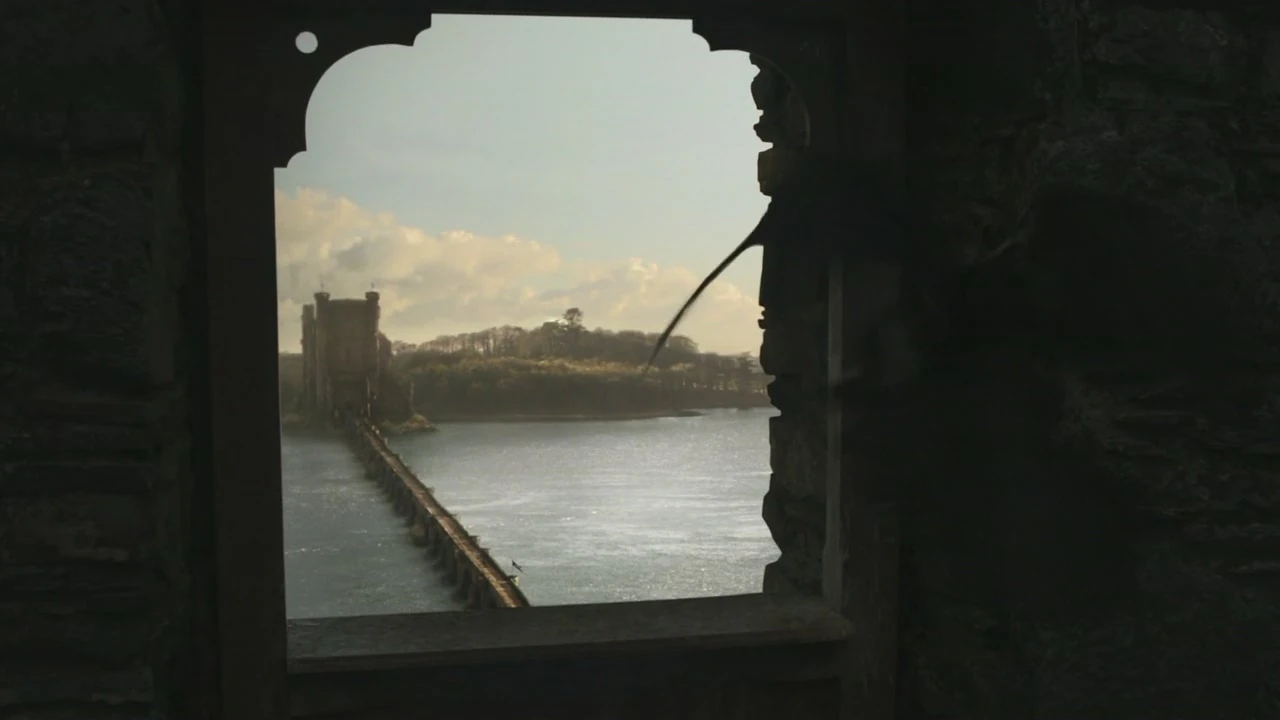
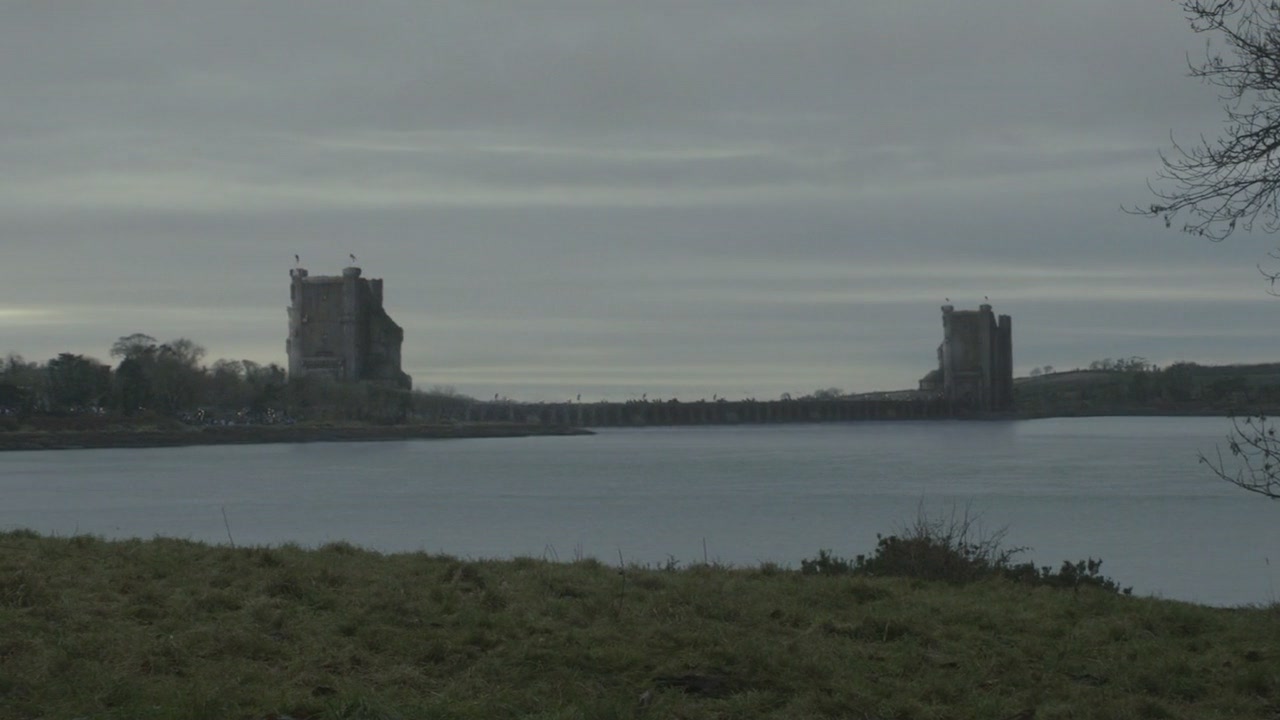
This is Game of Thrones inspired, but the specifics are absolutely based in reality and I need historical opinions and data. Using book-period technology, I'm thinking of how to beat the The Twins: two bridged towers, castles joined by a bridge across the Green Fork River.
It's stated or implied that this castle is not vulnerable to direct attack. A siege, then: fortified encampments on each bank, ships and river defenses to prevent relief by boat. Long, costly, and the usual risk of failure due to camp diseases or desertion. Hm, no siege. So, I started thinking what a good engineer/sapper might do:
Technologically, this is within reach. But is it faster than a siege? I started searching for numbers.
Arya says the Red Fork River, south of The Twins, is 100 feet wide; a discussion of the Trident leads me to think the Green Fork is about the same size; also the River Quoile in Ireland-- the backdrop for The Twins on the show-- averages that. Problematically, the river depth is only described as "deep and fast."
Let's assume the soil is firm but easily turned. The Riverlands-- the region around the Twins-- is described as flat with lots of large and small rivers. It is an area of moderate rainfall that lacks the protective swamps of the region to its north, the Neck. It's also stated that it's a very fertile region. Thus my guess of firm but tillable soil.
Other than that... I am thinking we'd have to re-route a mile of river: a half-mile on either side of the castle in order to keep the bend out of easy bowshot. The flat land means little time spent on surveying, and presumably the castle would have cleared out most of the trees within a mile of the castle walls for defensive reasons (much like the Black Watch used to do at the Wall).
I'm figuring an army of 20,000 men (not coincidentally, about the size of House Stark's). For (relative) simplicity we'll assume they're all on work detail-- somewhere we found other men for investing one bank of the castle, for cooking, etc. Each man is digging with a shovel. How long would it take?
You're welcome to add any period-appropriate technology (e.g., oxen-pulled machines, water sluices) that you know of, just if possible include an estimate of how much earth one such machine could remove in a day, and how many could be employed at once.
Also, please feel free to add to or correct any of my numbers, along with sources or rationale. Thanks!
I will be posting a link to this thread in /r/gameofthrones, if they'll let me.
Edit: hated the length of this post so I wrote a better tl;dr.
The best I can give you is Toyotomi Hideyoshi's rerouting of the river in the siege of Takamatsu Castle in the mid-late 1500s, where in around 12 days he managed to divert the river using dikes to flood the castle, resulting in a relatively swift surrender afterwards.
Japanese castles are a lot different than European-style castles, however, so this may not work.
I also seem to recall the Mongols attempted to do this in China, but it backfired on them and flooded their own encampment.
Wow, ok this is an interesting question. I am going to take my best stab at answering it. Please note that there will be best guess assumptions made and I will be clear listing those assumptions.
Initial Assumptions
Workforce = 20,000 able bodied humans
Width of the river = 100 feet^1
Depth of the river = average of 8 feet^2
Amount of Earth Moved
We are attempting to duplicate the river’s depth and volume so are going to dig a 100’ wide by 9’’ deep diversion trench.^3 It will be trapezoidal in shape with bases of 100’ and 30’ respectively and a height of 9’. Using area of a trapazoid that gives us 520 square feet and multiplied by 1 mile (the length of the canal) give us 3088800 cubic feet of earth to move.
**How long does it take to move ~3 million cubic feet of dirt?**^4
It depends on what level of technology you use to do so and what the soil is like.
Assumption: the soil is fairly soft alluvial plain but the water table is high so you’re digging damp soil
Given that assumption, a team of three men (a pickaxe and two shovelers) can move 14.1 cubic feet of earth in an 8 hour day. Extrapolated out to 20,000 men you are moving 93990 cubic feet of soil a day. Given that, it would take 32 days to excavate the canal using only hand tools.
But surely they would use some equipment besides picks and shovels.Lets manufacture 8000 wheelbarrows and use them to help move the earth. You're working in teams of five people and two wheelbarrows. Four people fill one using a picks and shovels while the fifth person pushes the full wheelbarrow to a dumping spot and comes back to pick up the now full second barrow. Each team can now move ~65 cubic feet of dirt in an 8 hour day. This means that the canal is dug in 11 days.
Ok, lets break outside of lore for a moment and compare this to modern earth moving equipment. A fleet of seven 130 HP Caterpillar bulldozers would approximately be equivalent to the 20,000 men working with hand tools.. Each one moves 1624.5 cubic feet of earth an hour or 12996 in a day. Hence they would also get done with the excavation in about a month.
But it can’t be that easy can it?
Well no, the calculations above are making some assumptions and leaving out some fairly large pieces of additional work.
Such as lining the newly dug canal with bricks or stones to prevent water seepage from ruining it.
Or building a dam across the river to divert it into the canal. A very non-trivial task in and of itself.
Or defending against the sallied attacks of the besieged defenders of The Twins. Or even just protecting your works against missile fire from the towers.
But that is all outside the scope of the question.
Footnotes
This seems inaccurate based on these pictures pic 1 pic 2 but it is what is given in lore so we’ll use it as an assumption. Estimating the width based on the pictures is outside the scope of this already ambitious post. If I had to make a guess three or four football fields or about 900-1200 feet wide. However that width puts this question of very shaky ground as far as being feasible to do under siege conditions.
This is an educated guess based on the following source: The Irish Coast Pilot
We need to account for freeboard and we’re going to need to line this trench with something otherwise water seepage is going to render it pointless. Hence we need to make it slightly deeper. See: 8. Water Transportation
All calculations in this section based on 4. Earthmoving Methods
**x-posted to /r/askhistorians /r/engineering and /r/gameofthrones/ **