All this Ebola talk has got me thinking about the Black Death.
I'm currently taking a class on the Black Death but don't have my books on me so I'll cite my sources later. As for your question, the Black Death affected all of Europe regardless of class. As the plague can be spread through fleas as well as through the air, with one creating buboes and the other being pneumonic, no one was really safe from the reach of the plague. Furthermore, the more one came in contact with those inflicted with the illness the more likely one was to contract it. It is for this reason that so many clergy fell victim to the plague due to their close proximity to those that were sick through mass, anointing of the sick, etc.
In an interesting side-note, it has been reasoned that the reason why Pope Clement VI did not contract the plague is due to the advice of his physician Guy de Chauliac. After Clement fled Avignon, Guy, who through his research had been able to distinguish between the two forms of plague, recommended that Clement not allow visitors in his chambers and that he continuously burn wood to purify the air. By not allowing visitors Clement was able to drastically decrease his exposure to plague through contact with individuals who had contracted it, while the lighting of fires most likely killed the flea population in his chambers.
While you wait for print sources I would suggest you visit the Wikipedia articles below.
Here are some print sources. Please keep in mind that Kelly's book is a popular history and that he is a journalist. It should be noted that I do still think that his work is a great launching point for someone who is interested in the Black Death
The Great Mortality: An Intimate History of the Black Death, the Most Devastating Plague of All Time - John Kelly
The Black Death: A Personal History by John Hatcher
The Black Death by Rosemary Horrox
The Black Death: Natural and Human Disaster in Medieval Europe by Robert Gottfried
edit: added print sources
Although we do have evidence in the forms of almost anecdotal stories (like the Decameron, or the stories about Clement VI) about people from all economic/social groups being equally affected by the Black Death, we actually have very little solid demographic data to quantify who died during the epidemics -- especially the one known as the "Black Death", the 1347-1351 outbreak in Europe. Welford and Bossak (2009) list the demographic data we have (you can see their footnotes based on the numbers in brackets):
A number of ‘quasi-empirical’ datasets of Black Death mortality have now been transcribed from original documentation by various historians and epidemiologists... These include daily mortality at Givry, France [21] in 1348 during the primary epidemic wave (1347–1351) and St. Nizier-de-Lyon [22] at the beginning of the primary epidemic wave; daily mortality at Penrith, England, in 1597–8 [23] and Eyam, England, in 1665–66 [24], and weekly data from England and Wales after 1532, with the advent of ‘Bills of Mortality’ [25], presented here in its original weekly tabulated form (from 1639–47) and aggregated to a monthly resolution (for the years 1625 and 1666). Additional aggregated monthly mortality totals are also available for Marseille (France; 1720–21) [26], Debrecen (Hungary; 1739) [26], [27] and Moscow (1771) [26], [28].
So you can see from that that they have only two sources listed for the 1347-1351 outbreak. There are a handful of other studies, from archaeological remains, but these often cover a relatively small number of individuals just because of the nature of what is being excavated (in largest case, a single graveyard rather than an entire town), and therefore are not indicative of wider trends until we have enough studies to put them together (and imho that doesn't exist yet).
Finally, we can try a secondary query of the existing demographic studies to see if we can draw any conclusions from that. I'm going to start speculating right here and not stop until the end of the post: For example, there's a study by DeWitte and Wood (2007) which examined 490 skeletons from plague burials in London to see if preexisting health conditions contributed to mortality in the Black Death. Their findings can be summarised (may they forgive me) as yes, they did contribute, but not much. From that we could extrapolate that people with poorer nutrition or poorer health may have been more likely to die of plague, but then we have to ask if poor nutrition/health were associated with a class in 14th century London -- and in fact studies have shown that wealthy individuals in medieval Europe died from nutrition related diseases (too much protein over other kinds of nutrients, for example). However, there was a period of famine caused by climatic downturn (amongst other things including social factors) in the decades prior to the Black Death outbreak in Europe, and that would almost certainly have adversely affected the poor -- so may have contributed to them having slightly elevated mortality. However, the Black Death seems to have been so virulent (according to DeWitte and Wood's study) that it largely ignored preexisting conditions, so these factors may not have been particularly important.
The sources indicate that all social groups were affected by the plague, since there are many recorded deaths of nobility to the disease. In terms of raw numbers most of the victims would have been peasants simply because there were more peasants than nobles. I honestly have no idea whether one group had a lower rate of death to the other. I'm not sure if such a study would even be possible. One thing to note is that nobility (or simply the wealthy) had the resources to flee areas of outbreak, and to effectively quarantine themselves. This is the framework story for Boccacio's 1353 work "The Decameron." Young nobles, who have lost most of their family members to the disease, flee Florence during the height of the 1348 outbreak. They wait out the plague in a countryside villa and pass the time telling each other stories.
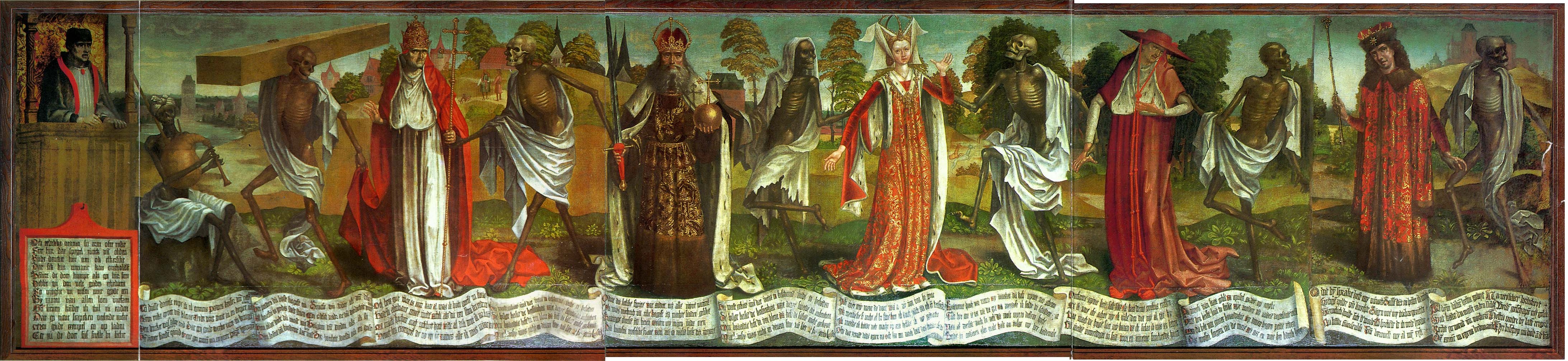
Another interesting note is that the ability of a personified Death to suddenly strike anyone at any moment, regardless of their worldly power and status, became a popular motif in the 15th and 16th centuries. This is not a direct result of the plague, since there were plenty of other ways for a medieval person to suffer a sudden death, but I'm sure the memory of the Black Death played a part in its development. http://upload.wikimedia.org/wikipedia/commons/5/58/Bernt_Notke_Danse_Macabre.jpg