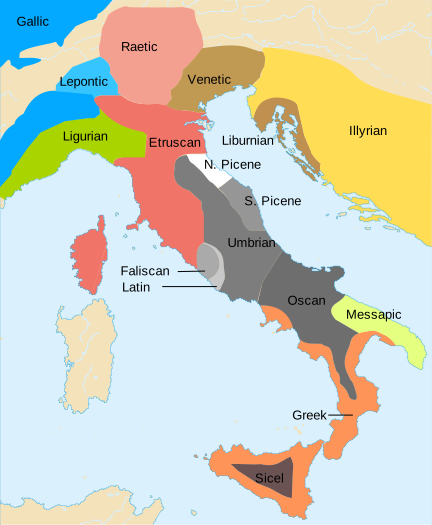
To be obtuse, I'll go in reverse order! Yes, Latin has a number of sister languages that belong to a group of languages known as Italic languages (to avoid confusion with Italian). Several of these languages are directly attested to with writing- prior to Roman domination they too had adopted versions of the Greek alphabet and adapted them. We can therefore talk about the linguistic situation of Italy from the 7th century BC onwards with some confidence. Inscriptions in particular have been helpful.
To name some Italic languages outside of Latin that we have evidence for: Faliscan, with over 300 known inscriptions and a close relative of Latin specifically; Oscan, spoken by famous peoples like the Samnites and Aurunci, and well-evidenced to the point where we can identify a number of local dialects; Umbrian, which I believe is mostly evidenced from a cache of documents found under Gubbio (ancient Iguvium); and there are other major languages known like Volscian, Marsian, South Picene, and Sabine (though this one is poorly evidenced compared to most of the others).
Nearly all of these languages are named for a particular ancient people of Italy that the language is predominantly associated with.
However, the likelihood is that there are possibly more Italic languages that we currently lack evidence for- the North Picene language is currently undeciphered to my knowledge, and it isn't even known if it's European, Aequian and Vestinian are practically unattested but believed to be in the Italic group, and ancient authors attested that 'Sicel' (a language spoken in Sicily) was very similar to Latin but we know too little of it to tell.
In addition there might well be other dialects or full Italic languages that existed that are currently not attested to a degree where we can identify them clearly.
As for Latin's parent, there we enter controversial territory. A reconstructed Proto-Italic that is the ancestor of all Italic and thus Romance languages is now kicked about, but that's not the controversial bit. The controversial bit is that there are many who theorise that the Italic and Celtic language groups are very closely related. The idea that they're related at all is not controversial- both are Indo-European languages, rightly enough, which automatically makes them related on a basic level, just as Italic languages are related to Iranian on a basic level for the same reason. But the idea of a 'Italo-Celtic' group has been mooted, which theorises that Italic and Celtic languages were effectively a single branch of Indo-European that then further split apart at some estimated point. This is due to an unusually high number of shared innovations in both language groups. However, there are plenty of linguists who disagree with this idea, and do not see that Italic and Celtic languages share any more similarity than any other two branches of Indo-European.
So setting aside the idea that Italic and Celtic languages are closely related, the ultimate parent of Italic languages is 'Proto-Indo-European'. The process of how you get from a theorised Proto-Indo-European to Proto-Italic is... tricky. There are those much better educated about PIE linguistics than I am on the subreddit, so I feel they will need to expand on this particular area, but my own understanding is that the two likely origin points of Indo-European as a distinct language family are either the Central Asian Steppes c.3000 BCE or Anatolia c.8000 BCE, and of those two theories linguists vastly prefer the former whereas archaeologists are more prepared to entertain the latter. My other understanding is that understanding the spread of Indo-European languages is no longer (if it was ever) believed to be Proto-Indo-European spreading outwards, diversifying, and then those splits then further spreading outwards over time ad nauseam- rather the possibility is likely that the language had already diversified by the time groups began to move outside of Indo-European's 'homeland', and continued to do so resulting in even newer waves of Indo-European speakers moving outside of the original homeland. To construct a model, the former is imagining that X spreads out of Homeland, and turns into Y and Z, then Y and Z spreads and turns into YY, YZ, ZZ, and Mango. The latter imagines that X already had shifted to Y and Z within Homeland, then one or both moves out, but Y and Z within the Homeland further shift, and then spread again. If that didn't make any sense then I apologise, and I can attempt to rephrase it again or get somebody who has a better way of explaining the theory of IE spread and diversification.
Latin is an Italic language, so in normal linguistic terminology its parent would be proto-Italic. There were other languages closely related to Latin. Wikipedia's got a map. The grey ones between Etruscan, Greek, and Messapian are Italic.
However, Italic isn't the highest-level classification of Latin. Italic languages are members of the Indo-European family, along with the Germanic, Slavic, Indo-Aryan, etc,