Tourism as it is defined now did not really exist during the era of the colonies. The closet thing during that era would be the "grand tour" which was a rite of passage for wealthy young English students. They would make a tour/pilgrimage to important centers of classic history as a way of becoming cultured and as a way of signaling the status of their class. These tours would not have included America as it wasn't part of classical history.
Widespread leisure travel wasn't common until the industrial revolution.
Yes, though the popularity of imperial travel varied greatly from empire to empire (and from location to location within empires). Technology (such as steamships, telegraphs, etc.) played an important role, as well as the emergence of pro-imperial nationalist ideologies in Europe. One of my favorite works on this subject is Propaganda and Empire by John Mackenzie. He highlights the relationship between British nationalism, cultural imperialism and the emergent interest in an 'empire first' British economy. In short, the idea that the colonies were not just owned by Britain, but were British, was a late-19th century phenomenon, and largely a byproduct of British official efforts to promote the importance of the empire to the mother country. While the economic element of this was largely aimed at the working class, the 'imperial' element focused on the replication of upper-class interest and lifestyles overseas (especially in places like Kenya, India and New Zealand). From this, we see the rapid popularization of elite tourism such as safaris in Africa or tiger hunts in India.
There's quite a bit of debate on this subject, however. Mackenzie's historiographic rival is Bernard Porter, a historian who, in short, argues that the empire mattered far less (if at all) than the 'propaganda' and official efforts towards empire seem to imply. Porter's best work on this is Absent-Minded Imperialists.
There are similar works for French imperialism (which, generally, was far more 'nationalist' and consciously part of French culture than British imperialism), though my knowledge on that front is more limited.
See also:
Ornamentalism: How the British Saw Their Empire by Cannadine, David
Imperialism and Popular Culture by Mackenzie, John M.
The Tentacles of Progress: Technology Transfer in the Age of Imperialism, 1850-1940 by Headrick, Daniel R.
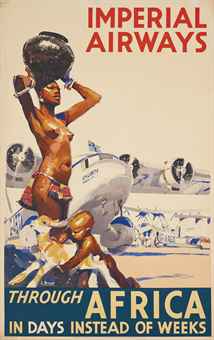
Edit: to add to my own post, the rate of overseas/imperial tourism increased greatly with the advent of air travel during the interwar and postwar years. This is where, for example, we begin to see the oft-emulated 'travel poster' begin to flourish, and the culture of international tourism really begin to take off (literally, in this case).
Here's an example for Britain: http://www.christies.com/lotfinderimages/D56110/albert_brenet_imperial_airways_through_africa_d5611030h.jpg
And here's one for France: http://www.postersplease.com/posterblog/wp-content/uploads/2013/12/PAI-LXII_37.jpg
I am not sure what period you refer to- "Empire" can be applied to many different historical locales/periods/situations.
But yes- Europeans traveled to areas under colonial influence/control during the late 19th and 20th centuries. They often wrote about it too- a famous example is the writing of Gustave Flaubert (a French writer who travelled to Egypt in the 1850s) Note that during this period Egypt was not a colony or protectorate of any European nation, it was technically a part of the Ottoman Empire. Still an Empire... technically colonial, but that is all debated. Although there was British presence in Egypt from the late 19th c, it was not technically made a protectorate until, I believe 1914. Anyhow. Egyptian history is complex. For some of Flaubert's responses to his Egyptian travels see Flaubert, Gustave. Flaubert in Egypt. Also, The Letters of Gustave Flaubert: 1830-1857. Trans. Francis Steegmuller. Cambridge: Belknap, 1980.
Also for an interesting discussion of Flaubert, and other European travellers to Egypt, orientalism, and responses to Oriental dance (belly dance), see Karayanni, Stavros Stavrou. Dancing Fears and Desire: Race, Sexuality and Imperial Politics in Middle Eastern Dance. Waterloo: Wilfred Laurier University Press, 2004.
And, from Karayanni's wonderful book...here are some more titles on the topic of Orientalism/European travel in the 19th/20th c.
Behdad, Ali. Belated Travelers: Orientalism in the Age of Colonial Dissolution. Durham: Duke UP, 1994.
Gregory, Derek. “Scripting Egypt: Orientalism and the Cultures of Travel.” Writes of Passage: Reading Travel Writing. Ed. James Duncan and Derek Gregory. London: Routledge, 1998.
Grewal, Inderpal. Home and Harem: Nation, Gender, Empire, and Cultures of Travel. Durham: Duke UP, 1996
Pratt, Mary Louise. Imperial Eyes: Travel Writing and Transculturation. London: Routledge, 1992.
Not a specific answer to your question, but a relevant and interesting find for you, perhaps!
It seems that since travel to the colonies was quite limited for the majority of the population, they brought the colonies to the home country!
http://www.messynessychic.com/2012/03/02/the-haunting-human-zoo-of-paris/
A further question: is tourism an act of colonialism today?