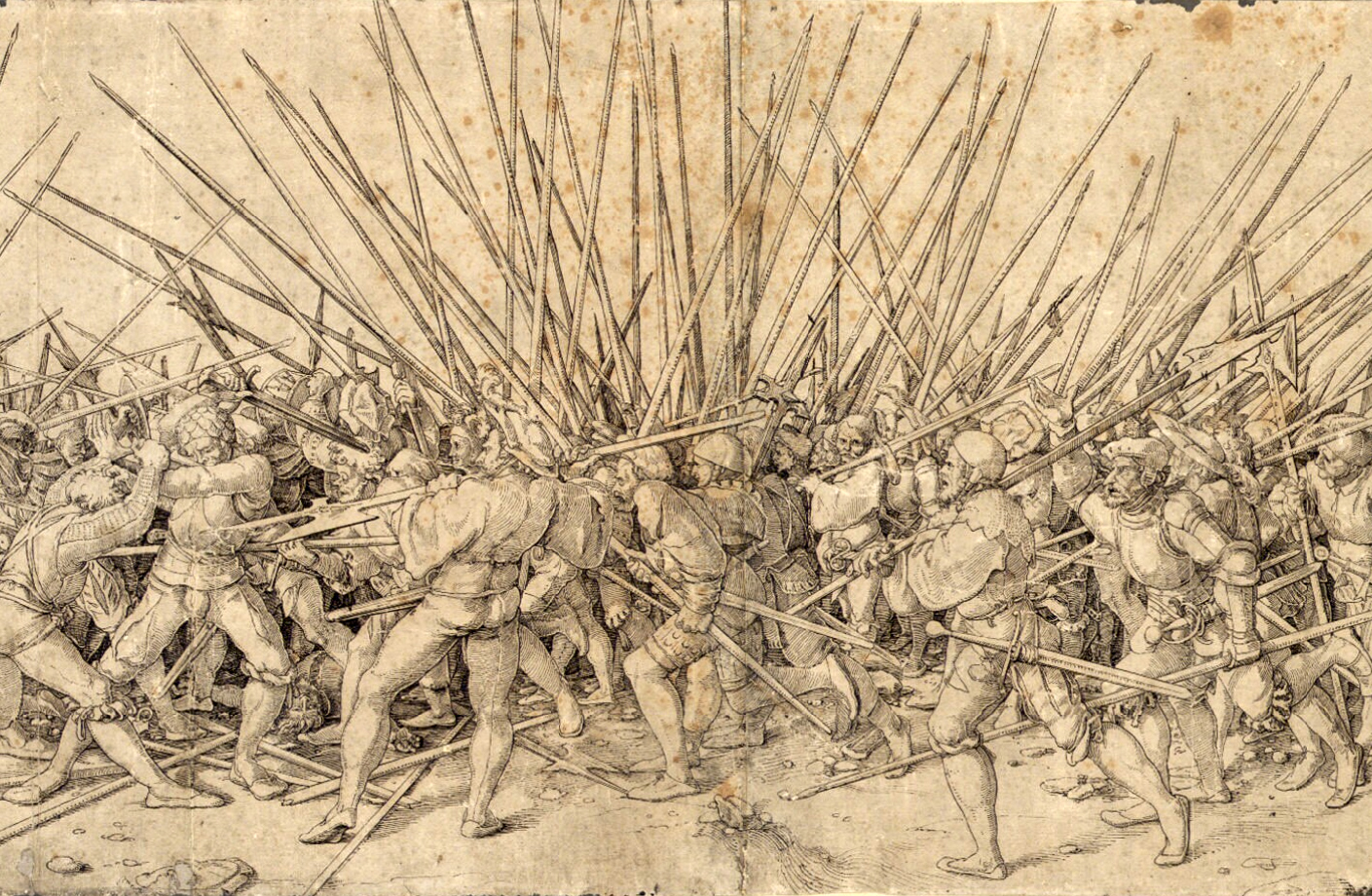
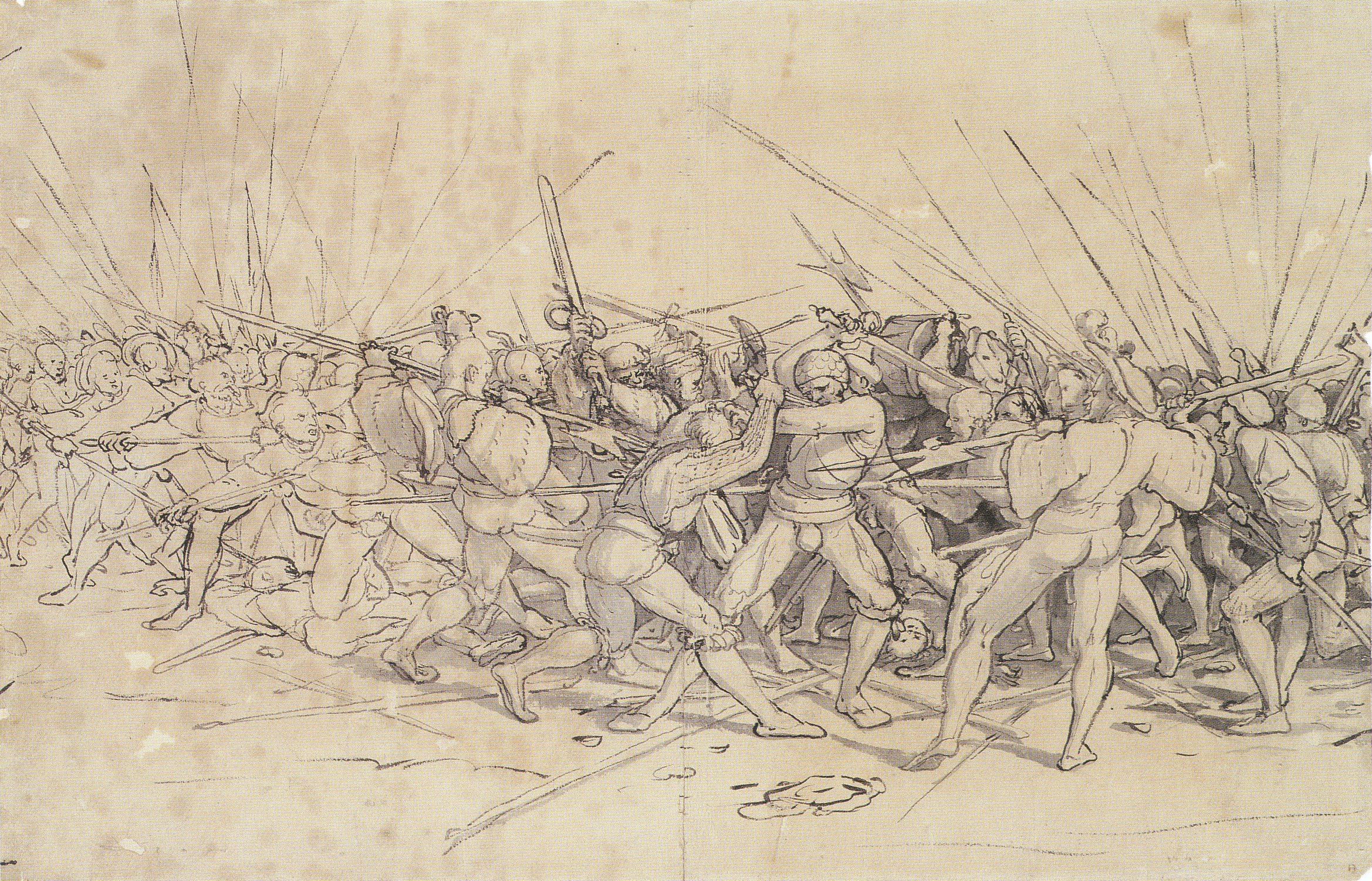
There is a lot of controversy and confusion over this term. It is the moment when just the advance of pike isn’t sufficient to scare the enemy into fleeing for their lives (which was the usual scenario). Against an equal opponent the pikes will not just chase the enemy away, but will actually engage them. Both sides will interlock their weapons, standing at the furthest reach they can, and will try and thrust their own pike at the enemy while avoiding the thrusts of the enemy pike. This is called the 'push of pike'.
'Push' does not mean what it means today of a sort of general scrummage. The original medieval meaning of ‘push’ was to thrust or stab with one’s weapon.
So therefore ‘this is certainly not push of pike, since they aren’t pushing their pikes at the enemy at all. The Wikipedia page uses this image as a representation, which is a reproduction from this image (or this version has some more detail). But this is not push of pike – it is explicitly titled ‘bad war’ which is the moment when the push has collapsed into disorder and the pikes have been swopped for melee weapons.
As I understand it this is push of pike or this image which shows that pike fighting wasn’t a free-for-all but a definite duelling battle between matched opponents in order.
So my questions are these? Does anyone have any more sources on push of pike, any drawings, or primary sources describing them, avoiding the errors I’ve highlighted above? I’ve checked the various previous posts on AskHistorians already so please don’t direct me to them. In addition I’d like to ask:
How long could a pikeman fight for before becoming exhausted? This would obviously depend on the length of pike. As pikes got longer they’d become more dominant in mass formation, but less easy to handle individually. So:
What is the optimum length pike for an average soldier to fight with, assuming they want to be able to fight, and not just hope the enemy runs away (which was always the best case scenario). I know in the English Civil War pikes were supplied at a regulation 16 foot but many pikemen found this too unwieldy and chopped the first few feet off them.
In tercios only around half of the pikemen were fully armoured, and the rest were unarmoured with only a morion style helmet. What was the point of these unarmoured pikemen? Obviously they couldn’t fight on the front rank since they’d be at a significant disadvantage, and they’d know it. So they’d probably run away before throwing themselves unarmoured onto the points of the enemy pikes. Perhaps they were there only to provide depth, but what was the point of having deep formations when most of the men can’t directly engage the enemy.
Could you please source your claims concerning your definitions of "push of pike" and "bad war." From my understanding, these are not rigidly defined terms. When two pike formations came head to head, it was "push of pike." If a lot of people died during a push, it was "bad war." As people became acclimated to the idea of high casualties in battle ( as opposed to the generally less lethal medieval battles), and as the importance of the pike dwindled in comparison to the gun, the term "bad war" fell out of common usage.
I honestly have no idea how pike fighting happened minute to minute. I would love to read a detailed account though.
It's important to remember that in early modern warfare, soldiers in continental Europe (I'm not going to address England here, I'm not as familiar with them) spent way more time marching, raiding, and conducting sieges than in fighting pitched battles. I don't have any of my books with me, but during the 80 years war for example, it was common for 2-3 sieges to occur during a season with maybe 1 battle. In a siege, march or raid, a long pike is a nuisance. Although to be fair, I'm not well acquainted with the minutia of raiding either. In short, soldiers had an incentive to keep their kit as light as possible.
I can tell you that Gustabus Adolphus set the length of his pikes at 17.5 feet. Pike length in general seemed to hover between 16-18 feet. The macedonian phalanxes used pikes of approximately 18 feet. During the wars of the Diadochi (after Alexander the Great's death), they experimented with pikes longer than and shorter than 18 feet before deciding that somewhere close to 18 feet was ideal. So for fighting, 18 feet seems best, but the infantry were always trying to get them shorter. It was not unusual to see pikes range in length from 12-18 feet during the renaissance era. Although officers of the Army of Flanders were specifically instructed to make sure that their soldiers were not shortening their pikes to much.
Secondly, and most importantly, deep formations provided a boost to moral. People were more likely stay and fight when backed up by all of their friends. European reformers found that thinning pike formations required better discipline. Famously, Maurice of Naussau's thinner pike formations were thrown back by the thicker spanish lines, in spite of the Dutch's discipline, better firepower and better position. It was some time before European discipline progressed to the point were soldiers were comfortable fighting in lines 6, 3, or even 2 men deep. To be fair, fighting in thin lines was a historical novelty. Also to be fair, thin pike lines were not there to push off another line of pikemen. They were there to provide cover for your gunners.
Thirdly, fighting in deep formations provided a way for inexperienced soldiers to learn how to conduct themselves in battle. It provided valuable on the job training without putting the fate of your army in the hands of untested soldiers.
Sources:
"Battles of the 30 years war" William Guthrie
"Weapons and Warfare in Renaissance Europe" Burt Hall
"Warfare in the 17th century" John Childs
"The Army of Flanders and the Spanish Road" Geoffrey Parker
"The military revolution" Geoffrey Parker.