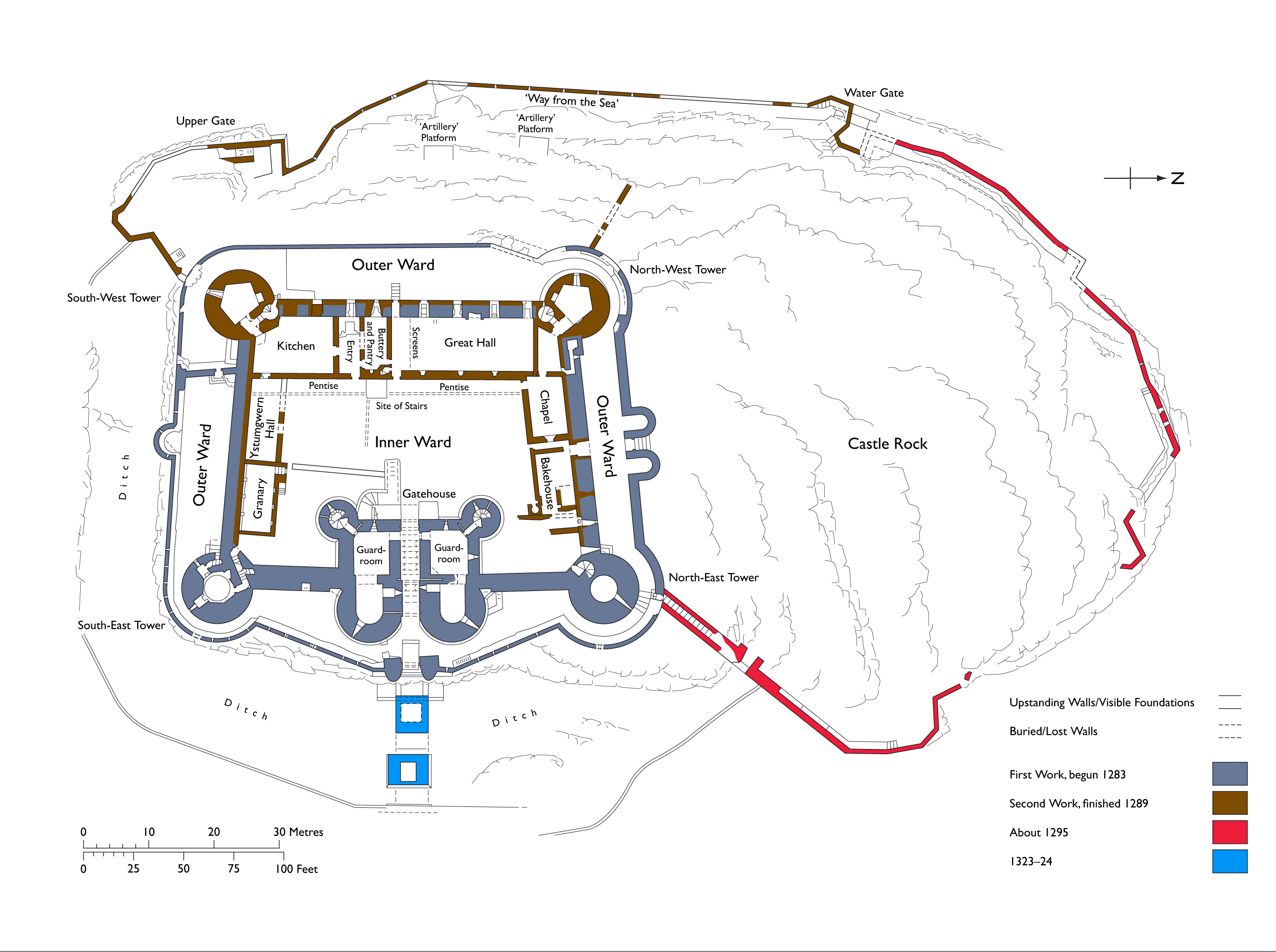
There have been a few books released in the last couple of years by Dan Snow ("Battle Castles: 500 Years of Knights and Siege Warfare) and Marc Morris ("Castle: A History of the Buildings that Shaped Medieval Britain"). One of the most authoritative books on English Castles is Brown's "English Castles. Morris points out, in his introduction in fact, that there are problems with how we even define castles, and there is a great deal of uncertainty about how to actually define them - purely for defence? stately home? All of that mixed into one?. Certainly before the period you identify, castles had a much more defensive purpose. One only has to look at Harlech Castle, built between 1282 and 1289 by Edward I during his invasion of Wales. This is a castle entirely geared towards defence and holding out during a siege. The castle was closer to the sea than it is today, allowing it to be resupplied in that way during a siege. As you can see from this plan, there was accommodation, but it is hardly a place of comfort (http://upload.wikimedia.org/wikipedia/commons/f/f8/Harlech_Castle_Plan.jpg). Indeed the strength of this castle in a military sense was demonstrated during the Wars of the Roses when the Lancastrians held out for seven years before the castle finally fell in 1468. But castles were not just purely military (although of course important in that regard). They were a demonstration of power, and closely connected with prestige. The positioning of Dover Castle for example, makes tactical sense, but was also a demonstration of power. Seen from the sea (http://static.panoramio.com/photos/large/11869700.jpg), this suggests power and might to any invading force from Europe. Certainly by the 15th Century, castles were no longer of such great importance both due to the nature of warfare, and the situation in England had changed somewhat. The welsh threat had been largely negated after Owen Glendower left the picture. There was not a threat to England directly, and there was no need to spend vast sums building and maintaining these enormous, strong castles. The barons also declined in wealth and power during the 15th century, meaning that they were unable to maintain their castles, previously a central part of their power and prestige. Castles were not very important in the Wars of the Roses, which was largely decided by pitched battles like the Battle of Wakefield, in which Richard of York was killed. But castles, having lost their defensive importance, retained their importance with regard to the aforementioned prestige element. Herstmonceux Castle, built during the 15th Century is a perfect example of this (http://www.aerialphotographyforyou.co.uk/newsitepics/herstmonceux_castle.JPG). It certainly looks impressive, but from a military point of view, it is feeble. The castle is not elevated, as you can see from the picture, and the "moat" doesn't really help when you can walk right up to the back door. The walls are thin, and the windows are too low. But what is interesting about this castle, is that it demonstrates the transition from castles being largely defensive structures, to castles deliberately evoking the tradition elements of castles (such as battlements, towers, moats etc.). By retaining these traditional features (but no longer in a practical form), the castle became more of a symbol than anything else. My answer is rather a rambling meander through some of what I know, but I would recommend the Marc Morris book for further reading.
r/cool0hand does a good job of explaining how castles became a fashion item around the 15th century. Bodiam Castle is another example of this, it looks cool but is defensively useless.
We still needed fortifications though, and this period saw castles evolve along 2 lines, the retro looking stately homes, and the state-of-the-art defences.
As walls were made pretty mush useless by cannons, you had to be a bit smarter with how you kept the enemy out, therefore the moat became more important.
A moats were made much wider and a glacis was added in front, this pic explains it quite well. http://1.bp.blogspot.com/-foP_J_BfjVU/UOLGRLPJuVI/AAAAAAAAES0/PwMPbaoFZIQ/s1600/glacis+constructed.JPG Notice how there is still a wall to climb, but the attacking cannons only have about 4 foot of it to aim at.
Also, notice the sticky out bits (brilliant use of language I know, they're called ravelins if we are being technical). If the walls were circular then the best place to hide was directly underneath them, earlier castles had walls that were wider at the bottom to counteract this, http://peacebeme.files.wordpress.com/2011/02/castle.jpg Ravelins give you a much better view of your attacker.
Eventually all these features grouped together to create star forts like Bourtange in The Netherlands http://en.wikipedia.org/wiki/Bourtange_(fort) While extensive fortifications like this caught on in 15th century Europe, politics and military tactics meant that they did not arrive in England until much later. There was not much need to dig up half of the countyside like this.
Probably the best example in England is The Royal Citadel at Plymouth. It's star-fort inspired but still looks medieval. http://en.wikipedia.org/wiki/Royal_Citadel,_Plymouth
Edit: My grammar is horrendous.