Did either side see this as a strong possibly of happening at any point? Were the rulers of England steadfast at conquering all of France or would they have been satisfied with a much larger country of England plus half of France?
Oh yeah! So I'll apologize up front, I haven't studied this subject in some time, but I'll give you what answer I can.
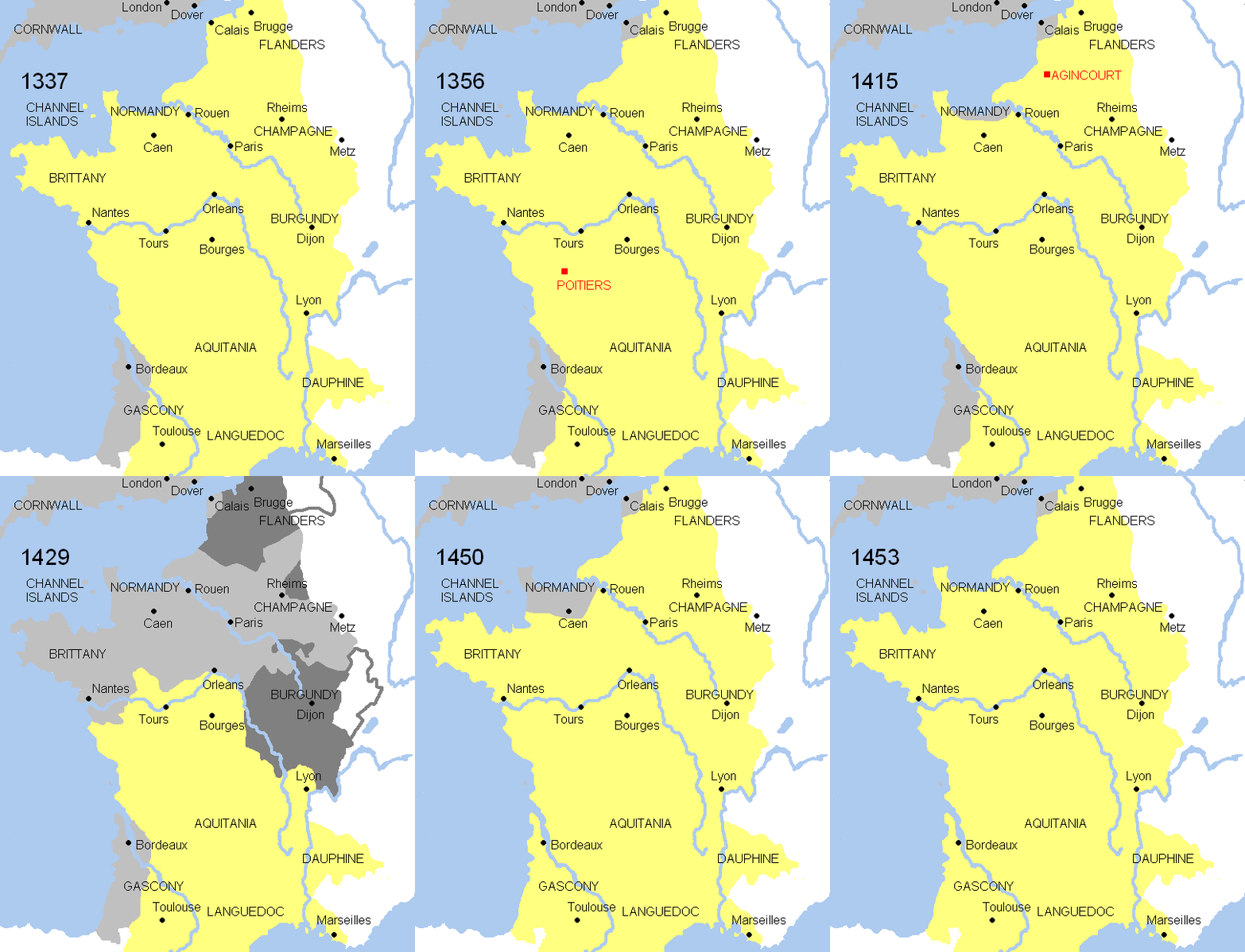
First, take a look at this gif. It shows the territorial holdings of English vs French from 1337 to 1453. While the English experienced some setbacks in the late 1300s, under Henry IV and Henry V, they made huge inroads into conquering, at least militarily, the whole country. Then, of course, Joan of Arc and her witchcraft came along and upset the whole thing until all England was left with was Calais.
Here's the complicated thing, I'm not sure how effective lordship through conquest would have been in this period. While it's certainly possible the English King could have occupied two kingships, as King of England and King of France, it's doubtful he could have joined the two kingdoms into a single political entity. As the whole concept of nationalism was still in utero at this point, we can't say how much resistance the French people would have given solely due to their opposition to foreign rule. I'm much more of a scholar of the early modern period, and when Charles V and his son Philip II took over Italy, while the Italians nominally recognized the Spanish Kings as their overlords, this was not accompanied by a wider acceptance of their incorporation into the Spanish Empire.
So, fair warning, this will turn a bit conjectural, but I would hazard to say that if England had established a permanent form of sovereignty over French territory that lasted past wartime, the greatest extent of this would be the replacement of a French monarch at the top of their Feudal hierarchy with an English one. The majority of this hierarchy would stay the same, but the top rung or so would be occupied by the English. Especially in the times before cohesive nation-states, common life would remain unchanged. The English King and some of the nobility would be the main recipient of any benefits reaped from the conquest (e.g., taxes would end up in different pockets), but the French and English people would likely have remained as foreign to each other as they had before the war.
Edit: The more I'm thinking about this, the more I wonder about the impact that Norman culture had on the English nobility. The pervasive bi-culturalism of the English aristocracy in the centuries after 1066 would not have been a distant memory during the Hundred Years War. I do know of a bit of intermarriage between the English and French even during this period of conflict. I think if the society was able to democratize this biculturalism, there'd actually be a chance at a cross-channel union, the problem is this just stayed at the highest social rung. Since travel at this time was pretty unusual, having two distinct cultures wouldn't have too much of an impact on the governing of the two realms since they were so geographically separated.
I somehow doubt though that this polity could survive into the modern age. England had enough trouble dealing with its religious upheavals. If you made one man responsible for that and much of France, I think the whole thing would just go to shit before 1600.
The English won the Hundred Years War. They got what they wanted, the King of England getting rightful recognition as the King of France. They briefly "conquered" all of France (or at least conquered enough of it to get a treaty giving the King of England the throne of France).
Then they went and lost it all.
Leaving out the whole front end of the Hundred Years War, in the Treaty of Troyes in 1420, the English recognized Charles VI as King of France and the French recognized King Henry V of England as his heir (cutting Charles VI's son, the Dauphin, out of the succession). This treaty was rather forced on the French by Henry Vs military victories.
In 1422, both Henry V and Charles VI died. At this point, Henry VI, the infant son of Henry V and Charles VI's daughter (the marriage had been another outcome of the Peace at Troyes) became King of England and France - The only English King to actually rule France (not personally, of course, he was an infant).
The Dauphin was upset by this course of events. With the help of Joan of Arc, he rebelled against the Treaty of Troyes and had himself crowned King Charles VII of France in 1429. By 1436 he had re-taken Paris. By 1453, he had driven the English out of all of France except Calais and the Channel Islands (which Islands are today the only French possessions remaining to the English Crown).
If King Henry V had not died of dysentery at the young age of 35, things might have turned out differently.
Still, even with the English handicapped by having an infant King, the Dauphin was doing a terrible job of reclaiming the Throne of France until Joan of Arc came along.
Whatever she did, it might as well have been the divine intervention that she claimed. Her arrival galvanized the French into action, and turned a losing situation into ultimate victory.
She was more than just a symbol or a figure head or a morale booster.
Against the wishes of the strategic leader of the army (Jean d'Orleans) she led soldiers and towns people in four assaults on the ring of bastions and fortresses which the English had erected around Orleans during the siege.
In each of these assaults (during the third of which she had to persuade the mayor of Orleans to open a city gate to let her forces attack after Jean d' Orleans had ordered all the gates locked to prevent further attacks led by Joan) she captured an English bastion.
In the fourth attack, despite being wounded by an arrow in the neck, she succeeded in capturing "Les Tourelles" which was the main English fortification in the siege lines, thus ending the siege of Orleans.
Thereafter, she had the support of the army command and the army advanced towards Reims at her insistence, winning the battle of Patay along the way and capturing many towns.
When the French reached Reims, they crowned the Dauphin King of France, and he went on to reclaim the kingdom.
http://ehistory.osu.edu/osu/archive/hundredyearswar.cfm http://www.bbc.co.uk/history/british/middle_ages/hundred_years_war_01.shtml http://web.cn.edu/kwheeler/Hundred_Years.htmlhttp://en.wikipedia.org/wiki/English_claims_to_the_French_throne