Ooooh this is right in my wheelhouse.
The French army expected the war to be a highly mobile one and designed its army and its doctrine around this premise. Something crucial to understanding early-Great War French doctrine is the idea of the "cult of the offensive" -- that is, always be on the attack. It was almost religious the adherence by high command to this simple concept and it shaped their entire military and the inevitable destruction they would face in the upcoming weeks. Joseph Joffre, the leader of the French military, said in 1913 regulations which I like to pull out all the time: "The French army, returning to its traditions, accepts no law in the conduct of operations other than the offensive."
Because they were to be on the attack constantly in a maneuver based war the French saw no reason to burden the infantry corps with ponderous heavy artillery. The mid and late war ideas of 'softening' enemies up with incredible artillery barrages were seen as unnecessary and tactically irresponsible by most staff planners. A withering barrage of bullets from their singleshot 1886 Lebel 8mm rifles would shock the enemy and then they would fix their bayonets la rosalie and 'finish off' the remaining soldiers in a charge.
They also, unlike the Germans, had a very restricted set of artillery calibers as they did not want to complicate supply. As such, they went in with mostly groups of 75mm mobile field artillery and very limited numbers of 105mm and 120mm heavy artillery. This would prove to be disastrous against the Germans who had a significantly larger amount of heavy artillery that outranged and outgunned the French and rendered their artillery, essentially, useless.
Cavalry was also in a unique position in the early stages of the war. Something that is wildly overblown in hollywood is the amount of death in ancient battle. The death came when the army was routed and the cavalry pursued and destroyed the scattered army who was giving their backs. That was the job of the cavalry for thousands of years -- the final slam that broke the enemy armies back for good. Cavalry's essential role in WWI was to scout and assist infantry in the attack but the latter part became...problematic. It doesn't matter if you route the enemy army. They still have guns and they can still turn around and shoot your cavalry armed with lances and sabres if you try to slam into their rears.
This is a particularly interesting area of history for me because it was essentially the armies marching as fast as they can without any regard for rest or recuperation. It got to the point where the many times the only chance the German infantry had a chance to engage the French infantry was when the French had to stop to rest. It didn't really matter though, since the Germans were marching for tens of kilometers straight and were too exhausted to fight.
This is a hole that would be filled up by light armor and trucks in World War II but for now was a void and thus when the French were sent reeling back from the Belgian border towards Paris the Germans could not properly capitalize. They could only pursue the French military as fast as the infantry could march which would, ultimately, lead to massive amounts of attrition. So much that many estimates put the strength of the 1st, 2nd, and 3rd Armies (the ones who were the "hammer" coming through Belgium in the Schlieffen-Moltke Plan) at less than 50% manpower by the time the Battle of the Marne had occurred. The battle which would break the back of the German Army's on the "right" flank and send them fleeing back near Belgium where both sides would default to what we now know as trench warfare for the majority of the war.
Anyways, back to the actual military fighting. Aviation was still in its infantry and filled a role similar to cavalry -- scouting. In fact, to get back on my tangent above, it was actually airplanes which noted the German movement South prior to the Battle of the Marne which gave the French the German army's flank and ultimately lead to their decisive victory.
I hope I am painting a pretty picture here, and I hope it's a very gruesome one. The nature of Joffre's war centered on the offensive and the nature of the Schlieffen-Moltke Plan which called for a rapid strike through Belgium and to Paris was a lightning fast, maneuver based war that had to end in a matter of weeks -- with modern weaponry. It's a disaster waiting to happen and that's what came to be.
For example. The French in the early days of the war advanced on a German town in Alsace-Lorraine called Mulhouse and occupied it with little resistance and the Germans prepared a counter attack. They would march into battle shoulder to shoulder in ordered lockstep and the battle would rapidly disintegrate into a bloody mess in a dense vineyard and forest. The massive heat and exhaustion took an insurmountable toll as hundreds of men simply collapsed into roadside ditches and those who did not would be cut down by French machine guns.
Part of the reason of the French slaughter of the Germans was the German insistence on usage of reserves. The Germans used their reserves on the frontlines while the French were more reluctant to do so and as such, at the Rhone-Rhine Canal, the French opened fire on disorganized Baden Landwehr (reserves) across open fields. One company of the Landwehr's alone fired off 35,000 rounds blindly. Sergeant Otto Breinlinger of the 11th RIR said that after Mulhouse his company was reduced from 250 men to 16.
Orders were not heard or flat out ignored until officers threatened to shoot deserters. In the Second Battle of Mulhouse, which had similar results, Major Leist of the 40th IR, 1st Battallion said: "There can be no talk of a connection with the Regiment; not a single regimental order was passed down during the entire battle."
This type of battle would define the early war battles between the French and Germans before the Battle of the Marne which would send the war into what we now know as trench warfare. Incredible amounts of death to artillery, charging into machine guns, marching lockstep and charging in giant blobs into rifle fire. It seems almost cartoonish but that was really what was the strategy early on. The other great example of early war battles were the engagements between the Belgians and the Germans, where the Germans had to push on a ring of forts in the Liege region to gain control of the narrow passage into the country and keep their war plan on schedule.
Despite the Belgians inept armed forces of half trained militiamen they absolutely slaughtered the Germans. During what is now known as the Siege of Liege the Germans got lost in the dark, officers were separated from their men, soldiers panicked and shot wildly under suspicion of guerrilla fire. Further, the Germans attacked in tight formations -- a rich environment for untrained soldiers to unleash mass fire upon and cause devastating damage. 150 rounds every sixty seconds and incredible artillery fire swept out massed German columns before the walls of the fort. From an anonymous Belgian officer: "As line after line of German infantry advanced, we simply mowed them down. ... They made no attempt at deploying, but came on, line after line, almost shoulder to shoulder, until, as we shot them down, the fallen were heaped one on top of the other, in an awful barricade of dead and wounded men that threatened to mask our guns and cause us trouble."
No war games or military theory provided the Germans or the French with the knowledge of what modern warfare truly was and the lethality it provided. Officers thought to overcome the firepower of thousands of rifles, dozens of machine guns, and artillery pieces fixed on their position with dash and daring maneuvers and were punished with staggering casualty rates.
Quotes:
Collected via Holger H. Herwig's The Marne, 1914: The Opening of World War I and the Battle That Changed the World
General Sources:
Barbara Tuchman The Guns of August: The Outbreak of World War I
Holger H. Herwig The Marne, 1914: The Opening of World War I and the Battle That Changed the World
Holger H. Herwig The First World War: Germany and Austria-Hungary 1914-1918
Robert Doughty Pyrrhic Victory: French Strategy and Operations in the Great War
The initial days of the war (at least in the West), were characterized by two things: mobilization of the massive armies, and rapid movement across open terrain. The stalemate was reached almost as a consequence of the military technologies used, rather than as a deliberate tactic.
'The 1st Troop with Captain Hornby at their head went after them, and the rest of the squadron followed on in support, with drawn swords. Our troop officer, Lieutenant Pigeon, led the troop at a fast canter, and everyone was highly excited. As the Germans retired into the village they met up with a larger group of cavalrymen, and, owing to the congestion, were soon caught by the 1st Troop. A fight immediately broke out, swords clashing with lances. The German lances proved too unwieldy at close quarters and several of the enemy were downed. However, we arrived just after the Germans had scattered, with the main body splitting off and carrying on up the main road. We continued to give chase, our horses slipping all over the place as we clattered along the road's square-set stones. The First Shot: 22 August 1914
The above is part of a first hand account of fighting in Belgium by a cavalry troop at the vanguard of the advancing British Expeditionary Force. Battles were fought with almost the same tactics and bravado as the Napoleonic Wars a hundred years earlier during the opening months of World War One.
The tactics used at Omdurman and Fashoda differed little from those at Jena-Auerstedt or Waterloo, but these were considered colonial skirmishes even at the time. Military tacticians had yet failed to learn the lessons of the Siege of Ladysmith in the Second Boer War, or even farther back, the Siege of Sevastopol during the Crimean War (the siege of 1854-1855), by 1914.
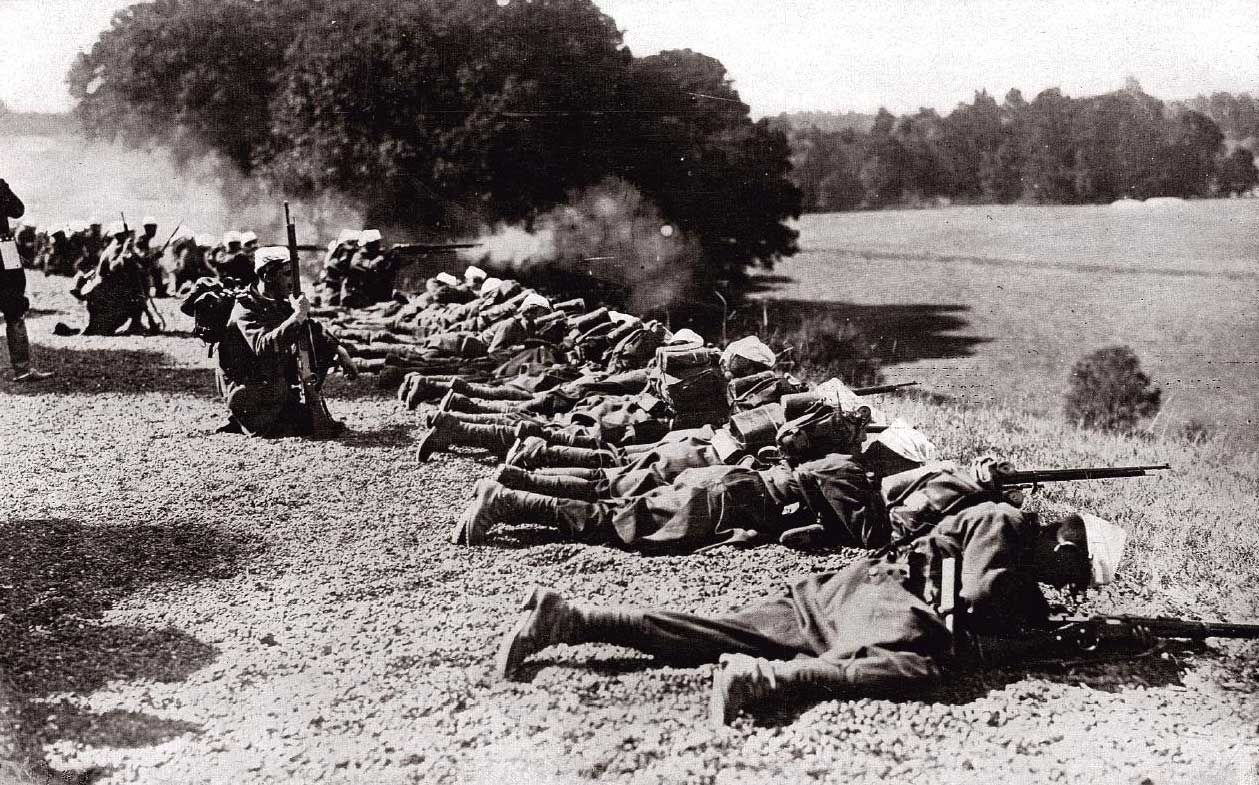
We have some very good first hand depictions of combat of this time period as well, thanks to newly invented camera technology. The Balkan Wars are a good example of less organized conflict, where soldiers advanced in ranks with bolt-action rifles and clad in long coats and kepis, only to first take kneeling positions in open order, and then prone positions behind cover as fighting progressed.
The rapid movement across the relatively open, flat terrain of Belgium and northern France, combined with modern mass mobilization of conscripted troops and reserves, and deployment by railroad, was the centerpiece of the German Schlieffen Plan which sought to seize Paris quickly by sweeping through undefended, neutral Belgium. This came to a grinding halt with the massed rifle fire, machine guns and artillery at the First Battle of the Marne, and lead both sides to begin digging in for the trench warfare that dominated the rest of the war.
Some images of the tactics in use at the time:
French soldiers taking firing positions, First Battle of the Marne, September 1914
French infantry charging across an open field, 1914
Belgian troops, lying prone at Battle of Liege, 1914
French heavy cavalry looking very Napoleonic on their way to battle, August 1914
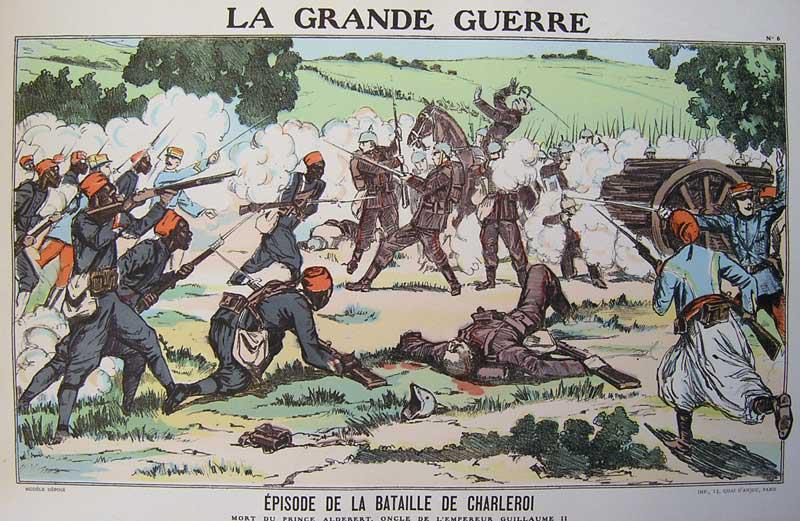
Depiction of French colonial troops and Zouaves repelling a German assault at Charleoi, 1914
German troops defending a trench near Arras, October 1, 1914
By October 1914, the "Race to the Sea" was over and both sides dug in, leading to years of bloody stalemate, rather inevitably.