To my knowledge it's been established that the natives of the Americas and Oceania died off in such massive numbers primarily due to diseases that Europeans and Asians had developed immunity too, but had not been present in these places (due to lack of towns and cities, domesticated animals etc) but what about Greenland?
To my knowledge it was colonised by the Norse and later the Danish in the modern era, who would have carried those diseases, and the original inhabitants were Inuits; so why did they not suffer the same fate as the American natives? Or perhaps they did and it was just never settled to the same extent?
Thanks
I don't have the backing to answer the entire question, but I can correct a point regarding
To my knowledge it was colonised by the Norse and later the Danish in the modern era... and the original inhabitants were Inuits...
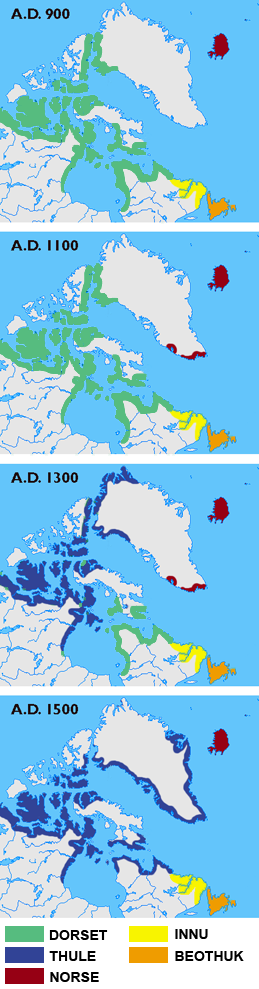
The Vikings actually arrived centuries before the Inuit. The part of Greenland the Norse settled was unoccupied when they arrived. Wikipedia has a handy chart showing this (the Thule people in blue, who supplanted the Dorset, were the ancestors of the modern Inuit). There was a period where they coexisted though, albeit with fairly limited interaction.
Greenland (and even Iceland) were isolated and small enough that they simply couldn't support epidemic diseases. It's not like the colonization of the Americas, where ships were setting sail from big cities in Europe and going directly across the Atlantic. Greenland was colonized by Norse, and even in the larger, closer Iceland smallpox wasn't introduced until 1241 (and killed 20,000 of 70,000 inhabitants there before dying out completely). Now, smallpox wasn't the only disease that the old-world gave to the new world, but other epidemic diseases follow the same pattern: they don't do well in small, isolated populations. Greenland was a tiny population colonized by a small population on the fringe of Europe, and was mostly outside the range of epidemic diseases.
Smallpox in Iceland see pg 299
Iceland's population too small to maintain measles permanently
I think this may be a bit beyond the scope of historians' expertise, and more in the field of biology and medicine. I don't think the premise of question itself is entirely correct.
Small pox wiped out up to two thirds of the Inuit population. It was also pretty devastating for Siberian peoples with whom the Inuit share genetic and linguistic ties, though I'm not 100% sure this was due to any sort of genetic factors. Health outcomes remain poor for many Inuit though that's beyond the scope of the subreddit (and due to a variety of factors).
but had not been present in these places (due to lack of towns and cities, domesticated animals etc)
There were some pretty large cities and towns in the Americas pre-contact actually, though someone else would be better qualified to comment on that.
hi! you'll find additional information in the FAQ. The first handful of posts ask whether the Norse introduced infectious diseases to the North Americans; the same factors can apply to early settlement in Greenland