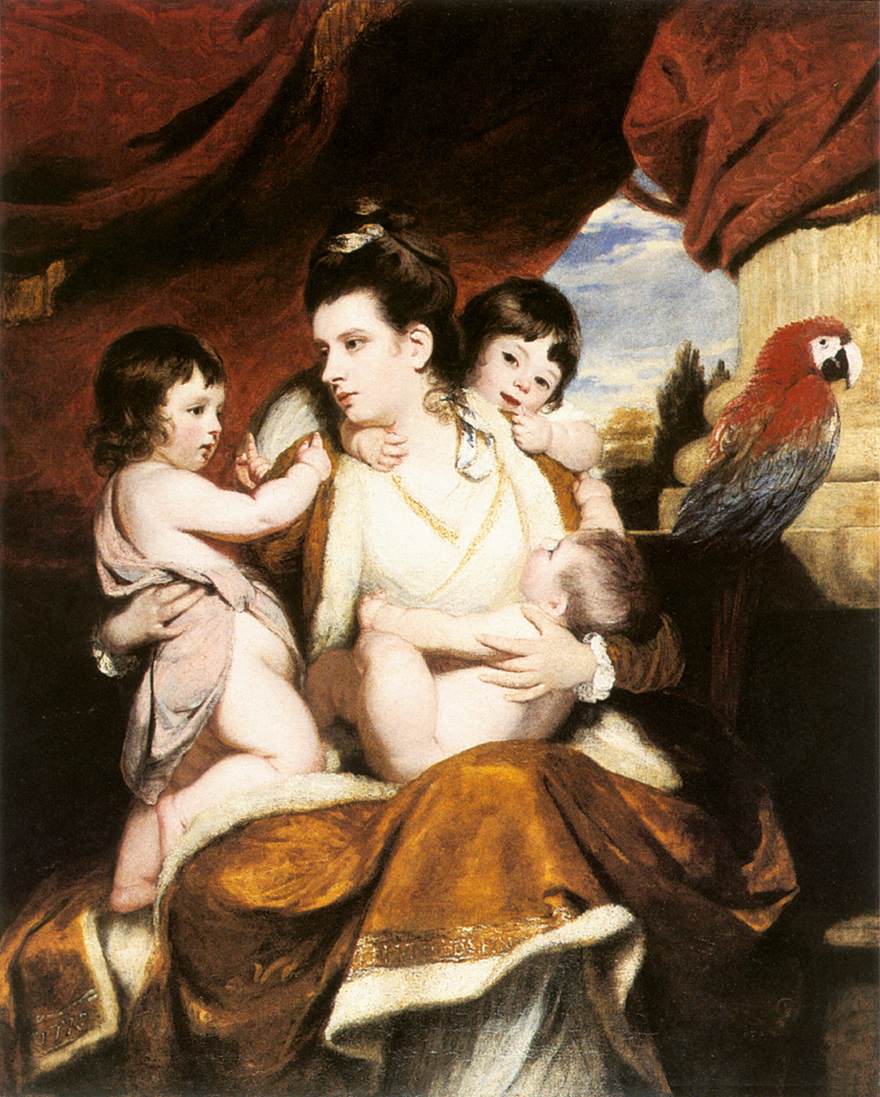
Not my area of expertise, but the report "Moving Towards a Quantitative Diagnosis of Down Syndrome in Historic Material Culture" contains photos of several works from neolithic figurines to Renaissance paintings, including:
"Adoration of the Christ Child" (ca 1515)
I can't help you here, but I'm curious to know why your asking. Is this part of of piece of work or is it just a thought that's popped into your head?
While it's not conclusively Down's Syndrome, Frans Hals's Malle Babbe ("Loony Babbe") done in 1633 depicts a woman whose physical characteristics have led art historians to believe she dealt with a mental disorder/illness of some sort. (source)
Quick note: In this painting, the owl on her shoulder is representative of foolishness and stupidity, not wisdom.
I wrote this in response to a now-deleted post and thought it might still be of use.
There are Olmec examples in the Mesoamerican region that are regarded by some as using a unified artistic style to represent hydrocephalia, spina bifida, or as Michael Coe would have it, Down Syndrome. The descriptor for that line of artistic pieces is typically "were-jaguar motif".
[ the now-deleted post] may be referring to Chimu figurines which are described by some as exhibiting either examples of purposeful mutilation or deformity due to diverse pathologies, as per this paywalled (JSTOR) article. Salaman, Redcliffe N. “Deformities and Mutilations of the Face as Depicted in the Chimu Pottery of Peru.” The Journal of the Royal Anthropological Institute of Great Britain and Ireland 69, no. 1 (January 1, 1939): 109–22. doi:10.2307/2844233. There may well be other examples, as there is potentially much more recent stuff on the topic.
Analysis in both these areas has led to varied theories about the consideration of such conditions as either a sort of blessing (as per the connection with the jaguar in the Olmec) or as art running the spectrum from "sadistic" celebration of mutilation to successful treatment of medical conditions with the Chimu, but unfortunately a scarcity of context leaves this basically unanswerable, to the best of my limited understanding of the topic.
My concern is that the original poster's question seemed focused on paintings and photographs. This might preclude the inclusion of both the Olmec (since this shows up only in stonework) and Chimu pottery. Still, they might serve towards the idea they are asking about if it's the concept and not the form that is crucial.