Many militaries today use doctrines that have evolved from either allied/NATO doctrine or from Soviet/Russian doctine, depending on whose sphere of influence they were in. I guess I have two questions regarding German doctrine here:
Yes, German doctrine did differ a lot from both the Allies and the Soviets.
All of course changed throughout the war, as what was available to commanders changed and the strategic possibilities and constraints changed.
The Germans
The Germans entered ww2 with one of the absolute best armies the world have ever seen. Building on their experience in ww1, where they had developed both operational and tactic doctrines that were well-adopted for both trench and more open fighting. Flexible defence, where you deployed small groups of troops to the front to hold the line and reserves to the back allowed them to delay and then counter-attack an enemy attack both tactically and operationally (note - tactics involves small units, operations divisions and corps and strategy large armies and logistics). A quick counter-attack to retake lost territory while the enemy was still trying to organise his defence, bring his heavy weapons up, entrench and re-align his artillery to provide defensive fire was often devastatingly effective.
On the offence, the Germans had developed infiltration tactics, meaning that small heavily armed groups of men would attack and bypass strongpoints and heavy resistance to allow following troops to neutralise them, and continue deep into the enemy line to attack support weapons, artillery and logistics and other rear area troops to cause the most destruction.
Building on these two doctrines, the Germans added a concentration of force - especially tanks - and the idea of punching even deeper to completely disrupt the enemy force. This is what Anglo-Saxon sources love to call 'Blitzkrieg' (the Germans themselves never gave it a name other than 'Schwerpunkt' - conctration point). Combined with a strong air force and close co-operation between tactical bombers (German infantry would often have Luftwaffe liason officers attached for communition and requests of air support), the Germans brought a revolutionising co-ordination and focus on air support to the battlefield in ww2.
German NCOs were extremely well trained - the Reichswehr, the 100 000 man army the Weimar Republic was allowed was trained so that every soldier could be an NCO, every NCO an officer and so on, to allow for a rapid expansion. German NCOs led from the front, died at a higher rate than regular soldiers, trained with their soldiers, ate with their soldiers and brought a very strong unit cohesion to German units, especially early war. It can probably be said that German NCOs led and kept the German army together throughout the war.
German officers and NCOs were not only very well trained - they were also allowed an extreme level of independence of action in what the Germans called auftragstaktik, or mission tactics. The unit was given a mission to solve and allowed a high degree of freedom to solve the mission how they saw most fit (as they were on the ground close to the objective). NCOs and lower officers were also encouraged to take opportunities without waiting for orders as the time to get a confirmation from higher command could mean that the opportunity was lost.
The Germans excelled in tactics and operations, but were not as good in artillery tactics, logistics and strategy as their opponents, especially the British and Americans.
Auftragstaktik was picked up by the Western Allies after the war, and is more or less standard for any western army today. Combined arms warfare, adapted to the armies of the time, is also standard in all armies today, as is concentration of armoured assets in specialised divisions.
Soviets, British and Americans will follow below.
*Have to go. Will be back to expand on points and add sources.
Air power
The German's focused on developing very fast, highly offensive shock tactics in the post-WW1 era (specifically in 1936+). Ernst Udet was in charge of shaping the Luftwaffe in the iner-war years, and a focus was placed on fast planes used to support offensive operations, instead of long range, high volume bombers.
Again, the favor of medium planes and the lack of long range bombers was an intentional choice to support the "blitzkrieg" concept. Hitler, and his various top planners abhorred the idea of static warfare.
This lead to dive bombing planes such as the "Stucka" Ju 87s making up a large portion of the bombing forces.
This concept worked very well in the opening stages of the war, such as the offensive against Poland and France. However, it lead to strategic weaknesses as the war dragged on. German planes were short range, requiring airstrips closer to the targets, and the carried relatively few bombs compared to something like an allied B-17 (Stuka carries 990lbs of bombs compared to a B-17 load of 8000lbs). The Germans could not really conduct effective long range, strategic bombing of logistical facilities the same way the allies could.
German machinegun tactics.
The Germans integrated real machineguns into their squads in the form of putting 4 MG42/MG34 machineguns into a platoon, which meant 12 machineguns in a company. Their tactics used the machinegun facilitating a lot of the movement. What the Germans did in WW2 with machineguns became the blueprint that the US and other western countries have since copied and expanded on.
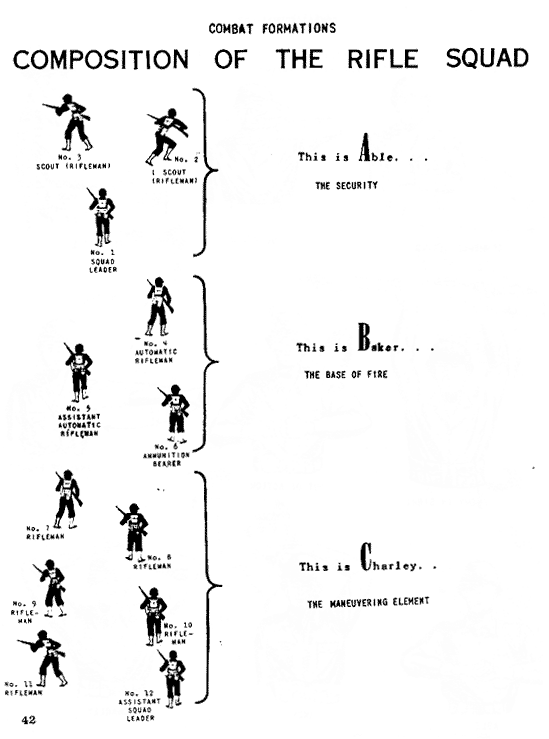
In contrast, the US issued Browning 1919 machineguns as company or battalion level assets. They supported the troops but were not as integrated into lower levels. A US rifle squad did use Browning Automatic rifles (TO&E diagram), but those were more like oversized battle rifles and not true machineguns.
(As a semi-related sidenote, after the war the US combined the designs of the MG-42 and FG-42 to create the T44 machinegun. That design was continually evolved upon and eventually created the M-60 machinegun.)
Airborne
The German command was enthralled with the idea of airborne operations. During the Battle of the Netherlands in 1940, the Germans dropped two divisions of airborne troops. It was the first large airborne operation in history (although the Italians beat them to the punch for the first ever airborne drop.)
Tanks.
Germans built impressive tanks, although the aspects of their abilities have become somewhat mythically inflated.
The Russians first integrated sloped armor in their tanks with the T-34. (Sloped armor effectively makes the armor thicker without adding weight when an AT round is first head on.) The Germans were impressed, and copied the sloped armor concept for their Panther and Tiger II tanks.
The German tanks had notoriously hard to crack armor. This reputation is especially heightened because the allied tanks were still using IFV type designs instead of tanks with main guns designed to defeat other tanks. The Sherman tanks main gun was not powerful enough to consistently defeat the more heavily armored German tanks. This lead to the creation of "Firefly" Shermans which used enhanced main guns.
German tanks were built with a much more "hands on" process. In popular culture this has been spun into a positive which supposedly reflects superior German craftsmanship and respect for detail. The reality though, is that without identical parts, this made the tanks more difficult to repair and more time consuming to build. The Germans had to make their tanks by hand because they didn't have the powerhouse logistics the way the US did. (The US used retooled car factories to pump out large amounts of identical vehicles very quickly.)
Helmets
The German helmet design was hands down the best of all the countries involved in the war. After the war, everyone recognized this, although it took many years for the shape to be widely adopted because of the Nazi stigma attached to the shape.
The germans developed their offensive doctrine from the works of liddel hart and other soviet strategists in the 20s and 30s. Through literature from people like heinz guderian and the small scale exercises by the germans in the mid 30s and the condor legions experience in the spanish civil war, the result of these was Blitzkrieg, literally lightning war. The essence of Blitzkrieg starts with the organization of the main heavy hitting components of the german army together into light, mobile formations with a premium put on communication. Tanks (panzer I & IIs), armoured troop carrying half tracks, Self propelled Artillery (SIGs), Light and Medium bombers (JU87 Stuka and He111s) would concentrate their forces at a percieved vulnerable point and blast open a hole in the front line while the light mobile armored units would drive into the enemy rear hitting vulnerable points and cutting off retreating troops while less mobile infantry units followed and consolidated the ground. See the Battle of Sedan for a perfect blitzkrieg scenario.
The way blitzkrieg differed from allied doctrine was that other than the soviets nobody had come close to using the tank to its full potential. The french for example had alot more tanks and alot heavier tanks like the Char B but they dispersed them and used them as infantry support. The way the allies eventually beat the germans in europe was by copying blitzkrieg and putting their own spin on it. The soviets learned the hard way by losing millions of troops to german encirclements brought on by blitzkrieg. But the soviets learned them well and went on to create the operational art of maneuver warfare. The counter-attack after Stalingrad, Operation Bagration and the encirclement of berlin are all good examples of soviet ability to learn. Im sure ill be hacked apart by my fellow WW2 enthusiasts but im typing this on my phone with my kids jumping all over me. The reason I mentioned only the german and russian armies is that the eastern front was a titanic struggle that developed the future army doctrines of the great powers and showcased the beauty and potential of armoured maneuver warfare. The soviet operational maneuver groups that threatened western europe during the cold war and the american armoured cavalry regiments using AirLand Battle doctrine were all born of the beast of the eastern front.