Ok, first it's important to distinguish between what I will call "Exodus" with a capital E, and "exodus" with a lowercase e.
Exodus is the biblical account. It includes a very large number of slaves, a destruction of Egypt through miraculous plagues, the total annihilation of the Egyptian army, a trek of the slaves through the desert (Numbers 1, puts the amount at 600k+ adult males), a 39 year encampment at Kadesh Barnea, an invasion of Israel, a conquest of the major cities including Jericho, Ai and others.
When historians say the Exodus did not occur, they are referring to this big E, Exodus. Basically the evidence runs down to that if all this were to happen, the chances of the archaeological record being as we find it today is infinitesmally small, so it couldn't have happened. There is broad agreement on this from Finkelstein (The Bible Unearthed) to Dever (Who were the ancient Israelites and what did they know). The biggest problems arise from the lack of appropriate destruction layers found in the cities in Israel, which led to the rejection of the "conquest hypothesis" championed by Albright, a father of biblical archaeology, for how Israel began.
Now there's the little e "exodus". What is that. This essentially means that there may have been some group of slaves, much smaller than the biblical account, that escaped Egypt, traveled across the Sinai, settled in Israel and then spread their story, which eventually was adopted by everyone. Such an exodus is certainly plausible, although it doesn't really resemble the biblical account, nor can it explain the origin of the bulk of the Israelites.
The main alternative to the conquest hypothesis was the "peaceful infiltration" hypothesis. In which the Israelites migrated into the land from elsewhere, subverting Canaanite culture. This hypothesis was held by the main counterpart to Albright, Albrecht Alt. However, this hypothesis has also been mostly abandoned recently because there do not appear to be any abrupt transitions.
So what theories are being talked about today? I'll give you some theories that I've seen bandied about. A lot of these are discussed in "Biblical History and Israel's Past" by Moore and Kelle, which is a very nice and recent overview of the various opinions about the origin and history of early Israel. What we do know is that at the beginning of the 12th century BCE the "bronze age collapse" occurred. When this happened the Egyptians lost control over Canaan. The city of Ugarit was destroyed in Syria. And roughly on or after this time the "sea peoples" often associated with the Philistines arrived.
One theory being talked about today is the "peasant's revolt" theory. Basically this states that the Israelites were actually an underclass that revolted against the ruling Canaanites. There may be some memories of the period of Egyptian rule over Canaan, and there are attempts to equate the Hebrews with the Apiru mentioned in various Egyptian and Sumerian sources. The Apiru are described as a kind of underclass. But the peasant revolt theory doesn't really explain all the details.
The theory of Finkelstein, which gets quoted a lot is also worth mentioning. In his conception the Israelites began in the north starting as a vassal of Aram-Damascus. The northern kingdom became prominent under the reign of Omri and Ahab. Only after the fall of the northern kingdom, did the southern kingdom of Judah rise to power. The united kingdom was a complete myth designed to give the leaders of Judah legitimacy. Finkelstein basis his hypothesis on broad archeological surveys of Israelite settlements and it requires his "low chronology" which I won't get into right now.
The counterpoint to Finkelstein is the "conventional chronology" which is championed by Dever, Mazar and others. It says that the united kingdom did exist, although perhaps was not as grand as the biblical account. Dever points at Judges as a good example of what proto-Israelite society looked like, a loose confederation of tribes that eventually unite (in Samuel) to counter the growing threat of the Philistines.
Ok, I've probably talked about this enough for now. I've mostly discussed things from memory, my sources are at home, and I can give more detailed info if that's wanted.
Edit: I'll mention one other theory that I like, which is the theory of Richard Friedman, famous for his defense of the Documentary Hypothesis, who describes it here. In short, Friedman says that the exodus occurred, and the escapees were Levites. Hence, the main protagonists, Moses and Aaron are Levites. The Levites arrive in Israel where the already settled Israelite tribes don't really want to give them land, but eventually they make themselves into a priestly class. The hypothesis is too fine to have archaeological support and mainly is based solely on the Biblical text.
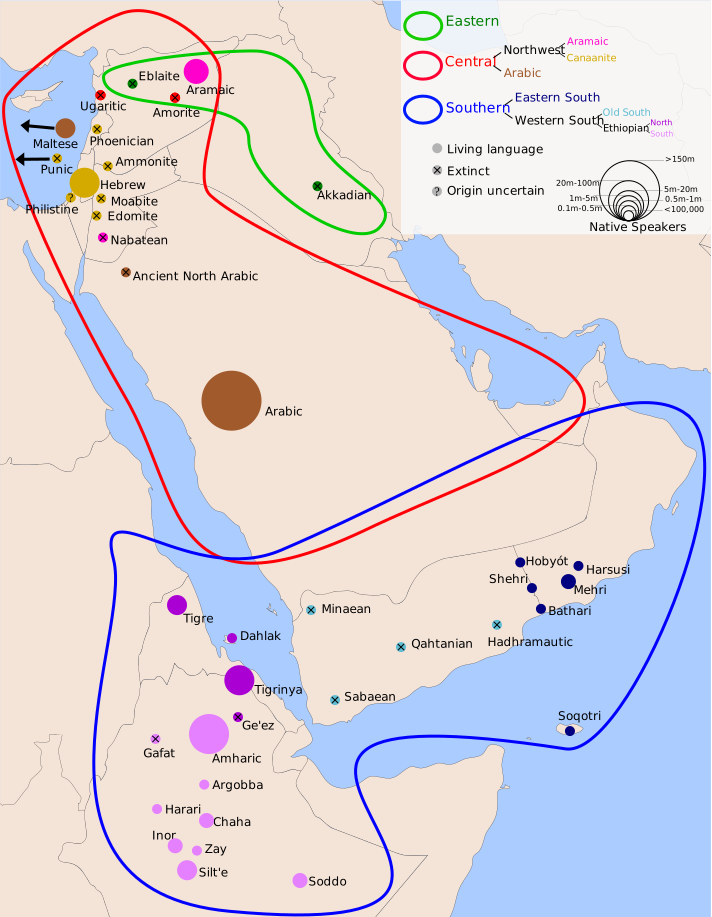
Proto-Semitic (the ur-culture that spread across this region) can be dated to 3750 BCE*, and the earliest surviving sections of the Bible were written no earlier than 1000 BCE**. So the true origin of the Jewish people is whatever happened in those 2750 years, as a subgroup of Semites slowly differentiated themselves from their neighbors.
Here's a map showing the Semitic language family. It doesn't have any dates, but you can clearly see how this spreading culture diversified into a bunch of localized groups. Given how closely their language is related to those in close geographical proximity, there is no reason to think the Israelites originated anywhere other than Israel.
Unfortunately anything more I could say would be pure speculation. Think about linguistic trends and changes that can be observed in the modern world (such as regional dialects), and apply the same rules to a grander timescale to understand how individual cultures like Israel evolve. This is all prehistory so I doubt there are any truly satisfying answers, though I'm sure some archaeologists can fill in the gap.
*Sorry I'm citing Wikipedia for this date. **Don't even have a source on this, apologies again. I am just trying to use rough dates given the timescale, and this is the earliest possible date I have encountered.
What exactly do you mean? While it may not have happened like it did in the Bible, I'm confused as to how you arrived at the conclusion that there was no exodus.
I am traveling at the moment but ifyou are interested in reading up on this subject I suggest checking out the Templars by Michael Haag. In te first two or three chapters he addresses the origins of the Jews and posits that they were a people referred to as the h'brai or something closeto that (sorry I can't access the book at the moment), and were something like merchant/mercenary/labor/migrant groups in Egypt. From the Egyptian word to describe these people came the word Hebrew we refer to today. They migrated to the areas around Jerusalem and settled, gradually encroaching on the jebusites of the city of Jerusalem. Ultimately through trade intermarriage and warfare the jebusites were assimilated and became part of the fabric of the Jewish people. Again sorry I can't provide direct sources but if interested I heartily recommend Haags book, even if you can only read the initial chapters.
There is no evidence for the Exodus, but there's no evidence against the Exodus! Thus, we can piece together plausible explanations based on the the legend as long as they don't conflict with anything known.
The destruction of the Egyptian army includes three instances. (1) They sunk like stones, (2) the parted sea was released and engulfed them, and (3) their chariots were clogged.
Then there is the cities of Ramses and Pithom which may be Tell-el-Maskhuta, and Tell er-Retaba located up north, surrounded by marsh lands, and "sea of reeds" to the east...
So you have a small slave community that decided to escape, the Egyptians gave chase, got stuck in the mud (chariots clogged), decided to say "ah screw this" and turned back. For the Egyptians this is a non event, but a big deal for the escaping slaves, perhaps miraculous.
Source is Coogan, The Hebrew Bible in Its Context, Chapter 6.