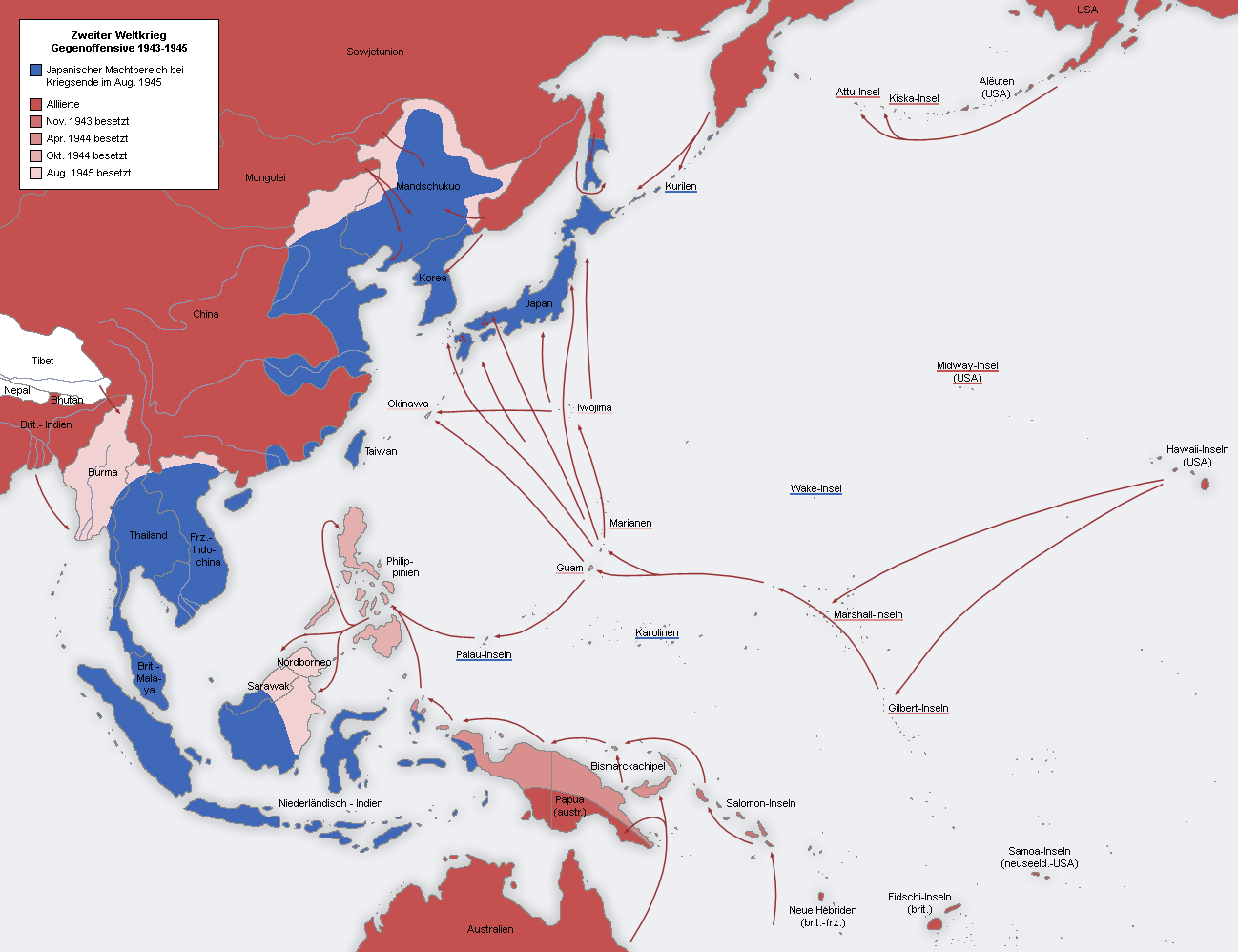
Almost all history books that entail information on the war, or the Pacific theater, mention the US' island-hopping strategy and the eventual Soviet invasion of Manchuria/Korea. However, what isn't touched on, that I've seen, is what happened in the western portions of the theater? How were the Japanese expelled, or were they simply standing guard while the rest of the front fell apart?
For our purposes, let's say the area in question is East-Central China and SE Asia.
In China fighting continued in one form or another until the Japanese surrender. But after Pearl Harbor the Japanese focused their efforts elsewhere. The Chinese however weren't in any position to take advantage of this. Most of their population and industrial base was under Japanese occupation. And the Allied supplies were largely inaccessible. Either the Japanese, the Himalayas, or The Soviets were in the way (Stalin was secretly occupying parts of China and refusing to allow supplies through). So for most of the war China was a stalemate.
Which frustrated the US to no end. They saw great potential in the Chinese and had visions of 10 million Chinese soldiers using American arms. Chiang loved the idea of getting the equipment. But never had the control over his subordinates that say a Stalin did. And thus never quite committed to the American plans. That and the fact that he didn't get along with Stilwell, the general the Americans sent to lead those soldiers and well the plans never quite got off the ground.
The one that did, was in late 1943 the US started basing B-29 bombers in China. Bases in China were close enough they could bomb Japan itself. The raids were never very successful. But it did finally motivate the Japanese and in April of 1944 they launched Ichi-go, a series of offensives with around 400,000 men that drove the bombers from those bases. Of course they then relocated to the recently captured Marianas. And eventually these air raids proved to be horrifyingly successful.
At the same time Burma was an "active" theatre throughout the war. True full operations were only possible from about December through April during the dry season. So the story is one of punctuated drives, and then pauses.
The first Arakan campaign from December 42 to April 43 was a disaster. The British attacked and were driven off, fairly easily. Chinese operations were badly organized and of little help.
So the British switched over to raiding operations. The "Chindits" as the brigade was known conducted small raids, cut telephone wires, tore up rail tracks, and made a general annoyance out of themselves, but did no real harm. And really got themselves chewed up doing so. General Wingate lost about a third of his men. But it raised British morale and showed the the British could conduct operations in the area and so was considered a success.
By December 43 everyone was ready for an offensive The Japanese wanted to push the British further back into India to protect the border. The Chinese were ready to drive south, the British East, and a super-sized American version of the Chindits was set in the interior. The resulting battles eventually all turned the Allies way although the fighting continued well into the monsoon season. The result was the Japanese were stopped and pushed back a bit, resulting in a road being re-opened into China.
By December 44 the British were ready to go again. And they drove all the way through Burma before the monsoon stopped them.
In the end Burma has been called a "sideshow." And it has been nicknamed the forgotten war. It is an open debate what if anything the combat operations there did to really defeat Japan. Especially the last campaign. By then the troops probably couldn't be moved anywhere else. Nor could the equipment or supplies. So you have to wonder what the men on either side were dying for.
Both the war in China and Burma are covered in Ronald Spector's, Eagle Against the Sun: The American War With Japan