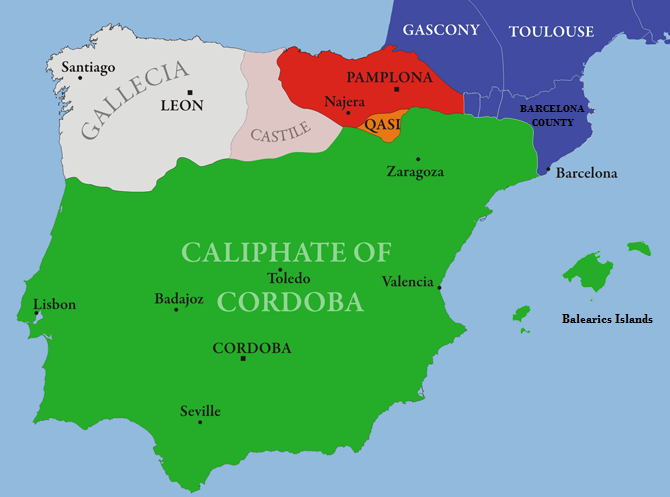
A big chunk of the Iberian peninsula was ruled by Muslims (Arabs and Berbers) from the 8th century and until 1492. They were not just casually visiting, they built their own palaces and mosques. Sicily was also conquered (they stayed for a while).
They brought their music with them. Their instruments influenced some European ones, and they brought lost Greek texts which were translated into Latin. As far as I know Arab music theory wasn't too influential in the European world (if it even managed to get out from their territories at all), the Ancient texts they brought and translated were more relevant.
Troubadours might have been influenced by the poetry and music (not just the instruments). I have not read about definite proof for or against this influence, but it has been proposed.
I don't know if there were any Arab musicians playing in courts deeper into the continent, but things got pretty Arabic in these conquered places.
References:
Haines, J. Eight Centuries of Troubadours and Trouvères: The Changing Identity of Medieval Music
Farmer, H. Historical Facts for the Arabian Musical Influence (Link to the actual book. From 1930, it shows its age; scepticism is adviced)
I do not have sources for examples of middle eastern musicians performing at european courts, but there is a strong influence of middle eastern music in european music. The most prominent example would be in european instruments. The lute and guitar are heavily influenced by the middle eastern oud, the riq, a small percussion instrument surrounded by hand cymbals, is the precursor to the tambourine, and the turkish mey is one of the double-reed wind instruments that would inspire the oboe.
Middle eastern music also has a strong troubadour tradition, and based on their presence in Europe it would not be farfetched to imagine their music was heard on occasion by europeans.
Sources: Mann, Horace. "Islamic and Middle Eastern Music and Dance." San Francisco Unified School District. Web. 12 Oct 2009.
Erica Goode (May 1, 2008). "A Fabled Instrument, Suppressed in Iraq, Thrives in Exile". New York Times. http://www.nytimes.com/2008/05/01/world/middleeast/01oud.html?_r=1&hp=&oref=slogin&pagewanted=all (More information about the oud in particular in this article.)