I remember hearing a teacher back when I was in grade school saying something about the United States being either entirely forested from coast to coast or everything east of the Mississippi River was forest. I can't remember which was said (it was years and years ago).
I do remember him saying that it was through the westward movement of settlers, the trees were cut down and prairies were developed etc.
I never heard anything after that one time and I'm curious if there is any truth to it.
It is said that when the colonists first arrived, a squirrel could travel from the Atlantic Ocean to the Mississippi River through the trees without ever touching the ground.
New England was certainly covered by forest.
The Environment of New England has changed visibly over its recorded history. First, European settlement cleared the forests and replaced them with the fields and pastures of agriculture in colonial times. More recently, we have seen the virtual disappearance of agriculture and the return of the woods.
One impact of the de-forestation was large scale erosion, which left visible evidence in the massive amounts of sedimentation that can be seen layered in the valleys of New England streams. As the forests have returned, the annual deposits of sedimentation have plunged. The little streams have cut down through the sediment and once again run clear and clean to the sea. The changing environment of New England provides some of the most visible traces of environmental degradation and recovery.
New England was covered by glaciers until about 10,000 years ago, which ground away most of the soil down to the bedrock. Only since the last glacial retreat did thin soils develop, built of glacial debris, then a slow addition of organic material first from the arctic tundra grasses and later from the leaf litter and fallen trees of the forests.
Pre-European human settlers affected the environment through migratory farming and controlled burning of the forest understory, but the largest human effects on the environment came with European settlement. European crops, domestic animals, and farming techniques were introduced, but the greatest environmental impact was caused by de-forestation.
Early settlers felled the trees at an accelerating pace. They used the forests for lumber, to build houses, barns and ships. They used the forests for firewood to keep warm in the harsh New England winters, but most of all, they felled the forests to clear land for planting crops or providing pasture for their livestock.
The first settlers farmed along the coast, or in areas previously cleared for agriculture by the Native Americans (whose population had crashed in an epidemic of presumably European disease (likely smallpox) shortly before the first Pilgrim and Puritan settlers arrived)(Cochran, p.163).
Soon, the expanding population started farming riverine terraces, such as those along the Connecticut River, which were grassland, rather than forested. Native American grasses were not a very nutritious feed for livestock, however, and English clovers and grasses were imported and sown by as early as 1665 (McManis, p. 95). Expansion of the population, together with rapid depletion of the thin soils of New England led to pressure to clear the woodlands for plantation or pasture.
The usual method of forest clearance on the New England frontier was to start by girdling the bark on the trees so they would die. A settler could crop corn and beans among the girdled trees once they produced no leaves to block the sunlight. The dead trees would then be felled over time, with some used to build housing, the better ones taken to the sawmill to be turned into lumber, and the remainder and the roots burned down into potash, which was a valuable cash crop, exported to England to be made into soap.
The early years of a New England forest farm were often the most prosperous. The soil was still rich, and produced good crops, there was significant extra income from lumber and potash, and the cleared hillsides could be sown in English grasses and used to graze cattle and sheep. (Though sheep only became viable once a territory was settled enough to have hunted out all the wolves.) Livestock were even more valuable than crops on remote farms, because they could transport themselves to market.
For over 200 years, from the 1620s to the 1840s, New England was gradually deforested. Old photographs from the 19th century from many parts of New England show a very different, and much more treeless landscape than that which we see today (Bierman).
One of the impacts of this deforestation was greatly accelerated erosion. Without the tree roots to hold the topsoil in place, it was washed down the steep slopes by storms and snow melt to accumulate as sedimentation in the stream valleys below. There it clogged streams, and damaged the breeding grounds of the fish that spawned in them, as well as impoverishing the hillside pastures.
The hydrological cycle in New England helped to make the erosion more severe. New England soils are thinly spread over the bedrock that was scraped clean by the glaciers. The ground water table is often not far down. A lot of the precipitation that falls in the winter is locked up in snow pack until the spring thaw, when it is released at once. This causes the water table to rise and lubricate the soil grains. Once they start to flow with the ground water, tons of soil can cascade down to the valley floor in massive landslides.
Examination of sediment layers in New England valleys show that sedimentation accelerated rapidly to a peak in about 1870, but then reversed, and decreased almost as rapidly as it had risen, as the tree roots of the resurgent forests stabilized the hillsides again (Bierman, Figure 3).
Why did the forests return to New England?
Farming in New England became less and less profitable, as erosion and depletion of nutrients such as nitrogen and potassium from the thin soils (modern inorganic fertilizers were unknown) caused crop yields to decline. By the early 18th century, New England, which had previously exported grain, (largely to the West Indies) had to rely on imported grain from the Chesapeake Bay region (McManis, p. 100).
In 1825, the opening of the Erie Canal created a route for cheap grain from the rich agricultural lands of the Midwest to be efficiently shipped to the East Coast (Sadowski). New England farmers began to abandon their marginal farms, either to move west, or to move into the cities to work in the factories. Little by little, the great American Forest began to reclaim the abandoned fields and pastures.
Today, New England is once again covered in woods. Deep in the forests we can still see the old stone walls that settlers worked so hard to build around their pastures. Old cellar holes and chimneys can be found in the heart of dense woods where farmers once made their homes. Rivers and streams run clearer and cleaner than they have for hundreds of years.
In New England we can see evidence in the sedimentation layers of how deforestation eroded the soil and damaged the environment, and how the environment is recovering with the return of the forests.
References:
McManis, Douglas (1975). Colonial New England, A Historical Geography. New York: Oxford University Press.
Oars, Organization for the Assabasset, Sudbury and Concord Rivers, Website, (2012). http://www.oars3rivers.org/
US Geological Services Website, Fact Sheet 2005-3019 (2005). Changes in Streamflow Timing in New England During the 20th Century. Retrieved from http://pubs.usgs.gov/fs/2005/3019/
Bieran, Paul (2005). Clearcutting and Erosion in New England, The Photographic and Stratigraphic Record, Retrieved from Vignettes, Key Concepts in Geomorphology, at http://serc.carleton.edu/vignettes/collection/24682.html
Sadowski, Frank E. Jr. (2012). The Erie Canal. Retrieved from http://www.eriecanal.org/
I recall reading a second hypothesis about North American forests that is not contradictory to the "westward settlement" idea. I would be interested in some more concrete information about this as well as the OP's question.
This hypothesis is that the Native American population was considerably larger in the pre-Columbian period, and had already developed and deforested parts of North America at their height. The arrival of Europeans spread disease and killed most of this population, leading to a rebound in the ecosystem by the time later European explorers were able to see and write about these regions.
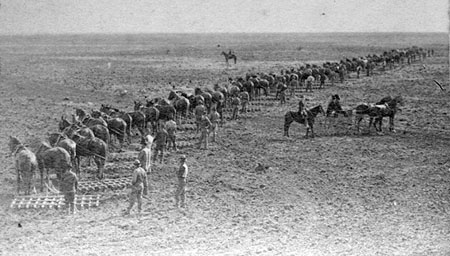
This older map of rainfail in the United States is very helpful is visualizing the division between the east and the west. Between the Rocky mountains and roughly the 100th Meridian West were the Great Plains, called derisively the "Great American Desert." They were the bottom of a former shallow sea that had retreated millions of years prior, and after the ice age, had been colonized by grasses and forbs (flowers and shrubs) to form the prairie. The tallest, lushest prairies were located on the eastern portion of the Great Plains, where there was the most precipitation. Again, consult the map for rainfall. These tall grass prairies, dominated by Big Bluestem and Indian Grass were plowed up by settlers using horses and immense steam traction engines like these and these in Illinois, Iowa and portions of Minnesota and North Dakota. Consider this map: The darkest green is the tall grass, as one moves west there is a band of mixed grass, where there just isn't quite enough water for Big Bluestem to flourish, and then finally the lightest green, the shortgrass prairie at the foot of the Rockies. Basically any place where Big Blue Stem didn't grow irrigation was needed for agriculture. The 100th Meridian West is the shorthand dividing line between non-irrigated and irrigated agriculture on the Great Plains.
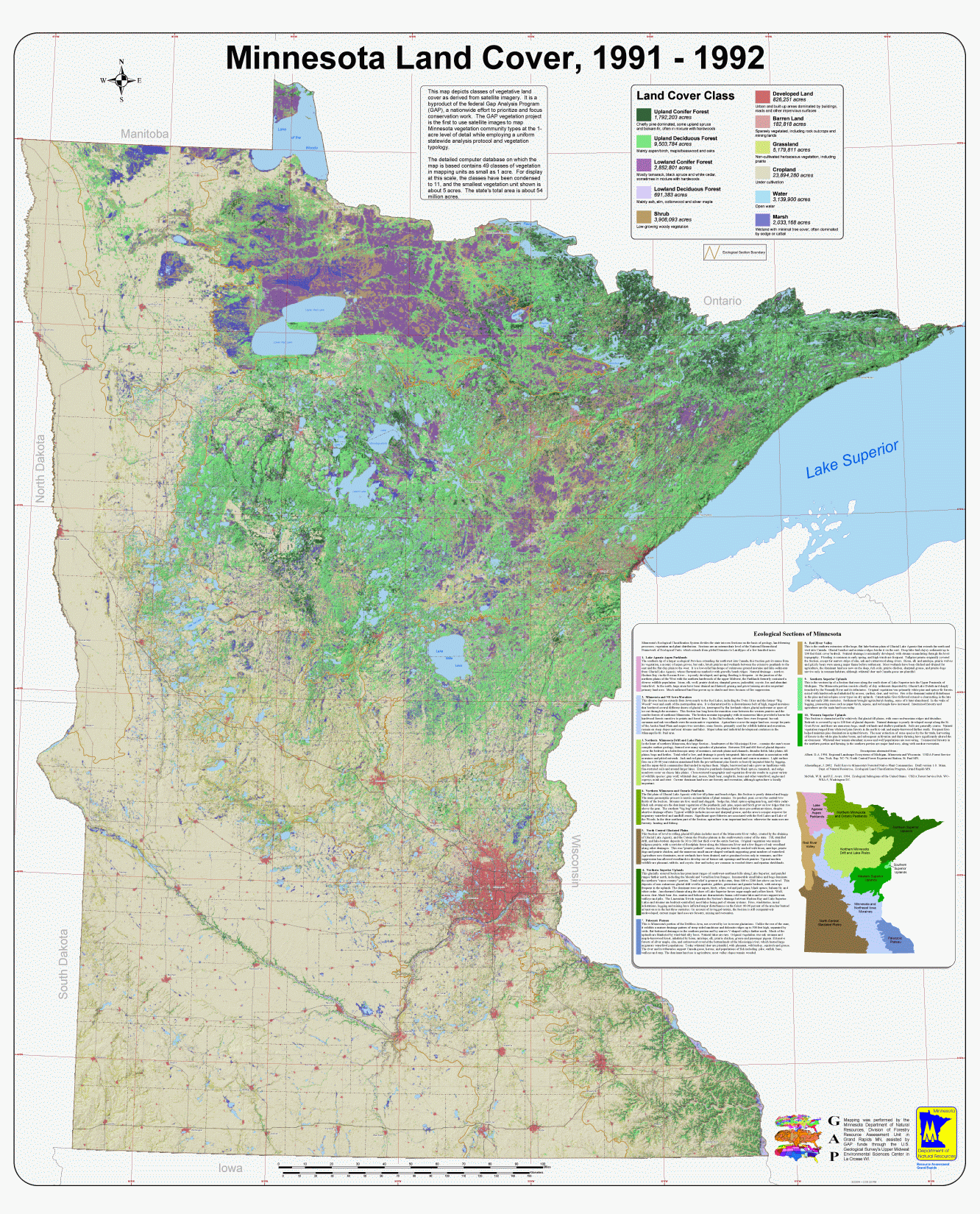
Today overall less than 1% of the original tall grass prairie exists. In my own state of Minnesota less than 2% of the remaining prairie still exists.(A note about the Minnesota map, virtually all the yellow is under cultivation) compare to this map of Land Use to get a clearer picture.
Settlers did not wipe out the forests. They erased the prairies.
I'm adjusting my conclusion a bit. Settlers did cut down virtually all of the old growth forests east of the Mississippi river, as /u/quickspore mentioned. Many of these regrew as new growth forests. The prairies that were plowed up are unlikely to ever become prairies again.