They were killing people every day and on festivals sometimes hundreds a day, so they must've had some system for dealing with the bodies. I've heard somewhere a long time ago that they would sometimes cannibalize the bodies, but I don't know if that was more than just a rumor that the conquistadors made up, and anyway they'd still have had most of the body parts to deal with.
A veteran conquistador of three expeditions named Bernal Díaz wrote a memoir of his experiences that contains the following passages concerning the eating of sacrificial victims.
Respecting the abominable human sacrifice of these people, the following was communicated to us: The breast of the unhappy victims destined to be sacrificed was ripped open with a knife made of sharp flint; the throbbing heart was then torn out, and immediately offered to the idol-god in whose honor the sacrifice had been instituted.
After this, the head, arms, and legs were cut off and eaten at their banquets, with the exception of the head, which was saved, and hung to a beam appropriated for that purpose. - Chapter XCI, pg 233
While dealing with the "Sempoalla" peoples, a group that sought alliance with Cortés, Bernal noted that:
...hardly a day passed by that these people did not sacrifice from three to four, and even five Indians, tearing their hearts out of their bodies, to present them to the idols and smear the blood on the walls of the temple.
The arms and legs of these unfortunate beings were then cut off and devoured, just in the same way we should fetch meat from the butcher's shop and eat it: indeed I even believe that human flesh is exposed for sale cut up, in their tianges, or markets. - Chapter LI, pg 119
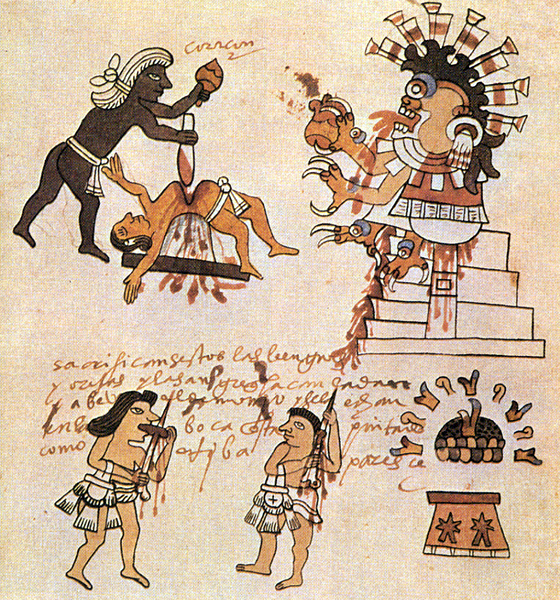
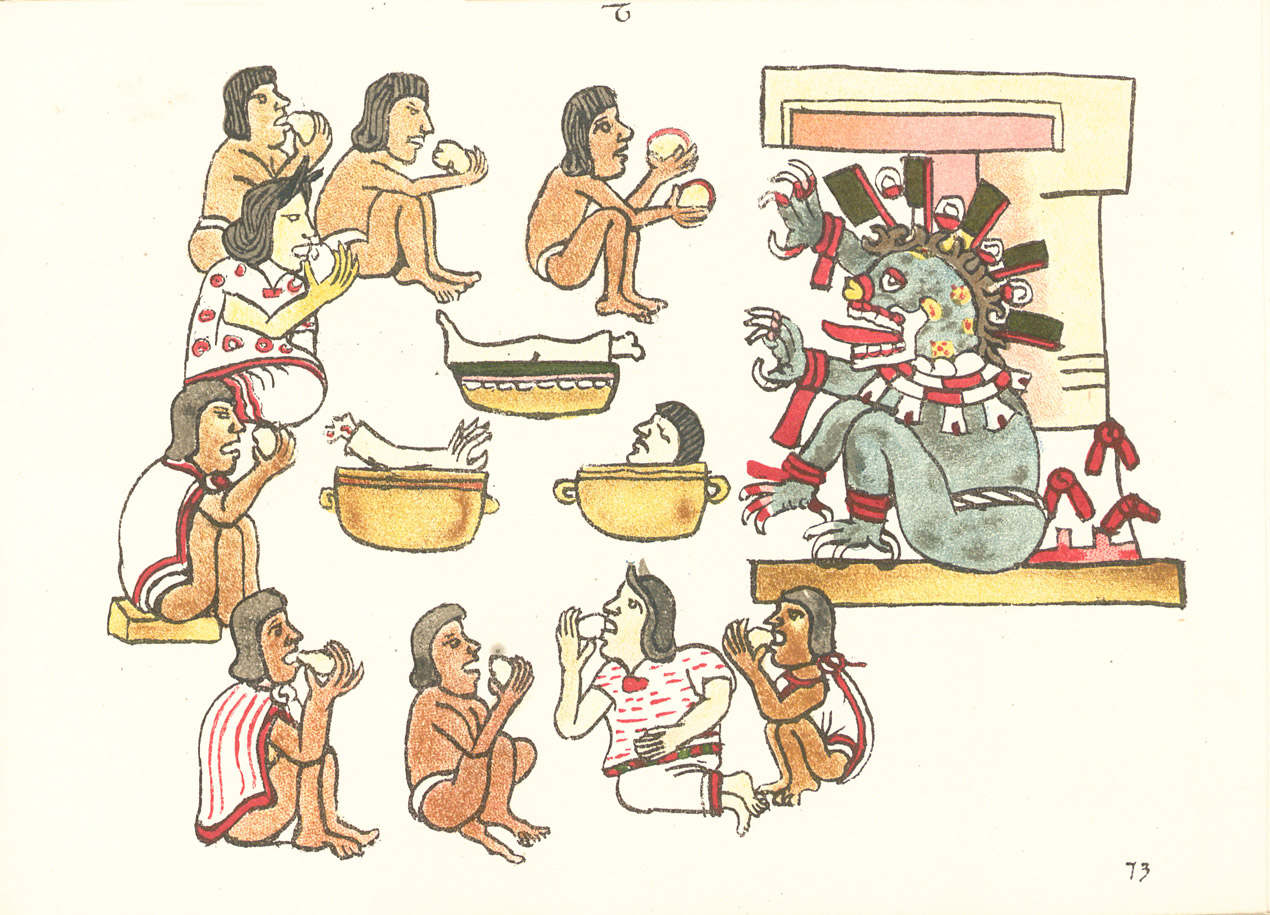
There are also a few illustrations from Aztec codices that suggest sacrificial victims were eaten in at least some ceremonies.
They were killing people every day and on festivals sometimes hundreds a day
If you don't mind me asking, what is your source for this? I'd be interested to know about daily human sacrifices. While auto-sacrifice (cutting or piercing of one's own body) has some evidence of being practiced by priests, "proper" human sacrifice was reserved for major rituals and holidays. Granted, every Aztec 20-day month included several different ceremonies, but then again not all of those were centered around human sacrifice, even if some did occur. Other month/festivals, like Tlacaxipehualiztli, were centered around human sacrifice. Sahagún, for instance, writes of Tlacaxipehualiztli:
This feast day came and was thus celebrated: it was the time when all the captives died, all those taken, all who were made captive, the men, the women, all the children.^1
This makes sense if you understand the exogenous sources of Aztec sacrifice; captives were taken from polities conquered during the Winter dry season, and Tlacaxipehualiztli fell towards the end of that period. Sahagún, however, gives no definite numbers, which brings us to an issue underlying your question: we don't actually know for certain how many people were sacrificed per year.
There's a couple reasons we don't know this:
All the primary sources had reason to lie and exaggerate the numbers, for different reasons. The Conquistador accounts were -- to various degrees depending on the work in question -- sensationalist, scheming, and/or working off their own incomplete understanding of the world they had stumbled into. They had every reason to portray the Aztecs as bloodthirsty heathens. Meanwhile, those bloodthirsty heathens had their own reasons for fluffing the numbers; sacrifice was a form of political intimidation in Postclassic Mesoamerica. Large numbers of sacrifices were a method of displaying military and political dominance as much as it was a religious ritual. Thus we get claims that 80,400 captives were sacrificed^2 during the 1487 dedication of the Templo Mayor, a number that is disputed in other sources and generally thought to have been a gross exaggeration, even if the lowest estimates still rank in the thousands.
The numbers of captives varied. Since sacrifices came from soldiers and slaves taken in conquest, the supply was dependent on military success. While the Aztecs enjoyed a largely positive success rate in their campaigns, with victories outpacing defeats, they were not always so triumphant. A military incursion into Tarascan territory led to serious defeat, with an army of around 24-32K limping home beyond decimated and with nary a captive to show for it. The coronation campaign of Tizoc is infamous for a coronation campaign that brought back to Tenochtitlan a purported 40 captives^3 . The number of sacrifices in a given year, in other words, would depend on the successes of the army.
Not that this hasn't stopped various scholars from estimating the number of captives who went under the tecpatl per annum. The highest numbers come from Harner^4 who estimates, based on a total Central Mexican population of 25M, that 15K were sacrificed in Tenochtitlan alone, with 250K sacrifices throughout the whole region. The problem with this number, as was noted and refuted by Ortiz de Montellano in numerous works^5 , that Harner was forming his estimate on the basis that cannibalism was not only an integral cultural part of Aztec life, but a nutritional necessity. In other words, his estimate (the highest proposed) assumed sacrifices had to occur or the populace would starve. Again, this has been roundly and soundly debunked; the captives were not livestock and cannibalism, when it did occur, was a limited and primarily elite affair.
The other complicating factor is that not all sacrifices were the same. While the "bend back over the stone, cut out the heart" ritual was by far the most dominant, there were various other modes of sacrifice, and sacrifices to certain gods could specifically mandate a body be buried whole, cremated (a typical funerary practice), or lost in the waters of Lake Texcoco. We do, however, have some caches of remains associated with Tenochtitlan-Tlatelolco which show evidence of ritual sacrifice and dismemberment,^6 suggesting that at least some bodies were buried following sacrificial processing.
A fairly well-attested to reconstruction of what happen to a body following the classic extraction of the heart then goes like this: the body would be rolled down the steps of the temple to specialized priests waiting at the base on a "blood mat." The body would be dismembered, with the head being sent to be placed on the tzompantli (skull-rack) and the limbs being apportioned to the ruler and the captor(s) of that victim. The limbs would be prepared in a stew with chili, salt, and tomatoes (not barring any other ingredients) to be consumed by the captor and his family.
The problem is what happens next is less well attested to. While Díaz del Castillo says that "the bodies, that is their entrails and feet, they threw to the tigers and lions [these would actually be ocelots and leopards]"^7 that were kept in a menagerie, he is not the most trustworthy on the subject and other versions speak only of entrails being thrown to the animals, which leaves the torso untouched. The archaeological evidence suggest though, that what remained of the bodies after decapitation and apportionment, was buried or cremated in accordance with the standard funerary practices of the time.
^(1 Sahagún General History of the Things of New Spain, Book 2, trans. Anderson & Dibble)
^(2 Durán History of the Indies of New Spain, trans. Heyden)
^(3 Multiple sources, but let's go with Bancroft 1883 The Native Races, Vol. 5)
^(4 Harner 1977 "The Enigma of Aztec Sacrifice" Natural History 86[4])
^(5 Ortiz de Montellano 1978 "Aztec cannibalism: an ecological necessity?" Science 200; 1983 "Counting Skulls: Comment on the Aztec Cannibalism Theory of Harner-Harris" American Anthropologist 85[2]; 1990 Aztec Medicine, Health, and Nutrition)
^(6 Pijoan-Aguadé & Lory 1997 "Evidence for Human Sacrifice, Bone Modification and Cannibalism in Ancient Mexico" in Troubled Times: Violence and Warfare in the Past eds. D. Martin & D. Frayer)
^(7 Díaz del Castillo True History of the Conquest of New Spain, trans. Maudslay)
hi! FYI, if you're interested in listening about it rather than reading, there was a great AskHistorians podcast recently that touches on this
AskHistorians Podcast Episode 003 Discussion Thread - On Human Sacrifice in Mesoamerican Cultures