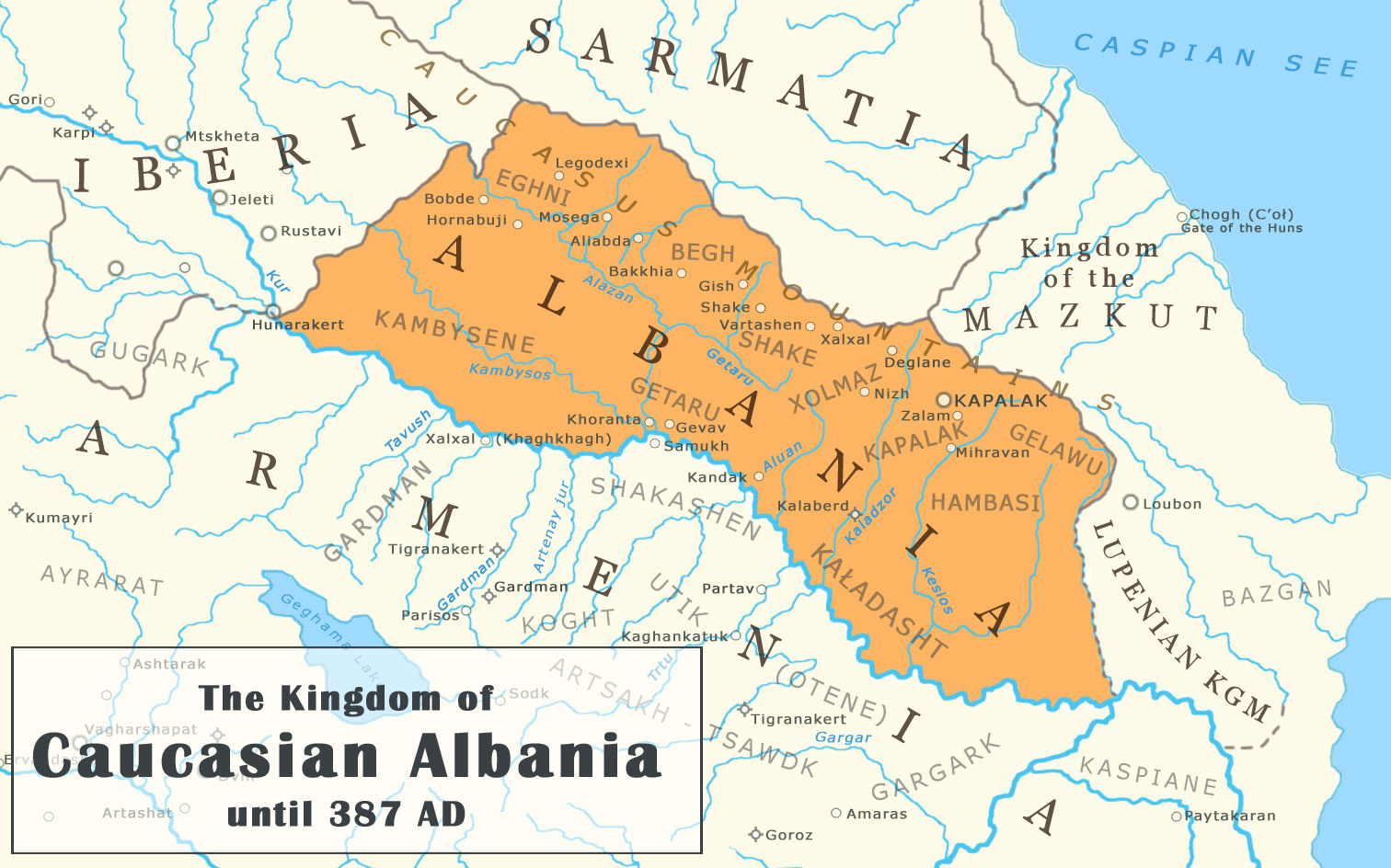
http://upload.wikimedia.org/wikipedia/commons/c/c9/Aghuank.jpg
I'm really interested in this region as a whole and this has always perplexed me.
edit: Seems I've spelled Caucasus wrong.
Scotland also used to be called Albania. And there is Albion and the Alps. According to etymonline that word means "hill" or "white" and is found across several Indoeuropean languages.
The etymologies are likely unrelated. "Albania" (Balkans) is likely named after the the Albanoi (Greek) or Albani (Latin), an Illyrian tribe that lived there. (Although the connection between the Albanoi and present-day Albanians is rather tenuous)
As Freiheit_Fahrenheit's Etymonline entry says, Albanoi in turn may ultimately derive from the non-Indo-European *alb for 'hill', or the Proto-Indo-European 'albho-' for 'white'.
As per that source, the name 'Albania' for the Balkan country didn't come around until medieval Latin. So the Caucasian toponym would appear to be older, as the Caucasian Ἀλβανία (Albania) is described in book XI of Strabo's Geography. But Strabo and your map also describe the neighboring state of Ἰβηρία (Iberia), which is a toponym also used for Spain (the Iberian peninsula) that does date back to ancient Greek, and has truly Spanish origins (cognate with the name of the Ebro river).
In both these cases, these were exonyms, not what those people called themselves. In the case of Iberia, they're presumed to have called themselves something similar, which was corrupted into this, more familiar name to Greek and Roman ears. The Caucasus gives a good example of how that happens with "Georgia" - having starting with a Persian name for them (Gurğ), it was turned into the unrelated-but-similar-and-familiar-sounding 'Georgian'.
Since it's not known what the Caucasian Albanians called themselves in their own language, there's no way of knowing if Caucasian Albania got its name that way. If their name did resemble it, its origin probably wasn't from the Indo-European 'white', as the language there would've more likely been Caucasian or Kartvelian rather than Indo-European.