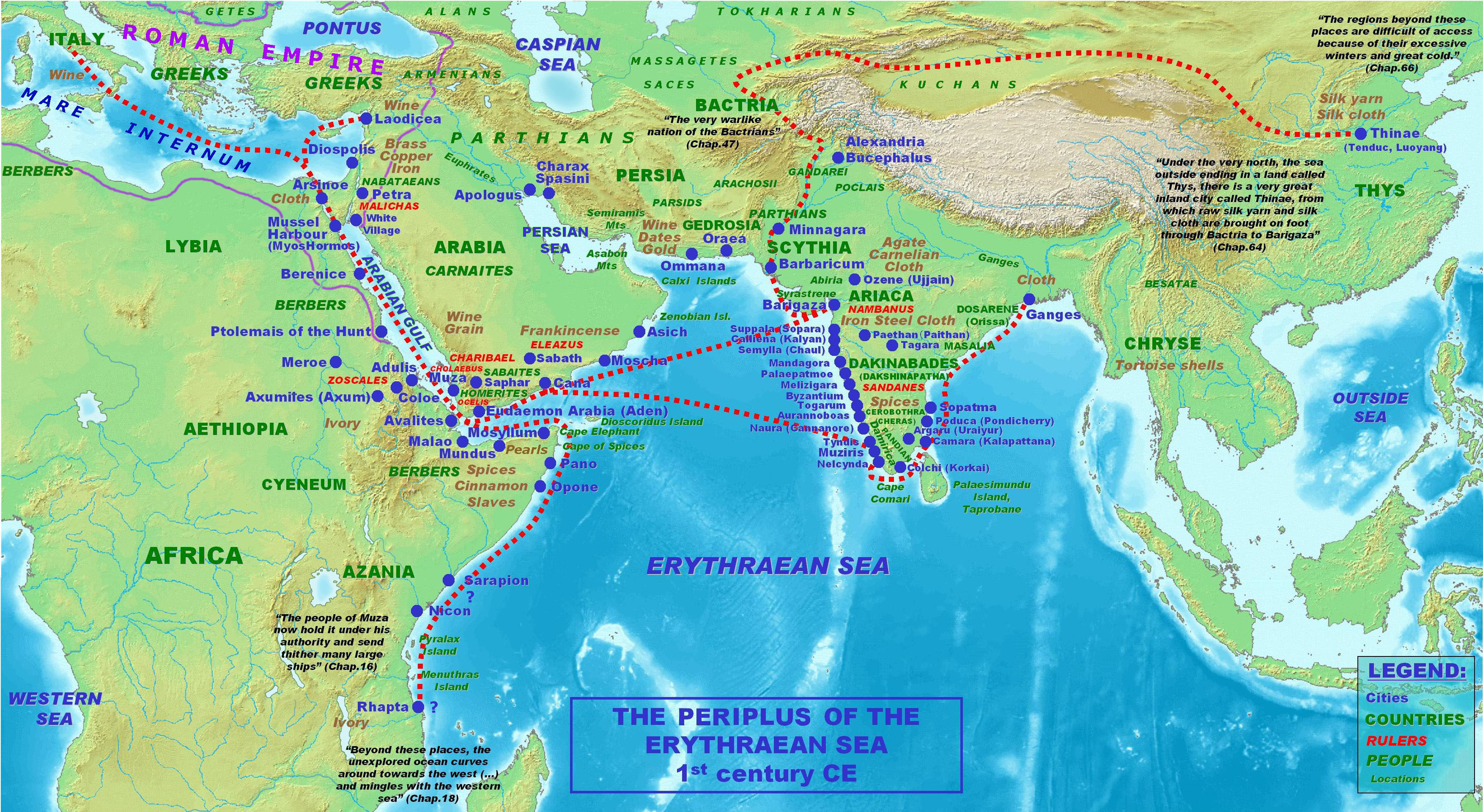
They certainly knew about Ceylon, but probably not about Japan. We have a source from the mid 1st century showing the range of their knowledge of the far east at that time. This work, by a anonymous Greek merchant, was a sort of travel and business guide to sailing the red sea and the Indian ocean. It also has a mention of Ceylon, which is called Palaesimundu. The full text can be found here. And click here for an image of the mentioned places. (image from Wikipedia)
Part 61 of the Periplus:
About the following region, the course trending toward the east, lying out at sea toward the west is the island Palaesimundu, called by the ancients Taprobane. The northern part is a day's journey distant, and the southern part trends gradually toward the west, and almost touches the opposite shore of Azania. It produces pearls, transparent stones, muslins, and tortoise-shell.
Also Strabo a Greek historian who lived around the year 0, in his Geographica wrote on Ceylon. Be aware, his work on the far regions is contaminated with fantasy. (He mentions Indians had giant ants with wings that mined gold.) But he was aware of the existence of Ceylon as seen in Geographica XV1.14:
As for Taprobanê, it is said to be an island situated in the high sea within a seven days' sail towards the south from the most southerly parts of India, the land of the Coniaci; that it extends in length about eight thousand stadia in the direction of Aethiopia, and that it also has elephants. Such are the statements of Eratosthenes; but my own description will be specially characterised by the addition of the statements of the other writers, wherever they add any accurate information.
There is also plenty archeological evidence of Roman coins found in India, so they were active in the Indian Ocean trade and possibly even traded with Ceylon
I took a class on medieval maps and so I can relate some of what the Europeans believed that was inherited from the Romans.
Macrobius and Scipio's dream depicted the Earth as being divided into five zones, the two frigid zones near the poles, the torrid at the equator which was believed to be too hot to cross, and the temperate zones in between these. This actually led to some theological discussion about whether there were people living South of the Equator.
A direct demonstration of how much the Romans knew about Europe and the near East can be found in the Peutinger table. Keep in mind with the Peutinger table though, that the point wasn't to make a supremely accurate map, but was more likely to demonstrate Roman power and territory, and was likely placed on wall.
^(http://www.fordham.edu/halsall/ancient/cicero-republic6.asp See section 20 for the discussion on the earth in Scipio's Dream)
^(I'm not sure if this up to standards and I can no longer access my sources, but this was based on working from a facsimile of the Peutinger table and I believe parts of the History of Cartography, edited by J.B. Harley and David Woodward)
In antiquity and medieval times, cartography was very infantile and limited compared to the age of discovery and thereafter. Let's take medieval England for example, they would've been mapped very well, France too. Germany and Italy would be a little off, but a modern person could still easily guess what country they were trying to get at. Eastern Europe and the Middle East wouldn't be accurate, and Africa would've been WTF. An educated person in Rome would be the same, only but Rome encompassed most of Western Europe. They may have had less than accurate maps of some of the outlying regions, but the main lands of the empire would've been great or at least pretty good. An uneducated person in either case would've had a general idea of lands (this area is cold, this area is a desert, etc), and would've had a vague idea of how close and far things are from each other.
They would've had some idea of what the baltics were like, they would know nothing of Iceland though. No direct contact with China and the west happened until the late medieval era, before then they just knew people who knew each other and traded through them. Japan wasn't in contact with the west until the modern era. Google Matthew Perry, Wikipedia isn't always the most reliable but in this case it suffices.